Independent comparisons. We may earn from shop links. More info

S1 or S3 safety shoes

Updated: 21 October 2026

Your induction named a code, and the Atlas title in the basket says S1, or it says nothing. S1 or S3 safety shoes are different packages, and the higher letter is not a safer toecap. In this comparison only one kept title prints S1, and none prints S1P or S3. The [Atlas safety shoes comparison](/hub/occupational-safety/atlas-safety-shoes) lists the three amazon.co.uk pairs, at £84.06, £92.17, and £106.15 on 20 October 2026. This page defines the codes and then shows what this file can match. A qualifying purchase can earn a commission at no extra cost to you. Peter F. used public UK guidance on the standard and the class field in this file, and did not certify a shoe.

Your induction named a code, and the Atlas title in the basket says S1, or it says nothing. S1 or S3 safety shoes are different packages, and the higher letter is not a safer toecap.

Our top picks

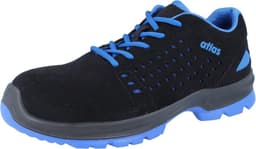
Atlas Atlas S1-W10 safety shoes, EU 40

Best overall

Atlas Atlas S1-W10 safety shoes, EU 40
7.4/10about £106.15
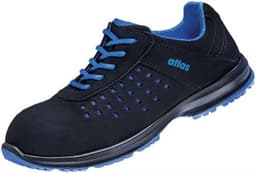
Atlas Atlas women's safety shoes

Best value

Atlas Atlas women's safety shoes
6.1/10about £92.17
Atlas Atlas GX 130 safety shoes

Alternative

Atlas Atlas GX 130 safety shoes
4.2/10about £84.06
On this page

What each class adds

Plain S1 is a 200 joule toecap, a closed heel, antistatic properties, and energy absorption in the heel. It does not include a puncture-resistant midsole. It does not include a water-resistant upper as part of the class. S1P is that S1 package plus the midsole, which is why people use it when the floor is dry and nails are the extra hazard. S3 keeps the toecap and adds a water-resistant upper, puncture resistance, and a cleated sole, which is why people use it when the day is wet or outdoors. Every one of those classes shares the 200 joule and 15 kN toecap. Steel, aluminium, and composite are ways of making the cap. They are not a climb in protection. HSE’s L25 guidance separates crushed toes, nails, slips, and wet work, and it says there is no such thing as non-slip footwear. It does not use the letters S1 and S3. The letters are how the standard packages those hazards. If your paper names S3, you need S3. The order of checks before the basket is the Atlas safety shoes buying guide.

Dry hall, nails, or wet ground

Match the floor you actually stand on. A dry hall where the risk is a dropped carton on the toe can start from S1, if the assessment agrees. Atlas’s own S1 page points that class at indoor work and points S3 at wet or outdoor work. That is maker copy. It matches the buyer split above, and it is still not an independent test of these listings. The moment the same hall has nails, strapping, or offcuts underfoot, S1 is the wrong package, because the midsole is what S1P and S3 add. The moment the ground is wet, or the work goes outside, the water-resistant upper and the cleated sole are why people step to S3. HSE expects a toecap on a construction site and, where nails are a risk, a midsole, supplied by the employer. If the induction card says S3, the card wins over a dry-hall habit. Do not swap an issued S3 boot for an S1 trainer because the trainer is lighter. Worn cleats lose the grip the new sole had. How a dry warehouse uses a stated S1 shoe is on the Atlas safety shoes for indoor work page.

SRC on an older shoe and SR on a 2022 shoe

Slip marks are the other argument people fold into S1 versus S3. Older shoes show SRA, SRB, or SRC. On EN ISO 20345:2022 those three marks are not used. A basic slip test is compulsory, and SR is the extra test on a ceramic floor with glycerol. Do not treat a 2011 SRC shoe as illegal, and do not relabel SRC as SR. A worn sole is a different sole from the one that passed the test. Oil-resistant is a materials claim. It is not a slip mark. Remember the current identifier, BS EN ISO 20345:2022+A1:2024, and read the year printed on the shoe you receive. Puncture marks have moved as well. Seller guides describe PS as a smaller nail test and PL as a larger one, and they do not all use the same millimetre. Howsafe has described the 2022 PS nail as 3.5 mm. Atlas’s S1 page describes S1PS with a 3.0 mm nail. This comparison did not measure a nail. Read the letters on the shoe. If the extra letters are missing, those extra risks are not what that marking covers.

What this Atlas file can and cannot match

A definition is useless if the title does not carry it. If your paper says S1, and the job is dry, the £106.15 listing is the one in this set that uses the word: 20345 S1-W10, EU 40, 4.6 from 798 ratings. You still check the tongue label when it arrives, because this file has no photograph of a UKCA mark or a certificate number. The written reviews are marked Germany or Spain. They describe openings and metal chips, which is a poor match for swarf even when the class letter is S1. The product data have no puncture claim and no water claim on that row, which is what you would expect from plain S1, and it is also why the row cannot stretch. If your paper says S1P or S3, none of these titles states it. The £92.17 women’s title and the £84.06 GX 130 title do not state S1 either. Stars do not fill the gap. A 4.6 from 313 ratings is not an S3 mark, and 4.2 from 5 ratings with no review text is not an ESD mark. Catalogue pages that describe a GX 130 as S1 ESD SRC are a different source from the Amazon title. Leave the set and take the labelled boot the site named. Match the paper, or do not wear the shoe on that job.

Common questions

Should I buy S1 or S3?
Buy the class the assessment named. S1 fits a dry place where the risk is the toe and there is no regular nail risk and no wet upper to resist. S3 fits wet or outdoor work, because it adds a water-resistant upper, puncture resistance, and a cleated sole. The toecap stays at 200 joules either way. If the site card says S3, an S1 shoe is the wrong package.
Is the toecap stronger on S3?
No. S1, S1P, and S3 share the 200 joule and 15 kN toecap. What climbs is the rest of the package: a midsole on S1P, and a water-resistant upper plus a cleated sole on S3. A composite cap is not a lower joule rating than a steel cap. Read the class letters, not the metal’s name.
When is S1P the middle step?
S1P is the step when the floor is dry and something sharp is underfoot. It adds the puncture-resistant midsole that plain S1 does not have, without the water-resistant upper and cleated sole that define S3. A warehouse with nails or strapping on a dry floor is the usual case. A wet yard is not. This Amazon file does not contain a title that states S1P.
What is SRC if the new mark is SR?
SRC is the older combined slip mark, with SRA and SRB, on shoes marked to the earlier edition. On the 2022 edition a basic slip test is compulsory and SR is the extra glycerol test. Do not relabel an SRC shoe as SR. A 2011 certificate can still be in the market through the transition. Read the year on the shoe, and remember that worn cleats lose grip.
Does this Amazon file include an S3 Atlas boot?
No. The only stated class is S1, on the £106.15 shoe in EU 40. The women’s title at £92.17 and the GX 130 title at £84.06 do not print S1, S1P, or S3. Puncture and water are unmarked on all three. If you need an S3 Atlas boot, you are outside this shortlist.
What if the site induction asks for S3?
Keep the class on the induction card. None of these titles states S3, so a lighter S1 shoe, or a title with no class at all, does not satisfy that card. Do not swap an issued S3 boot for one of these listings because the star line is high. The employer’s labelled pair is the pair that matches the paper.
Do PL and PS change the choice?
They change the puncture test, not the choice between a dry hall and a wet site. Seller guides disagree on the nail size: Howsafe has said 3.5 mm for the 2022 PS nail, and Atlas’s S1 page describes S1PS with a 3.0 mm nail. This file did not measure a nail. Read the letters on the shoe. If they are absent, that test is not what the marking covers.

Related pages

Sources

Public UK and manufacturer sources for this comparison, last retrieved on 20 October 2026.

  1. HSE, Personal protective equipment at work (retrieved 20 October 2026)
  2. The Personal Protective Equipment at Work (Amendment) Regulations 2022 (retrieved 20 October 2026)
  3. HSE, Selecting footwear for slip resistance (retrieved 20 October 2026)
  4. HSE, Construction PPE frequently asked questions (retrieved 20 October 2026)
  5. BSI, BS EN ISO 20345:2022+A1:2024 (retrieved 20 October 2026)
  6. Howsafe, Understanding EN ISO 20345:2022 (retrieved 20 October 2026)
  7. Atlas, S1 safety shoes (retrieved 20 October 2026)
  8. Guardsman, Atlas GX 130 ESD ladies trainer (retrieved 20 October 2026)