Independent comparisons. We may earn from shop links. More info

Atlas S1 safety shoes indoor

Updated: 21 October 2026

You walk a dry warehouse aisle, the risk on the assessment is a carton on your toe, and a light trainer feels like the obvious shoe. Atlas S1 safety shoes indoor use can match that hall, and the same hall with nails, swarf, or an electronics rule cannot use these titles as written. The [Atlas safety shoes comparison](/hub/occupational-safety/atlas-safety-shoes) holds three amazon.co.uk listings, at £84.06, £92.17, and £106.15 on 20 October 2026. Only one of them prints S1. This page stays on that one workplace. A qualifying purchase can earn a commission at no extra cost to you. Peter F. used the class notes in this file and public UK guidance, and did not walk your warehouse.

You walk a dry warehouse aisle, the risk on the assessment is a carton on your toe, and a light trainer feels like the obvious shoe.

Our top picks

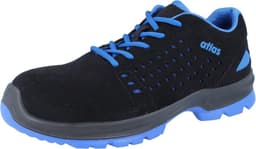
Atlas Atlas S1-W10 safety shoes, EU 40

Best overall

Atlas Atlas S1-W10 safety shoes, EU 40
7.4/10about £106.15
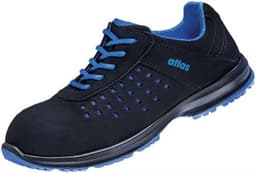
Atlas Atlas women's safety shoes

Best value

Atlas Atlas women's safety shoes
6.1/10about £92.17
Atlas Atlas GX 130 safety shoes

Alternative

Atlas Atlas GX 130 safety shoes
4.2/10about £84.06
On this page

When a dry hall matches S1

A dry, level floor with a dropped-object risk and no regular nails is the job plain S1 is built for. Atlas’s own S1 page makes the same split, indoor against wet or outdoor, and that sentence is maker copy. The class does not add a midsole and it does not add a water-resistant upper. If your paper allows S1, you can start from the listing that actually prints the letters. In this file that listing is B00AZ0Q9L4, the S1-W10 shoe at £106.15, 4.6 from 798 ratings, in a single size, EU 40. The written reviews are marked Germany or Spain, not the United Kingdom, so they are not a British warehouse trial. They are still the only construction notes you have: a roomy forefoot, a shoe that often runs large, and a style with buckles and ventilation openings. If EU 40 matches the foot you measured, and the floor stays dry and free of sharp debris, this is the indoor candidate. The other two titles do not print S1. How to measure that single EU 40, including why W10 is a width, is on the Atlas safety shoes size page.

Nails and swarf

Pallet debris is the usual reason an indoor S1 shoe fails. Nails, strapping, and offcuts need a puncture-resistant midsole. That is S1P on a dry floor, or S3 if the floor is also wet. None of these three titles states S1P or S3. If the aisle has broken strapping, the assessment has already left plain S1. Swarf is a separate limit, and it comes from the reviews on the stated S1 shoe rather than from a missing letter. Those non-UK texts describe ventilation openings, buckles, and metal chips getting inside. One text calls an earlier pair a sandal. The title says safety shoes. An open construction can be a fair S1 style on a clean floor. It is a poor match around machining swarf, because debris that a closed upper would shed can sit against the foot. This page is not a ban on every sandal. S1P sandals exist in the wider market, with a closed heel. The limit here is this listing’s own review notes. If chips are part of the week, leave the set. The letter table is on the S1 or S3 safety shoes page.

ESD is a second specification

Antistatic behaviour is already inside the S1 package. ESD is tighter, and it is what an electrostatic protected area asks for. It is not the same tick. Seller guides do not all quote the same resistance figure, so this page will not invent a single ohm value as if we had metered a shoe. The test-method identifier is BS EN IEC 61340-4-3:2018. Naming the standard is not a result for any ASIN in this file. The GX 130 title, B00AZ0MWU6, is the listing people reach for when they want a women’s indoor trainer. It is £84.06, in the Women’s department, with 4.2 from 5 ratings and no review text. The title does not print S1, ESD, or SRC. Catalogue and UK trade pages describe a GX 130 as a women’s S1 ESD SRC shoe, at a different shelf, including £119.61 excluding VAT. Those pages are not this Amazon title. If your area needs ESD, you need the letters on the shoe you will wear, not a model name that a catalogue completes and a marketplace title does not. The women’s listing at £92.17 also prints no class and no ESD line.

Issued boots and a personal pair

A light shoe that feels better by lunch is not a new specification. If the employer issued S3 or S1P, keep that pair. Do not replace it with an S1 trainer from this file because the aisle was dry this morning. The PPE at Work Regulations, amended from 6 April 2022, require suitable PPE free of charge for employees and limb (b) workers when it is still needed. They do not cover the self-employed, and they do not ask a limb (b) worker to buy their own boots. A private amazon.co.uk order does not cancel an induction card. Report a sole that has split, or a cap that has taken a hit, through the route the employer uses for defective PPE. Comfort complaints belong in the fitting conversation, not in a quieter substitution. If you are self-employed and the client’s permit names a class, you still match the permit, and you pay for your own pair. If the permit names ESD, chemicals, heat, or chainsaws, or if an insole needs sign-off, that is the assessor, not a three-row Amazon file. For a dry hall, toe risk only, and a foot that matches EU 40, the stated S1 listing is the one to read.

Common questions

Are Atlas S1 shoes enough in a warehouse?
They can be, when the assessment is toe risk on a dry floor and nails are not a regular hazard. In this file the only title that prints S1 is the £106.15 shoe in EU 40. The other two titles do not print a class. Non-UK reviews on the S1 shoe describe openings, so a clean aisle is the condition, not every room in the building.
What if there are nails or strapping on the floor?
Plain S1 does not include a puncture-resistant midsole. Nails and strapping are the reason to step to S1P on a dry floor, or to S3 if the floor is also wet. None of these titles states S1P or S3. A warehouse that looks dry and still has broken strapping in the aisle is outside this shortlist.
Do I also need ESD?
Only if the area asks for it. Antistatic properties are part of S1. ESD is a separate, tighter specification for an electrostatic protected area, and this file does not meter a resistance. None of the three Amazon titles prints ESD. A catalogue line that calls a GX 130 an ESD shoe is not the £84.06 title.
Can I wear an open S1 shoe around swarf?
The S1 listing’s own reviews, marked Germany or Spain, describe vents, buckles, and metal chips getting in. That is a poor match for swarf, even though the title states S1 and the hall is indoors. This is not a ban on every open safety shoe. It is a limit on this pair, from those texts. A closed upper is the safer reading when chips are part of the job.
Is the GX 130 the indoor women’s option on Amazon?
It is a women’s-department title at £84.06 that names GX 130 and does not print S1 or ESD. Five ratings and no review text mean fit and class are unknown from this file. Catalogue pages describe that model as S1 ESD SRC. Keep the sources apart. It is not the indoor specification unless the shoe in your hand shows the class the assessment named.
Who should switch to S3?
Switch when the work is wet or outdoors, or when the induction already says S3. S3 adds a water-resistant upper, puncture resistance, and a cleated sole. The toecap does not get stronger. This file has no S3 title. A dry morning in the warehouse does not cancel an S3 card for the yard in the afternoon.
Does a light trainer count if the employer issued boots?
No. Keep the issued pair if it is S1P or S3. A private purchase does not replace the class the employer selected, and employees and limb (b) workers are not expected to buy their own PPE when the assessment still needs it. If the issued sole has split, report it as defective PPE rather than quietly swapping in a lighter shoe from this set.

Related pages

Sources

Public UK and manufacturer sources for this comparison, last retrieved on 20 October 2026.

  1. HSE, Personal protective equipment at work (retrieved 20 October 2026)
  2. The Personal Protective Equipment at Work (Amendment) Regulations 2022 (retrieved 20 October 2026)
  3. HSE, Selecting footwear for slip resistance (retrieved 20 October 2026)
  4. HSE, Construction PPE frequently asked questions (retrieved 20 October 2026)
  5. BSI, BS EN ISO 20345:2022+A1:2024 (retrieved 20 October 2026)
  6. Howsafe, Understanding EN ISO 20345:2022 (retrieved 20 October 2026)
  7. Atlas, S1 safety shoes (retrieved 20 October 2026)
  8. Guardsman, Atlas GX 130 ESD ladies trainer (retrieved 20 October 2026)