Oscilloscope mains safety in the UK
The scope is rechargeable, the title says 400 V or 4,000 V, and the ground clip is already in your hand next to a UK socket or a consumer unit. Oscilloscope mains safety in the UK starts from the opposite fact: a battery and a large voltage in the title are not a measurement category, and none of the six handhelds on the [handheld oscilloscope comparison](/hub/measuring-equipment/oscilloscope-hand) rates that socket. Bandwidth for a hobby signal stays on the [handheld oscilloscope buying guide](/hub/measuring-equipment/oscilloscope-hand/sub/oscilloscope-hand-buying-guide). A safe-board trace stays on [how to use a handheld oscilloscope](/hub/measuring-equipment/oscilloscope-hand/sub/oscilloscope-hand-how-to-use). Peter F. applied HSE notes to these listings on 21 October 2026. A qualifying purchase can earn a commission at no extra cost to you.
The scope is rechargeable, the title says 400 V or 4,000 V, and the ground clip is already in your hand next to a UK socket or a consumer unit.
The scope is rechargeable, the title says 400 V or 4,000 V, and the ground clip is already in your hand next to a UK socket or a consumer unit. Oscilloscope mains safety in the UK starts from the opposite fact: a battery and a large voltage in the title are not a measurement category, and none of the six handhelds on the handheld oscilloscope comparison rates that socket. Bandwidth for a hobby signal stays on the handheld oscilloscope buying guide. A safe-board trace stays on how to use a handheld oscilloscope. Peter F. applied HSE notes to these listings on 21 October 2026. A qualifying purchase can earn a commission at no extra cost to you.
Our top picks
| Badge | Product | Voltage line | Category | Socket named | Note | Price | Offer |
|---|---|---|---|---|---|---|---|
| Best overall |  ZOYI ZOYI ZT-703S | CAT III 1000 V line | CAT III 1000, IV 600 V | Not named | 6.2 | about £86.50 | View offer |
| Best value |  BSIDE BSIDE OT3 | ±400 V bullet | No CAT mark | Not named | 6.8 | about £39.99 | View offer |
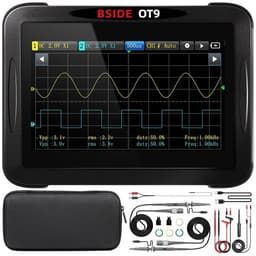
| Alternative |  BSIDE BSIDE OT9 | ±4000 V bullet | No CAT mark | Not named | 4.8 | about £149.99 | View offer |


On this page
Why the ground clip is the danger
Category and voltage together
What these listings print
Work law, and the same physics at home
Common questions
Can I clip the ground lead to mains live?
Does a rechargeable scope float?
What is CAT III in a UK house?
Is ±400 V the same as CAT II 300 V?
Does the ZOYI attribute make it safe on a consumer unit?
Related pages
Sources
Public UK sources from the research digest, last checked on 21 October 2026. Shelf prices and star lines are the amazon.co.uk figures captured with these six listings. The price bands are this set, not a market average.
- Electricity at Work Regulations 1989, regulation 14 (retrieved 21 October 2026)
- HSE GS38: electrical test probes (retrieved 21 October 2026)
- HSE INDG354: safety in electrical testing (retrieved 21 October 2026)
- Megger: measurement categories (retrieved 21 October 2026)
- Keysight: choosing a handheld oscilloscope (retrieved 21 October 2026)
- Rohde & Schwarz: oscilloscope buyer's guide (retrieved 21 October 2026)
- Compel: OT3 and OT5 handheld oscilloscope (retrieved 21 October 2026)
- Pico Automotive: ground clip on a common-ground scope (retrieved 21 October 2026)
- amazon.co.uk Lab Oscilloscopes best sellers (retrieved 21 October 2026)