How to use a handheld oscilloscope
You have one of these pocket scopes on the bench, a low-voltage board in front of you, and the trace is either racing sideways or showing spikes on a square wave. How to use a handheld oscilloscope, on the models in the [handheld oscilloscope comparison](/hub/measuring-equipment/oscilloscope-hand), comes down to the probe factor, the ground clip, and the trigger mode. This page stays on low voltage. If the wire is mains, stop and read [oscilloscope mains safety in the UK](/hub/measuring-equipment/oscilloscope-hand/sub/oscilloscope-hand-mains-safety). A vehicle ground clip is on the [oscilloscope for car diagnostics](/hub/measuring-equipment/oscilloscope-hand/sub/oscilloscope-hand-automotive) page. Peter F. followed public probe notes on 21 October 2026. Nothing was filmed in a lab. A qualifying purchase can earn a commission at no extra cost to you.
You have one of these pocket scopes on the bench, a low-voltage board in front of you, and the trace is either racing sideways or showing spikes on a square wave.
You have one of these pocket scopes on the bench, a low-voltage board in front of you, and the trace is either racing sideways or showing spikes on a square wave. How to use a handheld oscilloscope, on the models in the handheld oscilloscope comparison, comes down to the probe factor, the ground clip, and the trigger mode. This page stays on low voltage. If the wire is mains, stop and read oscilloscope mains safety in the UK. A vehicle ground clip is on the oscilloscope for car diagnostics page. Peter F. followed public probe notes on 21 October 2026. Nothing was filmed in a lab. A qualifying purchase can earn a commission at no extra cost to you.
Our top picks
| Badge | Product | Probes | Generator | Trigger note | Note | Price | Offer |
|---|---|---|---|---|---|---|---|
| Best overall |  BSIDE BSIDE O2 | 1 BNC for 2 channels | 7 waveforms | Firmware before single | 7.4 | about £79.99 | View offer |
| Best value |  BSIDE BSIDE OT3 | BNC probe and clips | Not listed | No external trigger | 6.8 | about £39.99 | View offer |
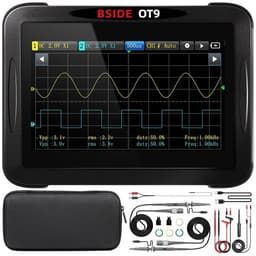
| Alternative |  BSIDE BSIDE OT9 | 2 BNC probes listed | 8 waveforms | No review line | 4.8 | about £149.99 | View offer |


On this page
Set the probe before you trust the voltage
Flatten the square wave
Make the trace stand still
When the handheld itself is the problem
Common questions
Where does the ground clip go?
What is x10 for?
Why does the waveform run across the screen?
When do I use single trigger?
What if the menu is not in English?
Related pages
Sources
Public UK sources from the research digest, last checked on 21 October 2026. Shelf prices and star lines are the amazon.co.uk figures captured with these six listings. The price bands are this set, not a market average.
- Electricity at Work Regulations 1989, regulation 14 (retrieved 21 October 2026)
- HSE GS38: electrical test probes (retrieved 21 October 2026)
- HSE INDG354: safety in electrical testing (retrieved 21 October 2026)
- Megger: measurement categories (retrieved 21 October 2026)
- Keysight: choosing a handheld oscilloscope (retrieved 21 October 2026)
- Rohde & Schwarz: oscilloscope buyer's guide (retrieved 21 October 2026)
- Compel: OT3 and OT5 handheld oscilloscope (retrieved 21 October 2026)
- Pico Automotive: ground clip on a common-ground scope (retrieved 21 October 2026)
- amazon.co.uk Lab Oscilloscopes best sellers (retrieved 21 October 2026)