Independent comparisons. We may earn from shop links. More info

Handheld oscilloscope buying guide

Updated: 22 October 2026

You are about to spend somewhere between £25 and £150 on amazon.co.uk for a battery oscilloscope with its own screen, and the title is offering megahertz, channels, and a voltage that do not describe the same limit. A handheld oscilloscope buying guide has to start with the signal you actually have, then with whether a probe is in the box, and only then with the price. The six listings on the [handheld oscilloscope comparison](/hub/measuring-equipment/oscilloscope-hand) are the only models named here. Peter F. checked those amazon.co.uk listings on 21 October 2026. Nothing was measured in a lab. A qualifying purchase can earn a commission at no extra cost to you.

You are about to spend somewhere between £25 and £150 on amazon.co.uk for a battery oscilloscope with its own screen, and the title is offering megahertz, channels, and a voltage that do not describe the same limit.

Our top picks

BSIDE BSIDE O2

Best overall

BSIDE BSIDE O2
7.4/10about £79.99
BSIDE BSIDE OT3

Best value

BSIDE BSIDE OT3
6.8/10about £39.99
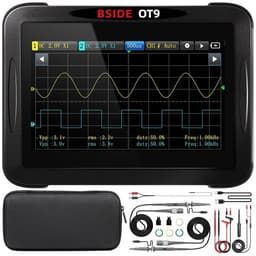
BSIDE BSIDE OT9

Alternative

BSIDE BSIDE OT9
4.8/10about £149.99
On this page

Start with the signal, not the title

Bandwidth on these listings is the frequency where a sine is already about 3 dB down. That definition comes from Keysight's handheld guidance. The same note asks for at least about three times the sine you care about. If a digital edge matters, the rule of thumb is about five times the clock. The DSO152 at £25.19 states 200 kHz and 2.5 MS/s. The BSIDE OT3 at £39.99 states 10 MHz and 48 MSa/s. The OT5, the O2, the ZOYI ZT-703S, and the OT9 all print 50 MHz, which is the sine-wave point, so a fast square looks softer than the generator that made it. Treat that 50 MHz claim as unmeasured. Who each listing suits is on the best pocket oscilloscope page.

Sample rate and memory

A bandwidth number with a slow sampler is decoration. Rohde & Schwarz describe a sample rate of at least about 2.5 times the bandwidth, and they note that the headline rate is often one channel only. The OT3's 48 MSa/s sits above that rule for 10 MHz. The OT5 states 200 MSa/s, the O2 250 MSa/s, and the ZT-703S 280 MSa/s, all beside 50 MHz. None prints a second-channel rate. The OT3, OT5, and OT9 print 128 Kb, and the O2 prints 128 K. That is a short record. The DSO152 and the ZT-703S do not state a memory depth. Probe setup is on the how to use a handheld oscilloscope page.
BSIDE BSIDE O2

Testsieger

BSIDE BSIDE O2
7.4/10about £79.99

Channels, probes, and extras

One channel can tell you that a signal exists. It cannot show an input and an output together. The O2 states two channels and lists one BNC probe. The OT9 lists two BNC probes, plus an alligator lead and meter leads. The ZT-703S title says dual channel, and the bullets omit the kit. The OT5's only United Kingdom review describes a single channel. The OT3 ships one scope probe plus an alligator lead. The ZT-703S states a 25,000-count True RMS meter. The OT9 states a 20,000-count meter. The O2 names seven waveforms and the OT9 names eight. Pay for the extra only if you will use it. A meter does not stand in for a missing second probe.

What the price band buys

About £25 buys the DSO152: 200 kHz, no review line, and no probe in the list. About £40 buys the OT3: 10 MHz, a probe and an alligator lead, 4.6 from 31. About £60 buys the OT5: a 50 MHz claim and one review. About £80 buys the O2: two channels, one probe, and 5.0 from 9. About £87 buys the ZT-703S at 4.6 from 310, with texts that are not labelled United Kingdom. About £150 buys the OT9: two probes and a meter, and no review line. None of these six files gives you a CAT rating that names the socket you would clip. If the job is a 230 V socket or a consumer unit, read oscilloscope mains safety in the UK before you order.

Common questions

What bandwidth do I actually need?
Take the highest sine you care about and look for about three times that frequency, using Keysight's guidance as a rule of thumb. If you care about a digital edge, use about five times the clock. In this set that splits 200 kHz (DSO152), 10 MHz (OT3), and 50 MHz (OT5, O2, ZT-703S, OT9). The 50 MHz figure is the sine point where the trace is already softer, and it was not measured for this page.
Is the sample rate per channel?
The listings print one headline rate. Rohde & Schwarz warn that the fast rate is often one channel only. The OT3 states 48 MSa/s, the OT5 200 MSa/s, the O2 250 MSa/s, and the ZT-703S 280 MSa/s. None of them prints a second-channel rate, so you should treat two traces at the headline speed as unknown.
Why does memory depth matter if I can zoom?
Zoom only shows samples you already captured. The pocket BSIDE listings that state memory print 128 Kb or 128 K, which is a short record on a slow time base. The DSO152 and the ZT-703S do not state a depth in the saved fields. A save-to-PC line, where the OT3 has one, stores that short record. It does not invent a longer one.
Should I pay for a built-in meter?
Pay for it when you will read a voltage number and a waveform on the same visit. The ZT-703S and the OT9 state a meter. The OT3, OT5, and DSO152 do not. A meter inside the scope does not isolate the inputs, and it does not add a second probe if the box never included one.
Is a higher voltage in the title safer?
A larger number is not a measurement category. Compel's sheet for the OT3 and OT5 family says about ±40 V on x1 and ±400 V on x10. The OT9 bullet says ±4000 V with no CAT mark in the file. Category and voltage belong together, on the probe and the instrument. Mains and consumer units are a separate decision, covered on the safety page.

Related pages

Sources

Public UK sources from the research digest, last checked on 21 October 2026. Shelf prices and star lines are the amazon.co.uk figures captured with these six listings. The price bands are this set, not a market average.

  1. Electricity at Work Regulations 1989, regulation 14 (retrieved 21 October 2026)
  2. HSE GS38: electrical test probes (retrieved 21 October 2026)
  3. HSE INDG354: safety in electrical testing (retrieved 21 October 2026)
  4. Megger: measurement categories (retrieved 21 October 2026)
  5. Keysight: choosing a handheld oscilloscope (retrieved 21 October 2026)
  6. Rohde & Schwarz: oscilloscope buyer's guide (retrieved 21 October 2026)
  7. Compel: OT3 and OT5 handheld oscilloscope (retrieved 21 October 2026)
  8. Pico Automotive: ground clip on a common-ground scope (retrieved 21 October 2026)
  9. amazon.co.uk Lab Oscilloscopes best sellers (retrieved 21 October 2026)