Independent comparisons. We may earn from shop links. More info

How to use a mini oscilloscope

Updated: 22 October 2026

The scope is already in your hand, the screen is lit, and the line is flat. How to use a mini oscilloscope, in the first hour, is two connections, a probe factor that matches the menu, and a trigger level that sits on the waveform. A flat line, a 1x/10x mismatch, or a missing ground clip looks like a dead unit and often is not. Peter F. used faults already in the amazon.co.uk reviews. This is not a button map. The instruments are on the [mini oscilloscope comparison](/hub/measuring-equipment/mini-oscilloscope). A qualifying purchase through our amazon.co.uk links can earn a commission at no extra cost to you. Clip the reference first.

The scope is already in your hand, the screen is lit, and the line is flat.

Our top picks

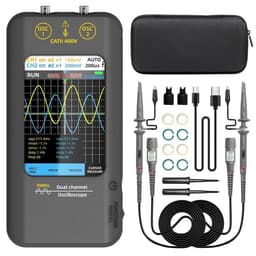
BSIDE BSIDE two-channel 50 MHz

Best overall

BSIDE BSIDE two-channel 50 MHz
8.0/10about £79.99
BSIDE BSIDE OT3 (probe and clips)

Best value

BSIDE BSIDE OT3 (probe and clips)
7.4/10about £39.99
BSIDE BSIDE OT3 (1,000 mAh listing)

Alternative

BSIDE BSIDE OT3 (1,000 mAh listing)
6.0/10about £39.99
On this page

Two connections, not one

The probe tip is one point. The ground clip is the reference the screen measures against. Put the clip on the reference before the tip touches the signal. Touch the clip to the circuit's 0 V, then the tip to a pin you expect to move. One OT3 box lists a BNC-to-alligator lead. The two-channel box lists one BNC probe. If the point is a socket or a consumer unit, stop. The bandwidth rules are on the buying guide.

Make 10x mean 10x in both places

The switch on the probe and the factor on the screen have to say the same thing. A 10x probe with the channel left on 1x throws the trace off screen, and the volts-per-division figure lies by about ten. Set both to 10x, or both to 1x, first. An alignment screwdriver is for the probe trimmer, not proof of a calibrator socket. If you have a square wave, the top and bottom should be flat. If you have no square wave, leave the trimmer alone. A generator square up to 10 kHz is practice, not a 50 MHz certificate.
BSIDE BSIDE two-channel 50 MHz

Testsieger

BSIDE BSIDE two-channel 50 MHz
8.0/10about £79.99

Auto is a guess, not a proof

Auto trigger tries to draw something even when the level is wrong. A UK review of OT3 B0DQKZ8BLF watched auto draw a flat line that was not the signal. Put the level inside the swing, then try normal trigger. Normal waits until the signal crosses that level. On B0DHCNZCF4, a UK buyer could not run normal or single until firmware arrived. On B0DQPP2FKZ, a UK review says settings slower than 100 ms/div work only in Auto. That is why the best handheld oscilloscope page does not give that listing the best-value line.

Save it, then know when to stop

When the trace is stable, save it if the unit claims a save, or photograph the screen. Write down volts per division, time per division, and the probe factor. Stop when the next connection is a second ground on a different potential. Two ground clips are a short, not a differential measurement. Do not charge the scope from the circuit under test. A battery does not make the inputs isolated. Stop for a consumer unit, and do not lift the protective earth of a Class I scope. HSE INDG354 forbids that. Hybrid and airbag circuits are the same stop, on the handheld oscilloscope for cars page.

Common questions

Where does the ground clip go?
It goes on the reference of the circuit, usually 0 V, before the tip touches the signal. The screen measures the tip against that clip. Leaving the clip off is a common way to get a flat or noisy line that looks like a broken input. On a battery scope the clip is still a short to the instrument reference. Do not clip it to a different potential from a second probe's clip.
What is 10x, and what if the screen disagrees?
10x means the probe divides the voltage by about ten, and the scope multiplies the reading back if the menu matches. If the probe says 10x and the channel says 1x, the trace is about ten times too tall and often off screen. Set both to the same factor. Then choose volts per division so the waveform is a few divisions high on the small screen. A mismatch is a setup fault. It is not evidence that the bandwidth bullet was wrong.
How do I compensate if I am not sure there is a test socket?
Do not invent a socket. Several boxes include an alignment screwdriver, which only means the probe has a trimmer. If you have a square wave whose corners you can see, adjust until the top and bottom are flat, using a non-metal tool if the probe requires one. Peaked corners are over-compensation. Rounded corners are under-compensation. If you have no square wave, leave the trimmer where it was. A wrong turn is harder to undo than a slightly soft edge on a slow signal.
Why does normal trigger wait forever?
Normal trigger displays a sweep only when the signal crosses the level you set. If the level is above the waveform, or the clip is off, it waits. That wait is not a crash. Move the level, or coarsen volts per division so the swing is obvious, and confirm the pin is active. On the two-channel listing, one UK buyer needed a firmware update before normal and single worked at all. Try that path if auto still draws something and normal never arms.
When do I stop and ask someone competent?
Stop at a consumer unit, at a live appliance, at hybrid and airbag circuits, and at any second ground clip on a different potential. The Electricity at Work Regulations 1989 expect competence or supervision for work on electrical equipment. These listings do not state a CAT rating, and a battery does not state isolation. A hobby board with a known 0 V is the job this first hour is for.

Related pages

Sources

Public UK sources from the research digest, last checked on 22 October 2026. Shelf prices and star lines are the amazon.co.uk figures captured with these seven listings. The price bands are this set, not a market average.

  1. HSE INDG354: Safety in electrical testing at work (retrieved 22 October 2026)
  2. HSE GS38: Electrical test equipment for use on low voltage electrical systems (retrieved 22 October 2026)
  3. HSE: Electrical safety and you, competence (retrieved 22 October 2026)
  4. GOV.UK: Electrical Equipment (Safety) Regulations 2016 (retrieved 22 October 2026)
  5. Institution of Electronics: measurement bandwidth (retrieved 22 October 2026)
  6. Rohde & Schwarz: oscilloscope buyer's guide (retrieved 22 October 2026)
  7. Keysight: handheld scopes and meters (retrieved 22 October 2026)