Independent comparisons. We may earn from shop links. More info

Mini oscilloscope vs bench oscilloscope

Updated: 22 October 2026

A battery unit at £35 to £80 is offered as the scope you can carry. Mini oscilloscope vs bench oscilloscope is a fork, not a spec grid. Keep the pocket unit for one low-energy waveform away from the bench, with a small screen and a short record. Leave it when you need isolation, a CAT rating, deep memory, or two probes on two references. Peter F. used the amazon.co.uk listings and HSE guidance on earth. This is not a lab test. Prices are on the [mini oscilloscope comparison](/hub/measuring-equipment/mini-oscilloscope). A qualifying purchase through our amazon.co.uk links can earn a commission at no extra cost to you.

A battery unit at £35 to £80 is offered as the scope you can carry. Mini oscilloscope vs bench oscilloscope is a fork, not a spec grid.

Our top picks

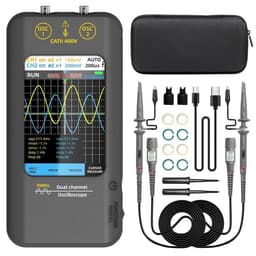
BSIDE BSIDE two-channel 50 MHz

Best overall

BSIDE BSIDE two-channel 50 MHz
8.0/10about £79.99
BSIDE BSIDE OT5 (one UK review)

Alternative

BSIDE BSIDE OT5 (one UK review)
6.6/10about £59.99
BSIDE BSIDE OT3 (probe and clips)

Best value

BSIDE BSIDE OT3 (probe and clips)
7.4/10about £39.99
On this page

What you are actually buying under £80

The pocket listings run from £34.98 to £79.99, on screens of about 2.8 to 3.98 inches. The BSIDE models quote 128 Kb. At 200 MSa/s or 250 MSa/s that is a short slice, and the listings do not say whether Kb means bytes or samples. You can catch a repetitive waveform, not a long rare event. A UK review of OT3 B0DQPP2FKZ timed about 15 minutes. One UK review wanted a small OT5 beside an old bench. That is the honest job. Bandwidth is on the buying guide. The top pick is on the best handheld oscilloscope page.

When the bench is the better instrument

Choose the bench when the edge, the record length, or the screen is the reason you are measuring. Bench bandwidth is usually above the 50 MHz ceiling here, and the memory holds more than a brief slice. A front-panel calibrator gives you a square wave for probe compensation. HSE INDG354 tells you not to lift the protective earth on a Class I scope. If the circuit cannot share that earth, you need an instrument designed to float. A battery scope does not become isolated, and none of these listings state a CAT rating.
BSIDE BSIDE two-channel 50 MHz

Testsieger

BSIDE BSIDE two-channel 50 MHz
8.0/10about £79.99

A laptop scope is not automatically the car solution

A USB scope can be portable in a workshop. In a car it adds a cable and a computer with a ground of its own. A battery unit removes the laptop and still shares a ground inside the scope. Cam against crank, and the hybrid and airbag stop, stay on the handheld oscilloscope for cars page. A Pico 4225A two-channel starter kit is listed at £819, with floating inputs on the maker's datasheet. The amazon band at £35 to £80 is coherent only when you do not need those floating inputs.

The ground is shared until the maker says otherwise

FNIRSI's manual for a different dual-channel handheld, the DPOX180H, says both ground clips must share one potential or the main board shorts. That manual is not the BSIDE sheet. It is the class warning. B0DHCNZCF4 does not state isolation, so read it as a shared reference and one probe in the box. Charge the scope on its own, then probe, and unplug USB before the clip goes on. If the only way to see the signal is to defeat an earth, stop.

Common questions

When should I buy a bench instead?
Buy or keep the bench when you need bandwidth past 50 MHz, a long memory record, a larger screen, or a calibrator you can trust for probe compensation. Also keep it when you already own it and the signal is on the desk. Do not lift its protective earth to fake a floating measurement. HSE INDG354 forbids that on a Class I instrument. If the circuit cannot share the bench earth, you need an instrument specified to float, not a defeated plug.
Is a USB scope a third option in a car?
It can be, in a workshop, with power and a safe reference. In a car it adds a laptop, a cable, and another earth. It does not automatically isolate the input. A battery pocket scope is simpler to carry and still shares a ground between its clips unless the maker states isolation. For vehicle signals and the stop lines, use the car page. For the fork itself, a USB box is not a shortcut around a missing CAT rating.
Do two channels on a cheap handheld share a ground?
Treat them as shared until the listing says they are isolated. The only two-channel unit in this set, B0DHCNZCF4, does not state isolated inputs, and the box lists one probe. A different FNIRSI manual tells you that two ground clips on two potentials short the instrument. That manual is not the BSIDE sheet. It is why this page will not call the £79.99 unit a differential scope. One reference, two tips, is the assumption to measure under.
What happens if I charge it from the circuit I am probing?
You can put the charger lead and the ground clip across two points that were not meant to be joined. Class manuals forbid charging from the device under test for that reason. Charge from a known USB supply, unplug, then connect the clip and the tip. The same caution applies to a laptop USB port while the clip is on a point above earth. A full battery does not make that lead harmless if you leave it attached.
What must I not claim about isolation?
Do not claim that any unit in this set is isolated, floating, CAT II, or CAT III. The listings do not say so. Do not claim the two-channel model is safe on two references because it has two inputs. Do not claim a battery cancels the USB earth if the lead is still plugged in. Do not claim a ±400 V bullet is a category. The pocket scope is a short-record, single-reference tool until a manual for that exact model says more.

Related pages

Sources

Public UK sources from the research digest, last checked on 22 October 2026. Shelf prices and star lines are the amazon.co.uk figures captured with these seven listings. The price bands are this set, not a market average.

  1. HSE INDG354: Safety in electrical testing at work (retrieved 22 October 2026)
  2. HSE GS38: Electrical test equipment for use on low voltage electrical systems (retrieved 22 October 2026)
  3. HSE: Electrical safety and you, competence (retrieved 22 October 2026)
  4. GOV.UK: Electrical Equipment (Safety) Regulations 2016 (retrieved 22 October 2026)
  5. Institution of Electronics: measurement bandwidth (retrieved 22 October 2026)
  6. Rohde & Schwarz: oscilloscope buyer's guide (retrieved 22 October 2026)
  7. Keysight: handheld scopes and meters (retrieved 22 October 2026)