Mini oscilloscope buying guide
You are looking at pocket scopes on amazon.co.uk. Prices sit close together, from £34.98 to £79.99, while the bandwidths do not. A mini oscilloscope buying guide has to split that band before the star lines do. The FNIRSI DSO152 is 200 kHz. The DSO153 is 1 MHz. Two BSIDE OT3 listings are 10 MHz. The OT5 listings and the only two-channel unit are 50 MHz. Prices and the seven rows are on the [mini oscilloscope comparison](/hub/measuring-equipment/mini-oscilloscope). Peter F. checked those amazon.co.uk listings. This is not a lab test. A qualifying purchase through our amazon.co.uk links can earn a commission at no extra cost to you.
You are looking at pocket scopes on amazon.co.uk. Prices sit close together, from £34.98 to £79.99, while the bandwidths do not. A mini oscilloscope buying guide has to split that band before the star lines do.
You are looking at pocket scopes on amazon.co.uk. Prices sit close together, from £34.98 to £79.99, while the bandwidths do not. A mini oscilloscope buying guide has to split that band before the star lines do. The FNIRSI DSO152 is 200 kHz. The DSO153 is 1 MHz. Two BSIDE OT3 listings are 10 MHz. The OT5 listings and the only two-channel unit are 50 MHz. Prices and the seven rows are on the mini oscilloscope comparison. Peter F. checked those amazon.co.uk listings. This is not a lab test. A qualifying purchase through our amazon.co.uk links can earn a commission at no extra cost to you.
Our top picks
| Badge | Product | Bandwidth | Channels | Voltage claim | Note | Price | Offer |
|---|---|---|---|---|---|---|---|
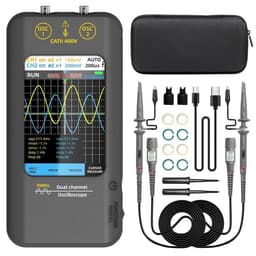
| Best overall |  BSIDE BSIDE two-channel 50 MHz | 50 MHz, 250 MS/s | 2 stated, one BNC probe in the box | Not stated, no CAT rating | 8.0 | about £79.99 | View offer |
| Best value |  BSIDE BSIDE OT3 (probe and clips) | 10 MHz, 48 MS/s | Not printed; a review calls it one channel | ±400 V, no CAT rating | 7.4 | about £39.99 | View offer |
| Alternative |  FNIRSI FNIRSI DSO152 | 200 kHz, 2.5 MS/s | Not printed | 800 V peak-to-peak and 400 V, no CAT rating | 4.8 | about £38.57 | View offer |


On this page
Start with the signal, not the pounds
Sample rate only counts with memory and with the channels switched on
The probe and the ground clip are part of the specification
What that leaves you holding
Common questions
How much bandwidth do I need before I look at price?
Why is 2.5 MS/s not a 10 MHz scope?
Do I need two channels?
Is ±400 V safe on a UK socket?
Why do two OT3 listings at the same price differ?
Related pages
Sources
Public UK sources from the research digest, last checked on 22 October 2026. Shelf prices and star lines are the amazon.co.uk figures captured with these seven listings. The price bands are this set, not a market average.
- HSE INDG354: Safety in electrical testing at work (retrieved 22 October 2026)
- HSE GS38: Electrical test equipment for use on low voltage electrical systems (retrieved 22 October 2026)
- HSE: Electrical safety and you, competence (retrieved 22 October 2026)
- GOV.UK: Electrical Equipment (Safety) Regulations 2016 (retrieved 22 October 2026)
- Institution of Electronics: measurement bandwidth (retrieved 22 October 2026)
- Rohde & Schwarz: oscilloscope buyer's guide (retrieved 22 October 2026)
- Keysight: handheld scopes and meters (retrieved 22 October 2026)