Independent comparisons. We may earn from shop links. More info

Plug-in energy monitor vs DIN rail meter

Updated: 22 October 2026

The shower, the heat pump, or the EV point is the load you want to count, and a plug-in energy monitor vs DIN rail meter is the choice in front of you. If the appliance ends in a UK 13 A plug, use a plug monitor. If the appliance is fixed wiring, stop and get an electrician before you buy a module for the consumer unit. This page, by Peter F., the DIY & tools editor, on 22 October 2026, is that one comparison. It uses the listings in our [electricity meter comparison](/hub/measuring-equipment/electricity-meter) as examples, not as a star table. Billing rules are only a pointer at the end. If you buy through a link to amazon.co.uk, we may earn a commission at no extra cost to you. We did not laboratory-test the meters, and this is not a wiring diagram.

The shower, the heat pump, or the EV point is the load you want to count, and a plug-in energy monitor vs DIN rail meter is the choice in front of you. If the appliance ends in a UK 13 A plug, use a plug monitor.

Our top picks

Awootsv Awootsv plug-in power meter

Best overall

Awootsv Awootsv plug-in power meter
7.4/10about £11.99
DEWIN DEWIN DIN-rail kWh meter

Best value

DEWIN DEWIN DIN-rail kWh meter
6.4/10about £13.29
On this page

The socket line

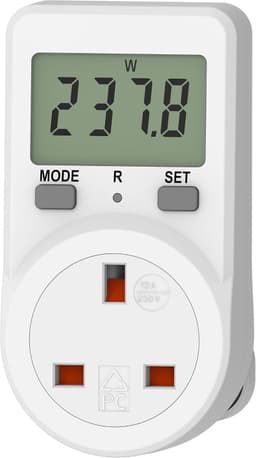
A plug-in monitor measures the appliance in that socket, including whatever shares the extension. Here the plugs are the Awootsv, which states a 13 A cut-out, and the KETOTEK, whose overload is 3680 W. BS 1363 is 13 A. Energenie's 13 A monitor is rated 3120 W. A 3680 W alarm does not raise the socket, the fuse, or the flex. A granny EV lead is still a plug, so a plug monitor can see that lead. It cannot see a wall-mounted charger, a shower, or a cooker. The Jadeshay review that mentions a granny lead wanted a DIN reading as well, which is the next section. Which? and trade pages such as Eastron's draw the same split between a plug and a board. Use the plug when you can lift the appliance plug out and put the monitor in its place. The how to use an electricity meter plug page is the button and unit-rate routine for that case. If you cannot find a 13 A plug on the load, you have already left this section.

What a DIN-rail meter is for

A DIN-rail meter counts one wired circuit on a rail, usually 35 mm, in the board or in a windowed box. The three here are the DEWIN at about £13.29, titled 5(80) A, the Jadeshay at about £13.69, titled 5(32) A, and the CYTGOUPER at about £16.09, titled 20(80) A. The number in brackets is the maximum claimed. A 5(32) A meter is the wrong module for an 80 A annex. The CYTGOUPER reviewer said to treat that meter as 80 A, not 100 A, and a second reviewer had not run the EV load. A review that says the module clicks onto the rail is not permission to take a live cover off. The DEWIN's UK notes include small terminals, a housing that melted on a 4 kW heater after just over 1000 kW, and an LCD that burst within a year. The Jadeshay owner needed spare ways or a separate windowed box, and still could not say which display was more accurate. BS EN 50470-3 does not cover portable plug meters. It also does not turn a DIN listing into a billing approval. MID is absent from all three of these cheap modules. They are check meters for a circuit total when the current matches and the person fitting them is competent. Electricians certify that kind of work to BS 7671. The buying guide holds the wider fork, including clamps and the supplier's meter, if you have not yet decided that the load is one circuit.

A clamp is not a plug either

A split current transformer is a third shape. It is not a DIN meter and it is not a 13 A plug. The POFET in this set is an 80 A clamp with a 10 mm opening, and it still has to be wired to 110–240 V for its own supply. UK reviews say that opening will not close on standard meter tails. Measure the cable before you buy a 10 mm jaw. If the jaw cannot shut, the reading can sit low, which several of those reviews describe. Hobut's note says one conductor through the aperture. Live and neutral together cancel. The POFET listing is one direction only, so export sits outside that claim, and UK reviewers had to add flex because the terminals are live. The Emporia Vue 3 is a sixteen-circuit hard-wired monitor, and the DEWIN panel meter uses a closed transformer. Neither answers plug or DIN for a shower on one circuit. That question is a DIN module of the right current.

England, the board, and the seal

In England, GOV.UK classes a new circuit or a replacement consumer unit as notifiable unless a competent-person scheme member self-certifies it. A like-for-like repair is a different case. Scotland and Northern Ireland do not take that England sentence as their own. Ask the electrician, or building control, which job you actually have before you order a module. Do not open the consumer unit unless you are competent to do that work dead and to reconnect it to BS 7671. Heat, an unknown three-phase board, or tails you cannot identify are the stop. This page will not add a wiring diagram. Citizens Advice says moving the supplier's meter yourself is illegal. A DIN module does not replace it, and it does not by itself let you bill the annex. When money will change hands, use the electricity meter for billing a tenant page. Until then: a UK plug gets a plug monitor; fixed wiring gets an electrician and a meter whose current matches the circuit.

Common questions

Can I meter the shower with a plug?
Only if the shower somehow ended in a 13 A plug, which a normal electric shower does not. The plug monitor sees the socket you put it in. The shower circuit stays invisible. Counting that circuit means a meter in the wiring, fitted by a competent person, with a current rating that covers the shower. A 3680 W alarm on a plug monitor is irrelevant to that circuit.
Is a granny EV lead a plug job or a DIN job?
The granny lead is a plug job for as long as you are measuring that 13 A lead. A plug monitor will see it. A wall charger on its own circuit is a DIN or clamp job. One review in this set used a Jadeshay beside a granny lead and still needed a separate enclosure. That review does not say the 5(32) A meter is the right module for a faster wired charger.
Who fits a meter inside the consumer unit?
Someone competent to work in that board and to certify to BS 7671. In England a new circuit or a replacement consumer unit is notifiable unless a scheme member self-certifies. Reviews that say a module snaps onto the rail are describing the clip, not authorising the cover to come off. If you would not replace a breaker yourself, you do not fit this meter yourself.
Is a new circuit notifiable in England?
GOV.UK says a new circuit or a replacement consumer unit is notifiable building work unless a competent-person scheme member self-certifies it. Work that is only a repair in the same place is a different case. Scotland and Northern Ireland are not covered by that England rule. Confirm which job you are actually doing before you assume a building notice, or assume you need none.
Why did a clamp read nothing?
The usual reason is both live and neutral inside the jaw, so the currents cancel. Hobut's note says one conductor through the aperture. The other reason, on the POFET, is a 10 mm jaw that never fully closes on a UK tail, which reviews link to a low reading. The POFET also needs its own mains supply. A clamp around a whole flex is not a successful install that happens to show zero.
Will a 5(32) A meter do for an 80 A supply?
No. The 5(32) A title is the Jadeshay, and 32 A is the maximum that title claims. An 80 A circuit needs a meter whose maximum covers 80 A, and even then the CYTGOUPER reviewer said to treat a 20(80) A meter as 80 A rather than 100 A. Matching the number on the title to the circuit is the electrician's check, not a star-rating check.
Does a DIN meter let me bill the annex?
A DIN module in this set does not state MID, and a circuit total is not by itself a bill. Charging someone else needs an approved meter, installed in an approved way. That test is on the billing page. Until the nameplate shows the marks, use the DIN reading only as your own information.

Related pages

Sources

Public UK sources from the research digest, last checked on 22 October 2026. Shelf prices and star lines are the amazon.co.uk figures captured with these nine listings. The price bands are this set, not a market average.

  1. GOV.UK: national regulation of gas and electricity meters (retrieved 22 October 2026)
  2. GOV.UK: MIR approved gas and electricity meters (retrieved 22 October 2026)
  3. Measuring Instruments Regulations 2016, regulation 3 (retrieved 22 October 2026)
  4. Ofgem: getting a smart meter (retrieved 22 October 2026)
  5. Citizens Advice: move your gas or electricity meter (retrieved 22 October 2026)
  6. GOV.UK: building work, replacements and repairs (retrieved 22 October 2026)
  7. BSI: BS 1363 13 A plugs and socket-outlets (retrieved 22 October 2026)
  8. NIE Networks: smart electricity meters factsheet, April 2026 (retrieved 22 October 2026)