Independent comparisons. We may earn from shop links. More info

Electricity meter for billing a tenant

Updated: 22 October 2026

The annex has its own kettle and heater, and you want an electricity meter for billing a tenant rather than a rough idea of the cost. The reading that becomes a charge has to come from an approved meter, installed in an approved way, and the unit price cannot be a private markup. This page, by Peter F., the DIY & tools editor, on 22 October 2026, is that rule, applied to the amazon.co.uk listings in our [electricity meter comparison](/hub/measuring-equipment/electricity-meter). It is not a star table and it is not a plug-in manual. If you buy through a link to amazon.co.uk, we may earn a commission at no extra cost to you. We did not inspect a nameplate in a lab, and we did not open the Emlite box.

The annex has its own kettle and heater, and you want an electricity meter for billing a tenant rather than a rough idea of the cost.

Our top picks

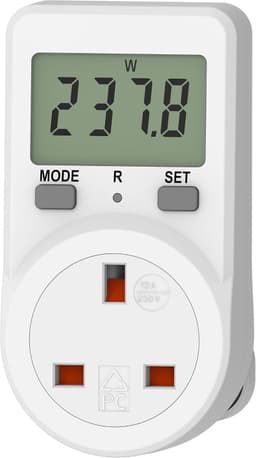
Awootsv Awootsv plug-in power meter

Best overall

Awootsv Awootsv plug-in power meter
7.4/10about £11.99
Emlite Emlite ECA2-MID kWh meter

Alternative

Emlite Emlite ECA2-MID kWh meter
6.6/10about £54.45
DEWIN DEWIN DIN-rail kWh meter

Best value

DEWIN DEWIN DIN-rail kWh meter
6.4/10about £13.29
On this page

A bill is a different job from a check

A meter you read for yourself is a check. A meter you use to charge a tenant, a lodger, or a workplace is trade. GOV.UK says a billing meter, including a landlord's, must be an approved design installed in an approved manner, under the Electricity Act 1989 Schedule 7. That guide covers England, Scotland, and Wales. GB pattern-approved meters are also suitable in Northern Ireland under the Electricity (Northern Ireland) Order 1992, and the register does not list MID or MIR meters. Approval still applies there. Certification of a secondary meter can be set aside in writing. Approval cannot. The Measuring Instruments Regulations 2016 cover active energy meters used for trade, with a carve-out above 100 kW when measured half-hourly. A domestic annex is not that carve-out. The moment the number is multiplied by a price and handed to someone else, you have changed jobs. A plug, an app screenshot, and a DIN module with no approval marks can show usage. They are the wrong document to attach to a demand for money. The buying guide separates those jobs. This page assumes someone will pay.

The marks, and why Module B is not the finish

GOV.UK's MIR guidance says the routes that put an active electrical energy meter on the market for supplier billing, or for landlord-and-tenant billing, are Module B plus D, Module B plus F, or Module H1. Module B alone is type examination. It is not the finished approval. If the metrology marks are missing, GOV.UK says the meter is not MIR approved, whatever the title on a web page claims. On the meter you are looking for CE or UKCA, the M mark with the year, and the four-digit approved-body number. Both CE and UKCA can be placed on the Great Britain market. A GS mark, or Class 1.0 in a bullet, is not this approval. Photograph the nameplate. A blank plate is not the proof this section asks for. A public UKCA certificate for the Emlite ECA2 type, 0120/SGS0103, valid to 22 March 2030, is Module B and says the type must be used with Module D or F. That PDF is not an inspection of the Amazon unit, and Module B alone does not finish the route GOV.UK describes.

What this set actually claims

Eight of the nine listings in this set do not say MID at all. The two plugs, the three cheap DIN modules, the panel meter that cites EN 61010-1, the POFET class 1.0 line, and the Emporia app are check tools here. BS EN 50470-3 does not cover portable meters. Using any of those screens as the bill skips the nameplate test. The Emlite row, titled ECA2-MID, is the exception on the page only. It is about £54.45, 4.2 from 37 reviews, 100 A, import active energy, and the bullets say fully MID approved. UK texts mention no wire seal and no instructions, and one describes fitting it in place of the house meter. Do not copy that. Citizens Advice says moving the supplier's meter yourself is illegal. The Amazon sentence stands until the metal shows the M mark, the year, and the body number, with D or F as well as Module B. Replacing the settlement meter is a supplier job in Great Britain and an NIE Networks job in Northern Ireland. A sub-meter on an annex is a different object. The plug or DIN-rail page says when the load is fixed wiring. It does not approve a charge.

What you may charge

Where electricity from an authorised supplier is resold for domestic use, Ofgem's maximum resale price direction of 14 March 2014 says the unit price cannot exceed the price the reseller paid. The standing charge is shared. You can recover what the bill shows. You cannot add a quiet margin inside the pence per kilowatt-hour and call it maintenance. Citizens Advice gives the same account to tenants, and notes that electricity carries no VAT from 1 October 2026 to 31 March 2027. Show the tenant the supplier bill the rate came from, and the meter reading the units came from. The direction excludes electricity resold from a charge point used solely for an electric vehicle. A granny lead on an ordinary socket does not get that exclusion. Ofgem's decision letter draws the distinction. A domestic socket that charges a car overnight stays on the pass-through price. If the annex has an approved meter, the arithmetic is its kilowatt-hours times the unit rate on your supplier bill, plus a fair share of the standing charge. If you cannot point to the nameplate and that bill, you are not ready to invoice.

Common questions

Can a landlord bill from any kWh meter?
No. GOV.UK says a billing meter, including a landlord's, must be an approved design and installed in an approved manner. A meter that only helps you see usage can be a check meter. Once the figure is a charge, approval applies, and a written waiver can set aside certification of a secondary meter, not the approval itself. A plug-in monitor or an unapproved DIN module does not meet that test because it shows kilowatt-hours.
What marks should be on the meter, not just in the title?
CE or UKCA, the M mark with the year, and the four-digit approved-body number, on the meter. GOV.UK says that if those marks are missing, it is not MIR approved. A title that says MID, a GS logo, or a class sentence in the bullet list is not a substitute. Photograph the plate. Both CE and UKCA can be placed on the Great Britain market.
Is Module B enough?
Module B is not enough for supplier billing or for landlord-and-tenant billing. GOV.UK lists B with D, B with F, or H1. The public ECA2 certificate 0120/SGS0103 is Module B, valid to 22 March 2030, and it says the type must be used with D or F. That certificate is not proof that the Amazon parcel in front of you carries those modules.
Does the Emlite listing prove the meter I receive is approved for billing?
It proves the listing says fully MID approved. It does not show you the marks on the unit, and UK reviews mention no wire seal and no instructions. One review describes replacing a house meter. That is not advice you should follow. Check the nameplate and the D or F evidence before you bill, and leave the supplier's sealed meter to the supplier or, in Northern Ireland, to NIE Networks.
Can the reseller add a margin?
Ofgem's 2014 maximum resale price direction says the domestic unit price cannot exceed what the reseller paid, and the standing charge is shared. A higher pence-per-kilowatt-hour figure described as a service fee is still a higher unit price. Keep the supplier bill as the source of the rate. Citizens Advice explains the same limit from the tenant's side.
Does this rule cover an EV charge point?
A charge point used solely to resell electricity for a vehicle is outside the maximum resale price direction. A granny socket used as a normal domestic outlet is not that exclusion. If you are billing the annex for household electricity, the pass-through price still applies to those units. A dedicated public or workplace charge point needs its own reading of the direction.
Can I use a plug monitor or the POFET app as the bill?
Use them as a check. The plugs in this set are portable monitors, and the POFET is a one-direction clamp whose UK reviews say the app has no unit price. Neither shows the metrology marks this page requires. An Emporia chart is the same kind of private record. Attach a demand for money only to an approved meter and to the supplier rate you actually paid.

Related pages

Sources

Public UK sources from the research digest, last checked on 22 October 2026. Shelf prices and star lines are the amazon.co.uk figures captured with these nine listings. The price bands are this set, not a market average.

  1. GOV.UK: national regulation of gas and electricity meters (retrieved 22 October 2026)
  2. GOV.UK: MIR approved gas and electricity meters (retrieved 22 October 2026)
  3. Measuring Instruments Regulations 2016, regulation 3 (retrieved 22 October 2026)
  4. Ofgem: getting a smart meter (retrieved 22 October 2026)
  5. Citizens Advice: move your gas or electricity meter (retrieved 22 October 2026)
  6. GOV.UK: building work, replacements and repairs (retrieved 22 October 2026)
  7. BSI: BS 1363 13 A plugs and socket-outlets (retrieved 22 October 2026)
  8. NIE Networks: smart electricity meters factsheet, April 2026 (retrieved 22 October 2026)