Independent comparisons. We may earn from shop links. More info

Electricity meter buying guide

Updated: 22 October 2026

You want one number for the tumble dryer, the annex, or a bill, and amazon.co.uk answers with plugs, clamps, and DIN-rail modules. This electricity meter buying guide, by Peter F., the DIY & tools editor, on 22 October 2026, is the fork: one socket, one wired circuit, a cable you can clamp, or the supplier's own meter. It follows the public UK rules and the listings in our [electricity meter comparison](/hub/measuring-equipment/electricity-meter). It does not rank those rows. If you buy through a link to amazon.co.uk, we may earn a commission at no extra cost to you. Nothing here was laboratory-tested.

You want one number for the tumble dryer, the annex, or a bill, and amazon.co.uk answers with plugs, clamps, and DIN-rail modules.

Our top picks

Awootsv Awootsv plug-in power meter

Best overall

Awootsv Awootsv plug-in power meter
7.4/10about £11.99
Emlite Emlite ECA2-MID kWh meter

Alternative

Emlite Emlite ECA2-MID kWh meter
6.6/10about £54.45
DEWIN DEWIN DIN-rail kWh meter

Best value

DEWIN DEWIN DIN-rail kWh meter
6.4/10about £13.29
On this page

Four jobs, four tools

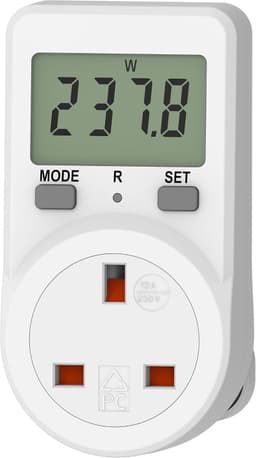
A plug-in monitor sits between a BS 1363 socket and one appliance. In this set that is the Awootsv and the KETOTEK. Which? wants a screen plus a unit price. A shower, a cooker, and a hard-wired charger never pass through that socket. A DIN-rail meter clips to a 35 mm rail and counts one wired circuit. The DEWIN, Jadeshay, and CYTGOUPER titles print 5(80) A, 5(32) A, and 20(80) A. The figure in brackets is the maximum claimed. A title is not permission to open the consumer unit. A clamp goes around one live conductor. The POFET is a powered 10 mm jaw on 2.4 GHz, one direction only. The Emporia Vue 3 is a hard-wired board project, and the DEWIN panel meter uses a closed transformer. The supplier's smart meter is already on the wall. An Amazon listing does not replace the quarterly bill.

What a UK socket can carry

BS 1363 is a 13 A system. Energenie's 13 A plug monitor is rated 3120 W. A listing that alarms at 3680 W is using a 16 A number. The KETOTEK page states 3680 W and does not state 13 A. Treat that alarm as a setting on the gadget, not as a higher rating for the socket, the plug, or the flex. If the appliance has no 13 A plug, leave the socket monitor in the drawer. Class 1.0 or ±2% is the manufacturer's sentence, not a MID class index, and BS EN 50470-3 does not cover portable meters. A useful plug shows kilowatt-hours and lets you enter the unit rate from your tariff.

What you may install yourself

A plug needs no wiring. You insert it, enter the unit rate, run the appliance, and read kilowatt-hours. The how to use a plug-in electricity meter page stays on that side of the socket. A DIN-rail module and a clamp powered from 110–240 V are fixed wiring. In England, a new circuit or a replacement consumer unit is notifiable unless a competent-person scheme member self-certifies it. Scotland and Northern Ireland do not inherit that England sentence. Electricians certify to BS 7671. Citizens Advice says you cannot move the electricity meter yourself: phone the supplier in Great Britain, and NIE Networks owns the meter in Northern Ireland. Heat, hot plastic, an unknown board, or a three-phase supply is the moment to stop.

Marks that do not authorise a bill

Seeing your own usage is a check. Charging a tenant, a lodger, or an annex is a different legal job. GOV.UK says a billing meter, including a landlord's, has to be an approved design installed in an approved way. CE, a GS mark, or Class 1.0 do not do that work. The cheap DIN listings in this set do not state MID. The Emlite row is the only one whose bullets say fully MID approved. That sentence is not the metrology mark, and a public ECA2 certificate is Module B, which GOV.UK says is not enough on its own. The electricity meter for billing a tenant page spells that out. The plug-in or DIN-rail page is the next stop for a shower, a heat pump, an EV point, or a granny lead.

Common questions

Is a plug-in monitor the same as the smart meter my supplier fits?
No. In Great Britain the supplier fits the settlement meter and the in-home display, and Ofgem says you can ask or decline. A plug-in monitor only sees the appliance you put into it. It cannot produce the quarterly bill, and it does not add the standing charge. In Northern Ireland the meter belongs to NIE Networks.
Can a plug see a shower, a cooker, or a hard-wired charger?
It sees only what is plugged into that socket. A shower, a cooker, and a charger wired into its own circuit never pass through a 13 A plug monitor. If the appliance has a normal UK plug, including a granny EV lead, the plug monitor can see that lead. If the appliance is fixed, you need a DIN-rail meter or a clamp, connected by an electrician.
When do I need a DIN-rail meter instead?
When the load is a wired circuit you want as a total: an annex, a heat pump, or a dedicated charger, and a competent person can fit a module whose current matches that circuit. The titles in this set print 5(32) A, 5(80) A, and 20(80) A. A 32 A maximum is the smaller of those claims. The meter still does not authorise you to open the consumer unit.
Is 3680 W a safe continuous load on a UK socket?
Treat 3680 W as a 16 A figure, not as the BS 1363 rating. A 13 A plug monitor from Energenie is rated 3120 W. An alarm set at 3680 W on a UK plug does not raise the socket, the fuse, or the flex. Keep long-running heaters inside what the plug and the cable are built for.
Can I replace the house meter with one from Amazon?
Citizens Advice says moving the electricity meter yourself is illegal. The supplier does that in Great Britain. NIE Networks does it in Northern Ireland. A review that describes an electrician swapping a house meter is not a set of instructions, and a check meter on a sub-circuit is a different object from the sealed settlement meter.
What is different in Northern Ireland?
NIE Networks owns the meter. Their April 2026 factsheet said there were no home smart meters yet, with first installations expected in early 2028. Smart Energy GB is a Great Britain programme. GB pattern-approved meters can be suitable in Northern Ireland under the Electricity (Northern Ireland) Order 1992, which is a rule for a billing meter.
Does Class 1.0 or a CE mark mean I can bill someone?
Neither mark is billing approval. GOV.UK requires an approved design, installed in an approved way, when the reading will be a charge, including a landlord's meter. CE can sit on a check meter. Class 1.0 on a listing is the seller's accuracy sentence. Read the nameplate, not the title.

Related pages

Sources

Public UK sources from the research digest, last checked on 22 October 2026. Shelf prices and star lines are the amazon.co.uk figures captured with these nine listings. The price bands are this set, not a market average.

  1. GOV.UK: national regulation of gas and electricity meters (retrieved 22 October 2026)
  2. GOV.UK: MIR approved gas and electricity meters (retrieved 22 October 2026)
  3. Measuring Instruments Regulations 2016, regulation 3 (retrieved 22 October 2026)
  4. Ofgem: getting a smart meter (retrieved 22 October 2026)
  5. Citizens Advice: move your gas or electricity meter (retrieved 22 October 2026)
  6. GOV.UK: building work, replacements and repairs (retrieved 22 October 2026)
  7. BSI: BS 1363 13 A plugs and socket-outlets (retrieved 22 October 2026)
  8. NIE Networks: smart electricity meters factsheet, April 2026 (retrieved 22 October 2026)