Independent comparisons. We may earn from shop links. More info

Magnetic tape measure

Updated: October 2026

You are measuring a steel stud, a run of trunking or a pipe on your own, and the hook keeps slipping while you reach for a pencil. A magnetic tape measure holds that end on steel. It does nothing on timber, plasterboard or concrete. In this amazon.co.uk set only one title states a magnetic hook: the Stanley FatMax 0-33-719. The [tape measure comparison](/hub/measuring-and-marking-tools/tape-measure) has the other rows. The Products Compared editorial team checked those titles on 16 October 2026. We did not test pull force. A qualifying purchase can earn a commission at no extra cost to you. Ordinary hook play stays on [how to use a tape measure](/hub/measuring-and-marking-tools/tape-measure/sub/tape-measure-how-to-use).

You are measuring a steel stud, a run of trunking or a pipe on your own, and the hook keeps slipping while you reach for a pencil. A magnetic tape measure holds that end on steel.

Our top picks

On this page

When the magnet earns its place

The magnet earns its place when the day's work is steel and you need the end to stay put. A plain hook needs a lip. A stud flange, a pipe or trunking often gives you a face instead. Hardware Tool Shop draws that line: the magnet holds on steel, and a plain hook is enough on an edge you can catch. On a steel stud wall you stick the end, walk the blade to the next stud, and mark. The free hand is the point. Class II on the 0-33-719 is a property of the blade marking. The hook should still move by about its thickness. If you only occasionally touch a radiator bracket, a plain hook is the simpler tool.

When it gets in the way

On timber, plasterboard and concrete the magnet is dead weight. A strong magnet can grab a nail, a hinge or a loose screw you did not mean to measure from. Reviewers of the 0-33-719 describe a hook that latches on edges and is hard to release. If your work is skirting, timber studs and kitchen cabinets, skip the magnet. Kitd, in a UK round-up, notes that metal dust on a magnetic hook can mark the blade. That is a user report, not a test we ran. Wipe the hook after cutting steel, before you rewind. The 0-33-719 title claims 3.3 m of standout on a 32 mm blade. One UK review says the blade collapses at about 1.5 m. We did not measure either.

The one listing in this set that says magnetic

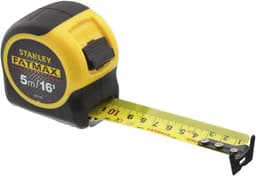
Stanley FatMax 0-33-719, ASIN B0001GRV9Q, is the listing whose title says magnetic hook end. It is a 5 m / 16 ft tape, 32 mm, Class II, with a 3.3 m standout claim, at £14.42 and a listed 390 g. The star line is 4.6 from 4,740 reviews. Review bodies praise a wide blade and a hook that is useful on metal. The same file records a lock that feels like two actions. One review title says the tape is not magnetic. The product title says it is. Check the hook on a steel edge when it arrives. Campbell Engineering's page for the same model number does not repeat magnetic, so use the amazon.co.uk title. The best tape measure UK page names the 8 m FatMax 0-33-726 for longer pulls, and that title does not say magnetic.

FatMax is not a magnet

The FatMax name does not mean the hook is magnetic. The 0-33-726 is an 8 m, 32 mm tape at £18.78 with a 3-rivet true-zero hook. The bullets do not say magnetic. The metric 5 m, 0-33-720, at £16.52, says tru-zero and Class 2. The metric 8 m, 0-33-728, at £20.04, says a 3-rivet true-zero hook. If a product photo looks similar, use the model number. The tape measure buying guide puts the magnet last, after length, class and width. The price check is £14.42 for the only magnetic title here, against £18.78 for the 8 m FatMax. Buy 0-33-719 if the day's work is steel. Buy a plain hook if the day's work is timber and board.

Common questions

Do I need a magnetic hook?
You need one if you measure steel alone and the end has no lip to catch: studs, trunking, conduit, pipe, a steel frame. You do not need one for timber, plasterboard or a door you can hook. In this set only the Stanley 0-33-719 title states a magnetic hook. A magnet does not improve the accuracy class.
Will it stick to timber or plasterboard?
No. The magnet is for steel. On wood, plasterboard and concrete it does not hold the end, and it can snag on a nail or a hinge you did not intend to use as zero. A plain hook is the better tool when the edge is timber. That matches the review complaint that the 0-33-719 hook is hard to release.
Which tape in this set actually says magnetic?
Stanley FatMax 0-33-719, at £14.42. The title says magnetic hook end, Class II, 5 m, 32 mm, and 3.3 m standout. It has 4.6 from 4,740 reviews. One review title says it is not magnetic. Check the hook on a steel edge when it arrives. No other ASIN in this comparison states a magnet in the title.
Does the magnet replace true-zero play?
No. The hook should still slide by about its own thickness so outside and inside readings share a zero. The magnet only helps the end stay on steel. Stanley states a true-zero hook on this FatMax and on the non-magnetic FatMax rows. Clamping the rivets removes the play on every one of them.
Can the magnet be too strong?
Yes, in the sense that reviewers of the 0-33-719 say the hook latches on edges and is hard to let go. That is a problem on timber and on any edge you need to lift off quickly. It is the trade-off for a hand left free on steel. We did not measure the pull force.
Will swarf scratch the blade?
It can. Metal dust stuck to the hook is dragged along the blade on the next pull. Kitd notes that as a user report. Wipe the hook after cutting steel, before you rewind. That is not a defect in the class marking, and it is not something we reproduced.

Related pages

Sources

Sources checked for this comparison; last retrieved on 16 October 2026.

  1. Measuring Instruments Regulations 2016, material measures (retrieved 16 October 2026)
  2. GOV.UK, Measuring Instruments Regulations 2016: Great Britain (retrieved 16 October 2026)
  3. GOV.UK, weights and measures business guidance (retrieved 16 October 2026)
  4. GOV.UK, placing UKCA or CE marked products on the Great Britain market (retrieved 16 October 2026)
  5. The Tape Store, Class 2 tapes (retrieved 16 October 2026)
  6. The Tape Store, how to read a tape (retrieved 16 October 2026)
  7. Stanley Tools support, why the hook moves (retrieved 16 October 2026)
  8. Homebuilding, diamond marks on a tape measure (retrieved 16 October 2026)
  9. amazon.co.uk listings for the ASINs in this comparison (retrieved 16 October 2026)