Independent comparisons. We may earn from shop links. More info

How to use a tape measure

Updated: October 2026

You marked a shelf, cut the timber, and the piece is 4 mm short. The hook was pushed when it should have been pulled, or you forgot the case, or your eye sat on the inch marks. This is how to use a tape measure so the next reading matches the first. Models sit on the [tape measure comparison](/hub/measuring-and-marking-tools/tape-measure). Length and class sit on the [tape measure buying guide](/hub/measuring-and-marking-tools/tape-measure/sub/tape-measure-buying-guide). The Products Compared editorial team used The Tape Store's reading guide, Stanley's note on hook travel, and BBC Skillswise on millimetres, on 16 October 2026. We did not calibrate a blade. A qualifying purchase can earn a commission at no extra cost to you.

You marked a shelf, cut the timber, and the piece is 4 mm short. The hook was pushed when it should have been pulled, or you forgot the case, or your eye sat on the inch marks.

Our top picks

On this page

Take an outside measurement with the hook pulled

An outside measurement is anything where the hook catches an edge and the blade runs away from you: a worktop, a door, a cabinet you can get an end over. Place the hook over the far edge so the blade is pulled. Stanley's support note says the hook is meant to move by about its own thickness. Pulled out, the zero sits on the outside face. Pushed in, the same zero sits on an inside face. If you tighten the rivets, you remove that travel and both readings shift. Keep the blade straight and read at eye level. For a 600 mm shelf, hook the left end and read the right end. If the span is longer than the blade will hold out, move the hook and add the two readings. That length choice is on the 5m or 8m tape measure page.

Take an inside measurement and add the case

An inside measurement is the opening you cannot hook: a window reveal, the inside of a cupboard, the gap for a washing machine. Butt the case against one side and run the blade to the other. The number under your eye is only the blade. Add the length of the case, which is printed on many cases and is not the same on a PowerLock as on an 8 m FatMax. Avoid bending the first 100 mm into the corner. The curve moves the zero, and a kink tears the first rivet. If the case will not fit, add a short offcut of known length. An offcut of 100 mm plus a blade reading of 742 mm is 842 mm. A true-zero hook covers its own thickness.

Read millimetres, not the other scale

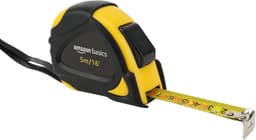
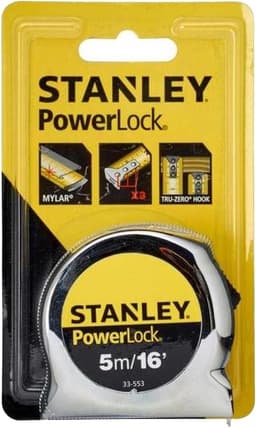
UK construction sizes are in millimetres. On a metric edge the large numbers are centimetres. Between 10 and 11 there are ten small spaces, each 1 mm. The longer mark in the middle is 5 mm, which is the point BBC Skillswise uses. A reading of 10 cm plus six small marks is 106 mm. If the tape also carries inches along the top edge, keep your eye on the metric edge for the whole pull. Dual-scale tapes here include the PowerLock, the OX twin and the Amazon Basics 5 m and 10 m. Metric-only tapes include the FatMax 0-33-720 and 0-33-728. Black diamonds are not millimetres. Homebuilding describes a diamond spacing of 19.2 inches on some tapes sold in the UK. Do not treat a diamond as 400 mm.

Let the blade back in, and know when the hook is finished

Guide the blade home with a finger on the lock. Letting it fly chips the hook. On the Rolson, a bottom button slows the return. If you do not hold it, a new spring snaps shut. Eye protection here is Tape Store retailer guidance. Designed play is a fraction of the hook thickness, with the rivets still seated. A finished hook has rivets torn out, a hook bent off square, or an end that has come off so the blade disappears into the case. That last fault is what one G4GADGET review describes. A magnetic hook that will not leave a steel edge is on the magnetic tape measure page. Replace the tape when the cut cannot be trimmed, such as a worktop join where 3 mm means the unit will not go in.

Common questions

Why does the hook move?
The hook slides by about its own thickness so one zero works for an outside pull and an inside push. Stanley describes that travel as intentional. If you clamp the rivets tight, both readings shift. Play with the rivets still seated is not a fault. Torn rivets or a bent hook are.
How do I measure the inside of a window or cupboard?
Butt the case against one side, read the blade at the other side, and add the case length printed on the case. There is no single case length for every tape in this set. If the case is unmarked, measure it once and write the figure down. Do not bend the first 100 mm into the corner if a short offcut of known length will do instead.
How do I count millimetres between centimetre numbers?
The large figures are centimetres. Each centimetre is split into ten millimetres. The longer mark halfway is 5 mm. From the 10 cm figure, six small marks further along is 106 mm. Read that edge only, at eye level, with the blade straight.
What if the tape has inches on the top edge?
Leave them alone when the job is in millimetres. Dual-scale blades are common on the PowerLock, the OX twin and the Amazon Basics tapes. Metric-only FatMax models omit inches on purpose. Switching scales in the middle of a pull is a common way to cut short or long.
Should I bend the blade into the corner?
Avoid bending the first 100 mm. The curve moves the zero off the face, and a kink there damages the hook. Use the case plus the printed case length, or add a short offcut of a known length.
When is a loose hook actually broken?
It is broken when the rivets are pulled out, the hook is bent off square, or the end has snapped so the blade retracts into the case and will not come out. A small slide with intact rivets is the true-zero movement. Do not pinch it tight with pliers to stop the rattle.

Related pages

Sources

Sources checked for this comparison; last retrieved on 16 October 2026.

  1. Measuring Instruments Regulations 2016, material measures (retrieved 16 October 2026)
  2. GOV.UK, Measuring Instruments Regulations 2016: Great Britain (retrieved 16 October 2026)
  3. GOV.UK, weights and measures business guidance (retrieved 16 October 2026)
  4. GOV.UK, placing UKCA or CE marked products on the Great Britain market (retrieved 16 October 2026)
  5. The Tape Store, Class 2 tapes (retrieved 16 October 2026)
  6. The Tape Store, how to read a tape (retrieved 16 October 2026)
  7. Stanley Tools support, why the hook moves (retrieved 16 October 2026)
  8. Homebuilding, diamond marks on a tape measure (retrieved 16 October 2026)
  9. amazon.co.uk listings for the ASINs in this comparison (retrieved 16 October 2026)