Independent comparisons. We may earn from shop links. More info

Digital angle finder for skirting

Updated: 22 October 2026

The bay looks almost square until the two lengths of skirting meet and leave a gap you can see from the door. A digital angle finder for skirting is a hinged rule you open across that real corner, then split, not the full angle dialled straight onto the saw. Listings and review notes are from amazon.co.uk, captured on 19 October 2026, on the [digital angle finder comparison](/hub/measuring-and-marking-tools/digital-angle-finder). Peter F. did not fit your room. A qualifying purchase can earn a commission at no extra cost to you. Blade setup, with the saw unplugged, stays on the mitre-saw page.

The bay looks almost square until the two lengths of skirting meet and leave a gap you can see from the door.

Our top picks

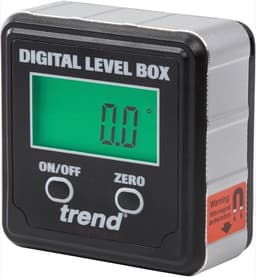
Trend Trend DLB magnetic level box

Best overall

Trend Trend DLB magnetic level box
9.5/10about £19.95
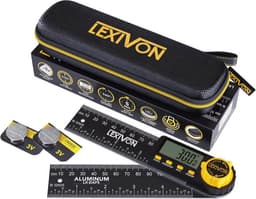
LEXIVON LEXIVON LX-DAF5 130 mm

Alternative

LEXIVON LEXIVON LX-DAF5 130 mm
9.3/10about £22.99
Trend Trend DAR/200 200 mm rule

Best value

Trend Trend DAR/200 200 mm rule
9.1/10about £18.49
On this page

Use a hinged rule, not a level box

Two walls need two arms. Sit one arm on each face, read the angle, and lock it if the knob holds. A magnetic level box reads the tilt of one face. The Trend DLB at £19.95 is the top pick in the wider set for a steel blade, and it has no arms, so it cannot take a wall-to-wall reading. The Trend DAR/200 at £18.49 is about 200 mm closed. UK reviews mention skirtings, dado, shelves, bay windows, and a centre lock. One review calls the 7 inch arms short on a larger surface. Measure where the skirting will sit, not a metre up the wall where the plaster bellies. How zero and hold differ is on the how to use page.

Internal scribe, external mitre, bay in between

Wickes treats a normal internal corner as a scribe: one board cut square, the other coped to the profile. A mitre on a textbook 90° internal joint often opens when the walls are not perfect. A square external corner is still 45° and 45°. The finder earns its place when the corner is not square. Metres Direct notes that bay windows are often 122.5° or more. Open the rule low, where the boards will meet, on the faces the skirting touches. A rounded body, which UK reviews mention on the LIBAIDZ, gives you the angle of the plastic, not the plaster. If you can scribe a standard internal, scribe. If it is a bay or an external that is off square, measure, then split.

Halve the turn, then match the saw

The number on the rule is the corner. Most mitre saws want each piece cut to half the turn away from straight, and only if that saw's 0° means a square cut. A Screwfix community example subtracts an internal angle from 180 and halves the result: 180 minus 133.5 is 46.5, and half of that is 23.25°. None of these twelve ASINs is a Bosch GAM calculator. Do not invent one setting for every saw. Set the saw, cut a scrap, and offer it into the corner before you cut the length that has to reach the door lining. If the scale and the scrap disagree, the blade setup is the mitre saw page.

Check the tool, then the offcut

A finder that reads 87° on a square will bisect the wrong angle. Flintronic UK reviews include 87° on a set square. LIBAIDZ reviews include about 2° and about 5° out on 90°. A LEXIVON review recorded 90.4° against a stated ±0.3°. The DAR/200 still needs the same square check. Put the rule on a square, zero as the sheet asks, and only then open it on the wall. The best value rule for this job is the DAR/200 at £18.49. None of these tools has a bisect button. You do the halving. When the offcut fits, cut the board. When the tool, the square, and the offcut disagree, stop. Stair skirtings are joiner's work if you are not already competent to set them out.

Common questions

Do I set the saw to the angle on the screen?
Usually you set the saw to half of the turn away from a straight line, not to the raw corner. A 135° internal corner is 22.5° on each piece if your saw's 0° is a square cut. A 90° corner, on that same saw, is 45° and 45° for an external mitre. If you dial 135° into a saw that expected 22.5°, the cut will miss the wall. Read the scale, then confirm on an offcut.
What is the cut for a corner that is not 90°?
Measure it with a hinged rule. Subtract that angle from 180, then halve the result, if the saw measures from a square cut the way the Screwfix example does. Their figure was 133.5°, which becomes 46.5°, then 23.25° on each piece. A bay is often 122.5° or more. Measure yours rather than painting a catalogue number onto every window.
Should an internal corner be mitred or scribed?
Wickes still wants a scribe on a normal internal corner: one board square, the other coped to the moulding. A mitre on a 90° internal joint opens if the wall is slightly off or the timber moves. Use a mitre when the corner is external, or when a bay is far enough from 90° that a scribe is the wrong joint. The finder tells you the angle. It does not cancel that scribe.
Can I use a magnetic angle box on skirting?
Not to measure the corner. The Trend DLB and the XUNTOP read the tilt of one face. They cannot bridge two walls. You can use a magnetic box later to set the saw blade, after you have the cut angle from the rule. Pressing a cube into a skirting corner does not produce the wall angle. Use a hinged rule that sits on both faces.
How long should the arms be in a bay?
The 200 mm rules, about 400 mm open, are the common length here, and a Trend review still calls 7 inches short on larger surfaces. Measure low, where the skirting sits. A 130 mm LEXIVON is easier in a tight toolbox and short if the bay faces are long and uneven. Extra reach does not help if the knob will not hold the angle on the walk to the saw.
What if the tool reads 87° on a square?
Do not bisect 87° and cut the room. That reading is in the Flintronic UK reviews, against a set square, and other listings here show about 2° or 5° out. Zero again, reseat the arms, and try a second square if you have one. If it still misses, the ±0.5° claim has failed for that unit. Return it rather than splitting the error across every joint.

Related pages

Sources

Public UK sources and the amazon.co.uk listings compared on this page. Listings captured 19 October 2026.

  1. Trend DAR/200 digital angle rule (retrieved 19 October 2026)
  2. Trend DLB digital level box (retrieved 19 October 2026)
  3. Trend, how to use a DLB digital level box (retrieved 19 October 2026)
  4. GOV.UK laser radiation safety advice (retrieved 19 October 2026)
  5. Consumer Rights Act 2015, section 22 (retrieved 19 October 2026)
  6. HSE, PUWER overview (retrieved 19 October 2026)
  7. Wickes, how to fit skirting (retrieved 19 October 2026)