Line levels not reading the same: test the pack

Find out why line-level vials disagree, how to test the bodies and hooks separately, and when a mixed pack should go straight back to the UK retailer.
On this page

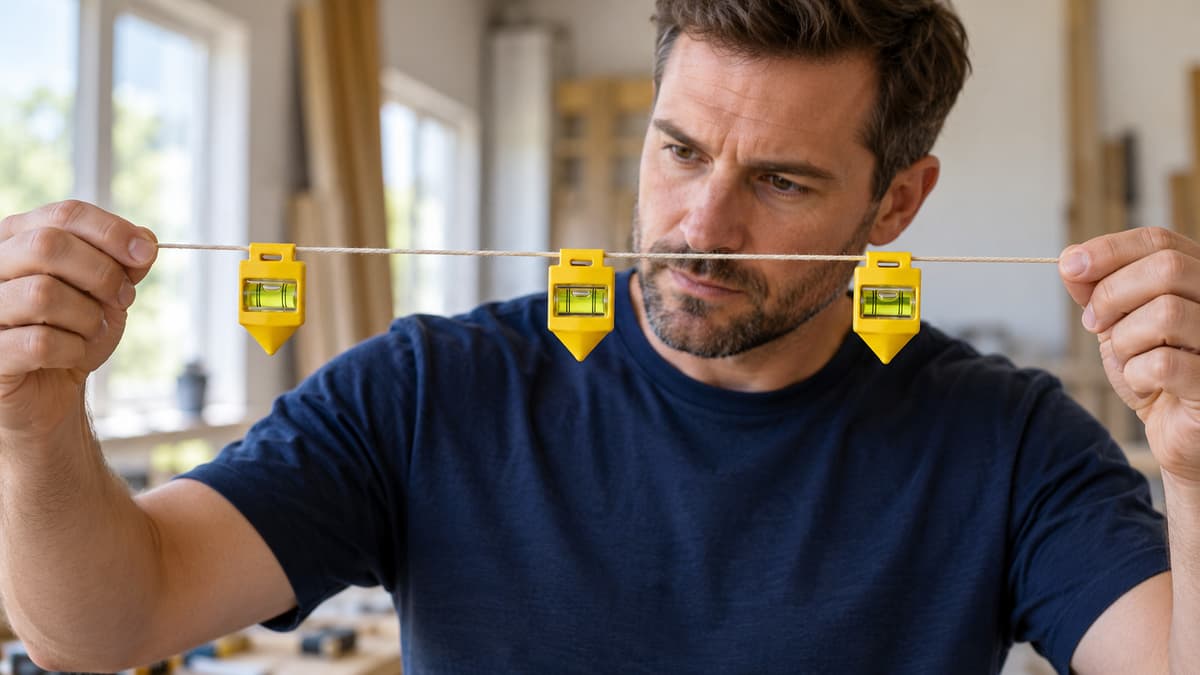
You clip two new line levels onto the same taut string, and one bubble sits between its marks while the other leans towards an end line. That is not a result you can average. When line levels are not reading the same, separate a bad set-up from a bad vial, body or pair of hooks. A line level is a suspended tool, so it has to agree on a stable surface and when it hangs as its maker intended. A ten-minute check on the day the pack arrives can stop a fence line, brick course or row of fixings from inheriting a small, repeated error.
In short
Compare every level in one marked position on the same taut line, facing the same way. Then reverse each one and test its body on a stable surface. If the bench result and the hanging result conflict, suspect the hooks or the way the body sits on the line. If the pack cannot repeat one reading, do not average it.
What disagreement actually looks like
Control the position before you compare the bubbles. A tool near a support and another halfway along a sagging span are not measuring the same slope. Mark a section of string a little longer than the level, place each tool there in turn and view the vial from directly above. Let the bubble settle, then record where it sits against the two lines.
True disagreement is repeatable. In the same marks and orientation, one level may keep the bubble left of centre while the next centres it. UK reviews of inexpensive multi-packs report one, three or four tools in a seven-pack failing to agree. Those reports are not laboratory measurements. Seven in the packet is not seven dependable references.
Ignore a tiny shift caused by viewing angle. A curved vial can make the bubble look displaced from the side, and a moving line makes a fine comparison pointless. Look for a clear, repeatable change. If the result changes every time you touch the string, fix the set-up before you blame the tools.
Why vials from one pack disagree
A shared moulding run does not calibrate the tools as a matched set. The vial can sit at a slightly different angle in each plastic body, the body can be twisted, or the moulded supports can hold one end higher. A loose vial can shift after handling. One buyer described filing and gluing a loose vial. That repair is not evidence the original tool was accurate.
Hook depth, spacing and shape decide how the body hangs on the string. A small moulding difference can rotate one level even when the vial looks right on a bench. Thick braided line can sit differently in narrow hooks from thin brick line, so a pack can agree on a flat surface and still split once it is suspended.
Builders line stretches and sags, especially on a long span or under several tools. Wind moves the vial and the string together, and a knot, fray or twist under one hook can tilt the body. Test one tool at a time on a short, sheltered, taut span. The string spirit level guide shows where this tool fits.
The top pick there is the Presch 2-piece line spirit level, model 10211, at about £11.99, with 4.3 from 704 amazon.co.uk reviews. It has counter hooks, a flat underside and a V-groove, and no cord in the box. In the first 50 UK texts, one reviewer shows one bubble centred and the other off to the right. The listing says 8 cm by 3.5 cm and 10 g, with no millimetres-per-metre figure. A qualifying purchase can earn a commission at no extra cost to you.
Why a bench test is not enough
A bench test asks whether the vial agrees with a face on the body. Put the level on a clean, stable surface, note the bubble, turn it end for end on the same spot and compare again. A substantial shift means the body-and-vial assembly is not repeatable. Running that check on every tool can expose an obvious outlier.
A small line level often has no machined sole. Grit, a moulding seam or a raised logo can change how it rests, so a bench result is a clue, not a certificate that the tool will hang correctly. The bench supports the body and the job supports the hooks. A UK review described a level whose reading on its back did not match the reading from its hooks. If you use the tool on string, the hanging check carries more weight.
How to test line-level hooks
Set up a short run of the line you will use, between rigid supports and out of the wind. Pull it taut without damaging it. Mark one test position with two pieces of tape, and keep knots and frayed fibres outside those marks. Leave room for the hooks to seat, on a span that does not dip.
- Hang the first level in the marked position, labelled side towards you. Let it settle and note the bubble.
- Remove it without changing the tension. Place the next level in the same position and orientation, and repeat for every tool.
- Hang the first level again, so you know the string and supports have not moved.
- Turn each tool end for end in the same marks, with the same face towards you. See whether the bubble reverses, stays centred or jumps.
- Bench-test any outlier, then hang it again. A repeatable difference between those modes points to the hooks or the suspended angle.
Use one level at a time. Several bodies add weight, deform the line and may touch. A side-by-side hang is only a warning. If you need to reduce sag first, follow how to use a string spirit level. The hook test shows agreement on your set-up. It is not traceable accuracy to a professional standard.
What the flip test proves
The spirit level flip test was designed for a rigid level on the same two marked points. Note the bubble, rotate the level 180 degrees end for end, and put it back on those points. Manufacturers use that reversal because a correctly adjusted tool should give the same indication both ways, within its stated tolerance.
On a box or I-beam level, keep the same working face down. Another face or another vial is a different test, and dirt, a bow or moved marks can make a sound level look faulty. A line level needs both reversals: on a stable reference for the body and vial, and hanging for the hooks. If it passes the first and fails the second, the hooks are the leading suspect. If it fails both, the vial or its mounting may be out. The string spirit level buying guide covers why construction matters in a replacement.
What to do with a mixed pack
Do not average disagreeing levels. Three bubbles one way and four the other do not reveal true horizontal. They show that the pack is not a dependable reference. Majority rule has the same flaw: several tools can share one moulding error, and a lone outlier could theoretically be the accurate one.
A trusted reference can show which tools agree with it. A sound long spirit level on a rigid board is more useful than comparing unknown tools only with each other. Check that reference end for end first. Moving a rigid horizontal plane onto a flexible line adds fresh error.
Stop using a new mixed pack, keep every part, and photograph the marked line, the readings and any loose vial or malformed hook before you file, glue or bend anything. Modification removes evidence a return may need. If the pack is faulty or not as described, follow the retailer's process. Your rights if a level is not level sets out the practical next steps. A new multi-pack should not have to be sorted into a reliable set.
What these tests do not prove
Agreement is not absolute accuracy. Two levels can share an offset, and a short vial cannot tell you how far the string drops between supports. A reviewer's claim of roughly 2 mm over 10 m is not a laboratory result or a specification. Let a cold tool settle, reject a vial that stays split, stuck or loose, and retest after a knock. Where a small error becomes costly, check with a longer level, a laser or a measured datum. A pack that agrees with itself still leaves the limits of the string, the short vial and your viewing angle.
Common questions
Why do two line levels from the same packet disagree?
Is a bench test enough for a line level?
Should I test a line level from its hooks?
What does the 180-degree flip test prove?
Can I keep the line levels that agree and discard the rest?
Does a high star rating mean every level in the pack agrees?
Is a split bubble the same as an inaccurate vial?
When should I return a pack of line levels?

Peter F. is the editor for DIY & tools at productscompared.co.uk. Comparisons in this category are checked against amazon.co.uk listings, review evidence and public UK sources.
Related articles

Builders line sag: how to keep your line true
A dipping builders' line moves the bubble. Tension, supports and line weight come first.
How often to check a spirit level: practical triggers
Check a pack when it arrives, after a drop, and before a job where the line is the datum.
Consumer Rights Act faulty goods: your 30-day rights
A new level that fails a careful check is a faulty-goods question, including the 30-day right to reject.