Independent comparisons. We may earn from shop links. More info

Half-moon or saw-tooth lawn edger: which blade?

Updated: October 2026

Choose a smooth half-moon or saw-tooth lawn edger according to what interrupts the cut, not according to which shape looks more aggressive. A smooth or pointed half-moon suits a maintained lawn edge and a new flowing line; a serrated head is worth considering when small roots and a neglected verge are the recurring problem. Teeth do not rescue a blunt blade, weak weld or baked soil. You can compare specific shafts, weights and saved GBP prices on the [main lawn edger comparison](/hub/lawn-and-garden-equipment/lawn-edger). A qualifying purchase through our links can earn a commission at no extra cost to you.

Choose a smooth half-moon or saw-tooth lawn edger according to what interrupts the cut, not according to which shape looks more aggressive.

Our top picks

On this page

Two shapes for one vertical cut

Both designs make the same basic cut: a vertical soil face between turf and a bed, path or gutter. A traditional edging iron normally has a smooth half-moon or pointed crescent. A saw-tooth model adds serrations around some or all of that curve, while V and double-V listings arrange larger teeth into a more angular cutting edge. A V-blade is therefore a serrated crescent variant, not a third scientific tool class with a guaranteed performance level. Smooth heads rely on a continuous sharpened edge. They are easy to place along a marked curve because there are no teeth trying to catch at different points. Serrated heads aim to maintain local pressure at their points and saw across fibrous material as you rock the tool. Construction still matters. This comparison contains smooth one-piece irons, serrated one-piece tools and bolted serrated step edgers. Use the lawn edger buying guide if shaft, tread and weight remain undecided.

Maintained edge or a newly marked line

A smooth half-moon is the straightforward choice for restoring a border whose line is already clear. It makes a continuous slice through ordinary turf, is easy to overlap and lets you judge a curve against string or a hose. The 92 cm Spear & Jackson Select Carbon illustrates this type: it is a one-piece, 800 g carbon-steel iron with treaded shoulders. It is an example of the format, not proof that every smooth blade will arrive sharp or resist misuse. The English Garden observed in its own tool trial that serrated blades tended to be fully semi-circular, while smooth blades often came to a point and were arguably better for breaking new ground. That magazine tested its own set rather than the nine amazon.co.uk listings here. Choose the smooth form if your main work is a crisp, maintained boundary or a sweeping new curve in workable soil. Detailed technique belongs in our how to edge a lawn guide.

Roots, stones and a neglected verge

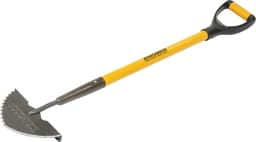
Serrations become useful when fine roots or dense, matted turf repeatedly bridge a smooth cut. The one-piece Roughneck pairs a serrated carbon-steel head with a fibreglass shaft; saved reviewers often praise it on turf and roots. Byhagern and the 96 cm Colwelt add wide foot platforms and saw-tooth heads, with review patterns that include progress through dense ground. These are owner observations, not a controlled trial of equal sharpness. There is an important counterexample. Some Colwelt saw-tooth reviewers say the teeth were too blunt and that they rocked the head or returned to a spade. YHZMZHY also uses a serrated profile, yet its saved reviews include a weld failure and a blade bending within minutes. Tooth shape cannot compensate for poor edge preparation, a weak head connection or missing fixings. If dry clay or frozen ground is the real obstruction, use the hard-ground troubleshooting guide instead of treating serrations as a cure.

Which blade to buy, and when shape does not matter

For maintained turf and a new flowing line, buy a smooth or pointed half-moon with a shaft length and tread you can control. For a rooty or stony neglected verge, choose a serrated model only after checking that its reviews do not show a recurring folding head, failed weld or blunt edge. That is the decision: condition first, shape second, construction alongside both. One good smooth iron can maintain most domestic borders, and a serrated model is justified only if roots repeatedly make that job inefficient. RHS guidance points to about 7.5–8 cm, roughly 3 inches, whether the edge is smooth or serrated. A heavier tool does not automatically cut better: the Byhagern weighs 2.16 kg, while the one-piece Roughneck is 1.3 kg.

Common questions

Which shape leaves the crisper line on a neat lawn?
A sharp smooth half-moon usually gives the simplest continuous cut on a maintained edge. It is easy to place and overlap along string or a hose. A sharp serrated head can also cut cleanly, but its advantage is more relevant when fibrous roots interrupt the line.
Which blade is better for a verge full of roots?
A serrated head can help saw through fine roots and dense turf, provided the teeth are sharp and the head is rigid. Do not use it on substantial woody roots or assume it will survive stamping in dry ground. Expose larger roots and decide whether professional advice is needed.
Is a V-blade the same as a saw-tooth blade?
It belongs to the same broad serrated family. V or double-V models use larger angled points rather than a row of smaller saw teeth. The label does not specify steel hardness, sharpness or strength, so judge the complete head, shaft and review pattern.
Can saw teeth be blunt?
Yes. Saved UK reviews for one Colwelt saw-tooth model say the teeth did not arrive sharp enough and some users returned to a spade. Serrations still need an effective cutting edge; the shape alone cannot force a clean line through resistant soil.
Does a pointed smooth blade start a new edge more easily?
It can. The English Garden noted that smooth blades in its trial often came to a point and were arguably better for breaking new ground. Treat that as an observation from its tested set, not a universal rule for every smooth edger.

Related pages

Sources

Sources from the research digest, last checked on 22 October 2026. Shelf prices, star lines, dimensions and materials are from the retained amazon.co.uk listings.

  1. RHS, how to create a lawn edge (retrieved 22 October 2026)
  2. RHS, how to maintain lawn edges (retrieved 22 October 2026)
  3. RHS, June lawns (retrieved 22 October 2026)
  4. The English Garden, best lawn edgers, updated 23 April 2025 (retrieved 22 October 2026)
  5. GOV.UK, outdoor equipment noise (retrieved 22 October 2026)
  6. Consumer Rights Act 2015, section 9 (retrieved 22 October 2026)
  7. GOV.UK, General Product Safety Regulations 2005 (retrieved 22 October 2026)
  8. HSE INDG143, Manual handling at work (retrieved 22 October 2026)