Independent comparisons. We may earn from shop links. More info

Lawn edger buying guide for UK gardens

Updated: October 2026

If your border has begun to creep into a path or flower bed, this lawn edger buying guide helps you choose the tool that cuts the soil face rather than merely trimming loose grass. A half-moon edging iron, edging shears and a strimmer all work near a lawn edge, but they do different jobs. Decide which job you need before comparing steel, shaft length or price. Our [lawn edger comparison](/hub/lawn-and-garden-equipment/lawn-edger) lists nine manual tools on amazon.co.uk, with saved prices from about £12.99 to about £29.99. A qualifying purchase through our links can earn a commission at no extra cost to you.

If your border has begun to creep into a path or flower bed, this lawn edger buying guide helps you choose the tool that cuts the soil face rather than merely trimming loose grass.

Our top picks

On this page

What you are actually buying

A manual lawn edger cuts a vertical face between turf and a bed, path or gutter. You place a boot on its tread, press the half-moon or serrated head into the soil and make overlapping cuts. That is different from edging shears, which trim grass blades hanging over an edge that already exists. The Royal Horticultural Society describes redefining the soil face with a half-moon and then holding shears upright to maintain the overhang after mowing. Permanent metal strip stays in the ground as a barrier, whereas an edging iron is removed after each cut. A flat-backed spade can mark a new line, but its longer blade may remove more soil than you intended. If you have already settled on a manual cutter but not the blade, our half-moon or saw-tooth comparison deals with that choice.

Tread, length and the carton trap

The tread must give your boot a stable place to apply pressure without encouraging you to jump. Traditional irons such as the 92 cm Spear & Jackson have shoulders either side of the head; step edgers use a wider platform or pedal. A broad platform can feel more secure on a neglected verge, but it adds material and often weight. It cannot make baked soil receptive to a blade, so wait for better moisture instead of stamping harder. Claimed working lengths in this set run from 92 to 110 cm. Read Amazon dimensions carefully. The Jardineer listing shows a 43 cm package, not a 43 cm working shaft. One Colwelt parcel is about 40 cm long because the shaft arrives in sections. The YL title claims 94 cm while another item-dimensions field says 30 x 15 x 2 cm, an unresolved conflict rather than evidence for a miniature edger.

One-piece iron or bolted step edger

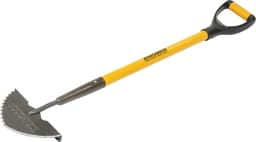
A one-piece shaft removes the assembly question and eliminates several joints that can loosen. The Spear & Jackson uses tubular steel in one piece, while the 1000 mm Roughneck combines a fibreglass shaft with a serrated carbon-steel head and is listed as requiring no assembly. A one-piece design is still not unbreakable: saved reviews include bends or breaks for both models, particularly when users encounter resistant ground. Bolted shafts make a full-length tool easier to pack and deliver. Colwelt, Jardineer, YL and YHZMZHY listings use sections, screws or bolts; some include two small spanners. Missing bolts appear in the weakest review record, while some buyers dislike movement at the joints. Choose one piece when immediate use and fewer parts matter more than compact delivery. Choose a sectional step edger when you want its broad footplate and will assemble and inspect it. Do not treat three sections as a strength claim, or one piece as permission to lever the shaft sideways.

Steel, weight and price bands

Carbon steel can take a useful cutting edge, but it should be cleaned and dried after use. A stainless claim may reduce maintenance, yet it does not prove that a weld is strong. None of the retained listings gives a steel hardness or a relevant British Standard, so do not infer those details from professional, heavy duty or upgraded in a title. Weight ranges from 800 g for the Spear & Jackson to about 2.16 kg for the Byhagern. A heavier head can feel planted underfoot, but you must lift and reposition it for every overlapping cut. The saved amazon.co.uk prices put entry models at about £13–£17 and most mid-range tools at about £21–£30. Manual edgers need no UK plug, battery or outdoor sound-power label: they are hand tools.

Common questions

Do I need a strimmer instead?
Choose a strimmer for fast control of long grass around obstacles. Choose a manual edger for a precise soil line beside a bed or path. A strimmer can scorch or scalp the edge if held badly, and it does not usually create the defined gutter that a half-moon produces.
What shaft length should I choose?
Choose a length that lets you place the head vertically while keeping a comfortable back and relaxed shoulders. The retained listings claim about 92–110 cm, but body proportions and tread position matter. If dimensions show about 40 cm, check whether that is the carton rather than the assembled tool.
Is a heavier lawn edger always stronger?
No. Weight may help a head feel steady, but strength also depends on steel thickness, head geometry, weld quality and shaft joints. A heavier sectional tool can still twist or bend. Select a weight you can repeatedly lift and place without losing control.
Does a manual lawn edger need a UK plug?
No. Every product in this comparison is manually powered, so there is no BS 1363 plug, voltage or battery to check. You still need closed footwear, a stable tread and a clear cutting line, particularly near paving, roots or possible buried services.
When is a spade enough?
A sharp flat-backed spade can mark a new border or handle an occasional small job. A half-moon gives a shorter, more controlled cut and is easier to overlap along an established line. Whichever you use, see how to edge a lawn before pressing into the soil.

Related pages

Sources

Sources from the research digest, last checked on 22 October 2026. Shelf prices, star lines, dimensions and materials are from the retained amazon.co.uk listings.

  1. RHS, how to create a lawn edge (retrieved 22 October 2026)
  2. RHS, how to maintain lawn edges (retrieved 22 October 2026)
  3. RHS, June lawns (retrieved 22 October 2026)
  4. The English Garden, best lawn edgers, updated 23 April 2025 (retrieved 22 October 2026)
  5. GOV.UK, outdoor equipment noise (retrieved 22 October 2026)
  6. Consumer Rights Act 2015, section 9 (retrieved 22 October 2026)
  7. GOV.UK, General Product Safety Regulations 2005 (retrieved 22 October 2026)
  8. HSE INDG143, Manual handling at work (retrieved 22 October 2026)