Electric patio heater vs gas: pick by the shelter you have
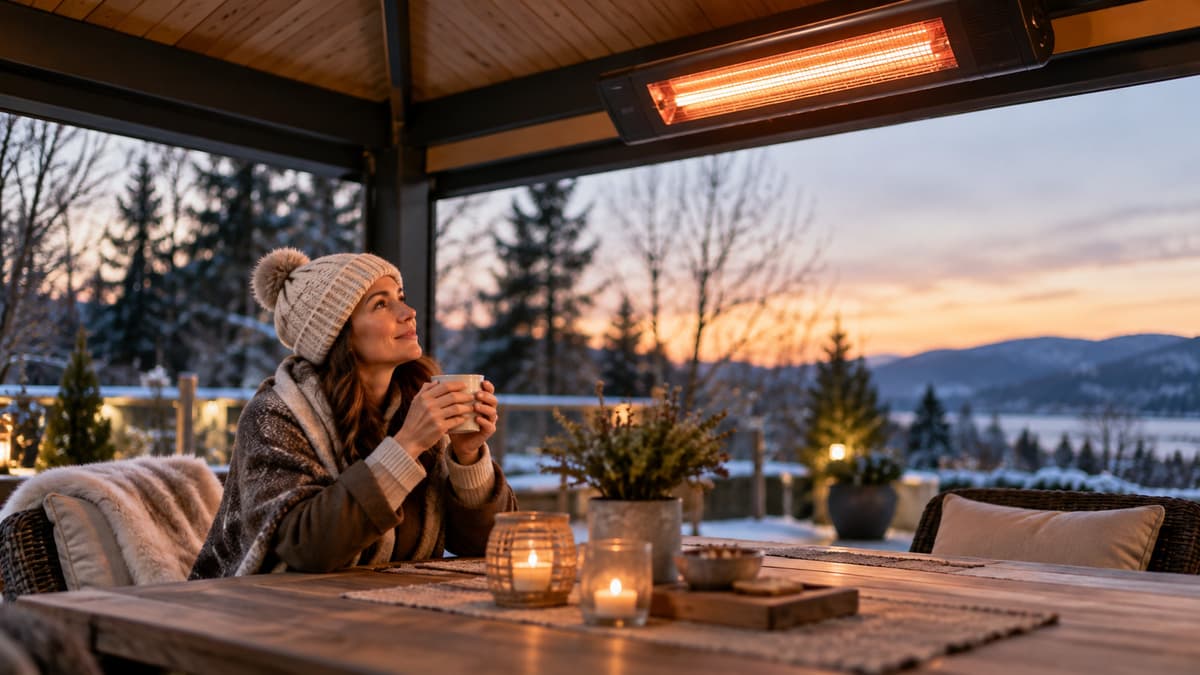
Electric patio heater vs gas: what 2 kW costs on the Ofgem unit rate, when a gazebo still needs ventilation, and which outdoor listing to trust.
On this page
In short
You are under the gazebo, the table is cold, and the choice in front of you is an electric patio heater vs gas. A no-flame electric heater needs no gas patio heater bottle and leaves no exhaust under the roof. Gas can still put more heat on an open, windy seat, so choose by the shelter you have and by whether you will store a bottle.
What each heater actually warms
A glowing outdoor infrared heater puts its heat on the people and the chairs in front of it. Your skin and your jumper take the beam. The air barely holds that warmth, and a breeze takes what little does warm. Step half a metre aside and the effect drops off. Glowing patio heaters are not home panels, which is the distinction the Energy Saving Trust draws. You feel the glow where it strikes. You do not heat the garden.
A claim that electric heat is 100% efficient only means the electricity becomes heat somewhere. It is not a test of these patio heaters, and it is not a promise you will feel warm in a wind. A lot of that heat misses you, or lands on you and is then stripped away.
A bottled gas heater is built for a wider throw. The flame, or the large head above the bottle, covers more of a table than a slim 2 kW bar, and it can still feel stronger when the patio has no walls. The heat and the exhaust arrive together. That extra output is why gas stays in the conversation on an exposed site, and why you cannot wrap the heater in side sheets because the evening turned colder.
The same comparison also lists indoor heaters. The top pick is the Warmlite WL42013, a freestanding indoor carbon tower at 500 W or 1,000 W, listed at £56.46 and weighing 2.2 kg. It oscillates through 70 degrees and belongs in a room. A gazebo roof does not turn it into a patio heater.
Bottles, flames and a covered roof
Under a gazebo the simpler machine is electric. You are not walking a gas patio heater bottle up the path, checking a hose, or sitting a flame under a fabric or polycarbonate roof. For a covered patio the usual job is two to four people, on seats you can aim at, for a couple of hours after dark. You switch it off from the seat, and nothing has to be shut at a valve.
Open sides and a high roof are still a canopy. Exhaust from the flame has to leave. Drop the side panels, zip a door, or sit under a low roof, and you have the enclosure patio-gas instructions warn against. Carbon monoxide does not care that the air felt fresh when you lit the burner. The risk grows when you close the gaps because you are cold.
Use the clearance printed for the gas heater you own. One distance does not fit every mushroom. If those instructions forbid tents, marquees and semi-enclosed spaces, a gazebo with walls is included. Store the bottle upright and outside, shut the valve when you finish, and keep the spare away from the flame. Divide the refill by the hours you actually got before you call gas cheaper.
Electric removes that exhaust. It does not remove the weather. A roof blocks rain that falls straight down. Wind still wets the head, the hem drips, and the plug gets wet. An IP65 patio heater is sold as able to resist water jets. IPX4 means splashes, a lower test. The Pro Breeze claim is IP65 only with an IP65 outdoor socket, and that socket still wants RCD protection. An indoor trailing socket under the bench completes neither rating.
What 2 kW costs per hour
The infrared patio heater running cost is the watts times the unit rate. The rate used here is 26.32p per kWh, Ofgem's price-cap figure for 1 October to 31 December 2026. A 2 kW heater uses 2 kWh in an hour, so 2 times 26.32p is 52.64p, about 52.6p an hour. That 2kW hourly cost leaves out the standing charge. Three hours, from seven until ten, is about £1.58. A true 1 kW setting is about 26.3p an hour.
Your tariff can disagree with 26.32p. Read the unit rate on the bill and multiply again. Three times 26.32p is 78.96p, about 79p an hour, which is why 3 kW is another purchase. At 230 volts, 3,000 W is about 13 amps, the top of a normal UK 13 amp plug. A 2 kW bar is about 8.7 amps. A coiled extension reel is a bad place to leave that load, because the coil holds heat a straight lead would shed. See a 3 kW heater and a 13 amp plug.
Those pence do not prove electric is the cheaper fuel. Divide the refill by the hours the bottle lasted at the flame you used, and set that figure next to 52.6p. Until both numbers exist, electric's advantage is a known rate and nothing flammable to store. Gas's advantage is more heat on an open site. The same sum for a panel is in what an infrared heater costs to run.
Outdoor listings to check
The outdoor names on the infrared heater comparison are Harrier, Pro Breeze, Devola and SOUTHEATIC. Prices are listing prices and they move. The best-value outdoor model is the Harrier 2,000 W patio heater at £48.99: wall or floor, three heat levels, a head that tilts from flat to 45 degrees, about 211 cm and 9 kg, IPX4 splash resistance, and a 1.8 metre lead that buyers call too short. The listing does not publish the watt split, so budget the evening at 2 kW.
The Pro Breeze PB-H16-UK is £79.99, a halogen bar at 1,000 W and 2,000 W for wall or ceiling, with a remote, a 182 cm cable and a weight of about 1.9 kg. Its IP65 claim stands only with an IP65 outdoor socket. SOUTHEATIC's T10-GR20B is £99.99 at 2,000 W, with IP65 claimed, two speeds, and a remote whose battery is not in the box. The freestanding T20-GR20 is £139.99, again 2,000 W carbon, with eight heat levels, an eight-hour timer, and the same missing battery.
The SOUTHEATIC TW30R is the 3,000 W wall or ceiling halogen at £179.97, with 1,000 W, 2,000 W and 3,000 W settings and IP65 claimed. That listing had eleven reviews. The top setting is the 79p hour and the 13 amp load. Devola's DVPH2000B at £109.99 says 2,000 W, IP65 and Wi-Fi in the title, and 1,200 W, IP24 and one speed in the table. The DVPH2400B at £119.99 says 2,400 W and IP65 in the title, and 1,200 W again. A remote and a 24-hour timer appear in the bullets. At 1,200 W the hour is about 31.6p. Plan on the table.
When to pick electric or gas
Choose electric when the seat is covered or out of the main wind, when you will not store gas, and when people can sit inside one beam. A 2 kW bar or the Harrier tower is about 52.6p an hour on the 1 October to 31 December 2026 cap, if the socket is close enough for the lead. You have heated the sitters, not the air in the garden.
Choose gas when the patio is open, the table is large, and you already accept a bottle, a regulator and a hose. One electric heater does not replace a large gas mushroom there. Two 2 kW bars, both flat out, come to about £1.05 an hour and need two sockets the leads can reach. That can suit a long covered wall. It is a poor imitation of one flame on a round, windy table.
After delivery, people close the gazebo sides because they are cold, which is when the exhaust stops leaving. They buy the indoor Warmlite at £56.46 and stand it on wet flags. They run 2 kW or 3 kW through a coiled reel because a 1.8 metre lead stopped short. They pay Devola prices for 2,400 W after the table has said 1,200 W. If the gas instructions ban the space, believe them. If a 3 kW load is about to land on an old outdoor socket, ask an electrician.
Common questions
Which is warmer on an open patio?
Which is simpler under a gazebo?
What does 2 kW cost per hour on the current cap?
Do I still need an IP rating if the gazebo has a roof?
Is there a carbon monoxide risk with electric?
Can one electric heater replace a large gas mushroom?
Are the Devola watts trustworthy?
Where is the product comparison?

Products Compared publishes British-English buying guides based on amazon.co.uk listings and public UK sources. We do not run a lab and we do not invent test scores.
Related articles

What an infrared heater costs to run
Turn a nameplate wattage into pence per hour on a British unit rate, including a 2 kW patio heater.

A 3 kW heater and a 13 amp plug
Why a 3 kW patio setting sits at the top of a 13 amp UK plug, and why the lead has to match.

Condensation before you buy another heater
Warming a cold wall is a different job from drying a damp room or replacing ventilation.