Infrared heater running cost: what you pay per hour

Turn nameplate watts into an infrared heater running cost in pence per hour at the Ofgem unit rate, with the standing charge kept out of the sum.
On this page
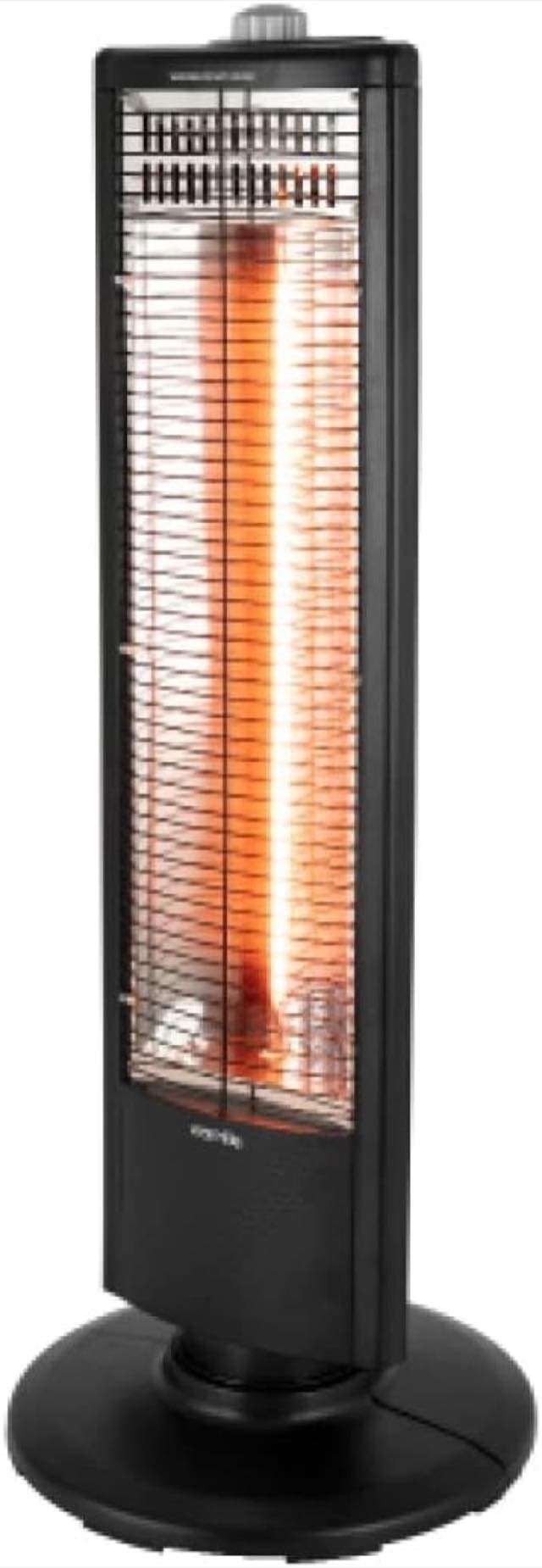
A 450 watt panel and a 2 kilowatt patio heater can both be sold as infrared. The hourly cost still comes from the rating plate. The infrared heater running cost for a flat-out hour is the power in kilowatts multiplied by the unit rate you pay, in pence. That multiplication is the whole sum.
Ofgem's average Direct Debit unit rate for 1 October to 31 December 2026 is 26.32 pence per kilowatt-hour in England, Scotland and Wales. The standing charge of 54.83 pence a day stays outside every hourly figure below. Products Compared has not metered a heater in a lab. The wattages are the bands on the amazon.co.uk shortlist. A purchase through a link can earn us a commission, at no extra cost to you.
In short
An infrared heater running cost, in pence for one hour, is nameplate kilowatts times your unit rate. At 26.32 pence per kilowatt-hour, a flat-out hour is 11.8 pence at 450 watts, 26.3 pence at 1 kilowatt, 52.6 pence at 2 kilowatts and 79.0 pence at 3 kilowatts. Those figures leave out the standing charge, and they assume the heater stays at full power for the whole hour, which a thermostat will often refuse to do.
The sum is watts times the unit rate
You turn watts into pence per hour by dividing the watts by 1,000, then multiplying by the unit rate. A 1,000 watt heater is 1 kilowatt, so one flat-out hour at 26.32 pence costs 26.32 pence, shown as 26.3 pence. A 450 watt panel is 0.45 kilowatts, and 0.45 times 26.32 pence is 11.844 pence, shown as 11.8 pence.
Use the unit rate on your bill whenever it is not 26.32 pence. The Ofgem figure is an average for Direct Debit in England, Scotland and Wales for this quarter, so a small panel and a patio heater can share one public number. If your statement says 24 pence or 31 pence, multiply by that figure. Twice the watts still costs twice as much while both heaters are flat out. Dividing 450 watts by 100, instead of by 1,000, pretends the panel is 4.5 kilowatts and prices the hour at 118 pence rather than 11.8 pence. The label is the ceiling for this sum, not a live meter.
A table for the heaters in this shortlist
One flat-out hour at 26.32 pence per kilowatt-hour costs 11.8 pence at 450 watts, 26.3 pence at 1,000 watts, 52.6 pence at 2,000 watts and 79.0 pence at 3,000 watts. The unrounded working is 11.844, 26.32, 52.64 and 78.96 pence. The rows are not four tariffs and not a promise about what a listing will draw in your room.
- 450 W is 0.45 kW, and a flat-out hour is 11.8 pence
- 1,000 W is 1.0 kW, and a flat-out hour is 26.3 pence
- 2,000 W is 2.0 kW, and a flat-out hour is 52.6 pence
- 3,000 W is 3.0 kW, and a flat-out hour is 79.0 pence
Add a row only if you would run both heaters in the same hour. Energy Saving Trust describes typical infrared panels as about 350 to 900 watts, so the 450 watt row sits in that band and 1,000 watts sits just above it. The 2,000 and 3,000 watt rows are closer to a patio heater, and the pence scale with that difference. The units sit side by side in the infrared heater comparison.
A 500 watt heater is 13.16 pence for a flat-out hour at this rate, standing charge excluded. Checkatrade's guide says about 13 pence an hour for 500 watts on its own tariff example. The 2 kilowatt patio heater running cost, flat out, is 52.6 pence an hour: two hours about £1.05, three hours about £1.58. You pay that only if the element stays at 2 kilowatts. Outdoors the meter still records the full draw.
At 3 kilowatts the flat-out hour is 79.0 pence. Two hours are about £1.58, the same as three hours at 2 kilowatts, because both are 6 kilowatt-hours. That load is also about 13 amps at 230 volts. Whether the lead should carry it is a separate check, in a 3 kW heater and a 13 amp plug.
What the sum leaves out
Ofgem's standing charge for this quarter is 54.83 pence a day. It pays for having the supply and does not sit inside the 11.8 or 52.6 pence. Switching the panel off leaves it on the bill, and a second heater does not double it. Spread across 24 hours it is a little over 2 pence an hour, which is still not a heater cost.
Treating 54.83 pence as if it were a unit rate, then times 2 kilowatts, invents about 110 pence for an hour that actually costs 52.6 pence of electricity.
The 26.32 pence figure describes Direct Debit in England, Scotland and Wales for 1 October to 31 December 2026. In Northern Ireland, on a prepayment meter, or on a fixed deal, use the unit rate on your own bill. A fix can sit above or below the cap.
Four flat-out hours of the 450 watt panel cost 47.4 pence. Forty such hours cost about £4.74. That sketch collapses when a thermostat, a timer or an open window cuts the running time, and it expires when the next price cap replaces 26.32 pence. A meter reading before and after a known hour, with other large loads off, is the figure you can reconcile.
When a dearer heater can cost less
The rating plate is a maximum. A thermostat cuts kilowatt-hours, not the price of each kilowatt-hour. Infrared does not get a private discount. Energy Saving Trust finds little research that infrared panels beat other electric panel heaters on that score.
A 1 kilowatt panel on for 20 minutes has used about a third of a kilowatt-hour, about 8.8 pence, against a nameplate hour of 26.3 pence. If the room never reaches the set temperature, you still pay 26.3 pence. Four hours of a 450 watt panel cost 47.4 pence. Twenty minutes of a 2 kilowatt heater cost about 17.5 pence. The same four flat-out hours at 2 kilowatts cost about £2.11. The cheaper large heater was an off-time story.
A patio heater in a breeze may never satisfy a thermostat, so the 2 kilowatt hour stays near 52.6 pence. Compare flat out with flat out when you choose a wattage, and apply a fraction of the hour only when you can say which fraction you assumed.
Infrared against gas central heating
This page does not award a saving to infrared against gas central heating. Energy Saving Trust treats electricity as the dearer fuel and warns against replacing gas central heating wholesale with infrared panels. It also finds little evidence that infrared panels beat other electric panels. No gas unit rate is calculated here.
A 450 watt panel for a few hours is a small electric load. A boiler feeding every radiator is a whole-home system. The panel can look cheap and still be a poor swap. 52.6 pence an hour is the cost of 2 kilowatts of electricity, not proof that a patio heater is more efficient than gas. A gas bottle has its own price and its own combustion under the gazebo. Electric or gas for a patio heater is the place for that choice. If a seller cannot show the wattage, the hours and the unit rate, the saving is not a bill you can check.
Why two websites quote different pence
This page locks every row to 26.32 pence per kilowatt-hour for one quarter. At 30 pence per kilowatt-hour a 2 kilowatt heater is 60 pence an hour, against 52.6 pence here. Only the rate on your bill is your cost. After 31 December 2026, 26.32 pence retires with the cap.
About 13 pence an hour in the Checkatrade guide belongs to 500 watts and to their example tariff. Half of 26.3 pence is also about 13 pence, which is a 1 kilowatt heater running for thirty minutes. The pence match and the heaters do not.
Folding 54.83 pence a day into one hour bills the heater for a charge you pay when it stays off. Quoting a three-hour sitting as an hour makes a 2 kilowatt heater look three times too expensive. On this page the figure is one hour, flat out, standing charge excluded.
Common questions
How do I turn watts into pence per hour?
Does the standing charge sit inside that hourly figure?
Is a 2 kW infrared heater four times the cost of a 500 W one if both run flat out?
Will a thermostat lower the sum?
Is infrared cheaper than gas central heating?
Does the Great Britain cap apply in Northern Ireland?
Why do two websites quote different pence for the same heater?

Products Compared publishes British-English buying guides based on amazon.co.uk listings and public UK sources. We do not run a lab and we do not invent test scores.
Related articles

Electric patio heater vs gas: pick by the shelter you have
Gas can throw more heat outdoors. Electric is simpler, with no combustion under a gazebo.

3kw heater 13 amp plug: what a long session asks of the socket
A 3 kW heater draws about 13 amps, at the top of a normal UK plug.
Bathroom zones electric heater: read the plate first
A panel sold for bathrooms can still be unsafe in the wrong zone.