KR1 KR2 body armour: what the UK knife levels mean
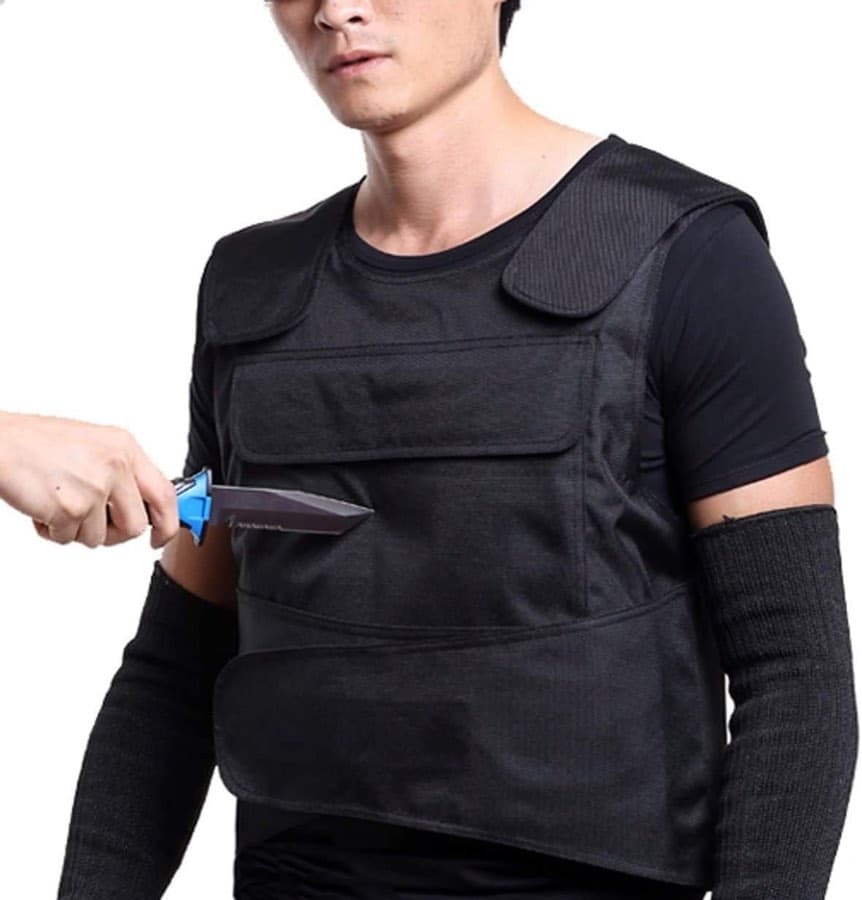
KR1 KR2 body armour sets KR1 at 24 joules and KR2 at 33 on the UK Home Office E1 knife test. Those letters belong on a certificate, not only in a title.
On this page
You are looking at two vests that seem almost identical, but one seller says KR1, another says 24 J, and a third simply says Level 4. Those phrases are not interchangeable. For KR1 KR2 body armour, the useful starting point is that KR means knife resistance under a UK Home Office standard: KR1 has a 24-joule E1 test and KR2 has a 33-joule E1 test.
In short
KR1 and KR2 are defined knife-resistance levels, not general claims that a garment is “stab proof”. A level only helps you assess a product when the label, exact model and certification evidence agree, and neither KR level automatically includes spike or ballistic protection.
The two knife levels
The 2017 Home Office body-armour standard sets out KR1 and KR2 for knife resistance. At the E1 test point, KR1 corresponds to 24 joules and KR2 to 33 joules. Joules measure impact energy, so the numbers describe a controlled test condition; they are not percentages, blade lengths or a count of blows a vest will always stop.
The test also includes a more demanding E2 overtest at an energy 50 per cent above E1. That makes E2 useful as a margin within the test programme, but it does not turn armour into a guarantee against every weapon, angle or real-world attack. The Home Office guidance does not promise zero penetration or 100 per cent protection, and knife levels allow limited penetration, which is why “knife resistant” is more accurate than “knife proof”.
KR2 is tested at a higher energy than KR1, but the larger number is not automatically the better purchase for you. Extra protection can affect weight, thickness, flexibility, heat and cost, while poor fit can leave the panel sitting away from the area it is meant to cover. Start with a proper risk assessment, then compare products whose documented level addresses that risk. Our stab-protection vest comparison can help you separate stated protection claims from sports padding and vague marketplace wording.
Spike is a different letter
A knife blade and a narrow spike do not challenge material in exactly the same way. In the Home Office system, knife resistance is marked KR, while spike resistance is marked SP. SP1 and SP2 therefore describe a separate threat and test; KR1 does not silently include SP1, even when a seller discusses the two together.
Some armour is tested and labelled for both threats. In that case you should expect to see both relevant markings, rather than assuming a knife-rated panel must also resist an improvised spike. This distinction matters for security staff and others whose risk assessment includes pointed objects that concentrate force over a much smaller area than a conventional knife blade.
What the label has to carry
The label is where a broad sales claim becomes traceable information. Home Office guidance requires the protection level to be identified and the body side to be marked, including the orientation wording THIS SIDE TO THE BODY. A label saying KR1, for example, gives you something specific to compare with the supporting certificate and the product you received.
Check more than the letters. The model or variant on the evidence should match the armour, because a certificate for a sister product does not prove that a different panel, carrier or construction passed the same assessment. Ask the supplier for the certificate or accredited test evidence, then compare model references, stated levels and any configuration details. If the seller cannot connect the paperwork to the item, the claim remains unresolved.
When you use our comparison of stab-protection vests, treat the table as a way to shortlist questions, not as a replacement for documentation. A listing can change, and a title may omit the exact model reference that the certificate needs.
Letters that are not KR
Body-armour terminology becomes confusing because similar-looking numbers can belong to different test systems. In the Home Office standard, HO1 to HO4 are ballistic levels. They concern firearm threats, not the KR knife test, so HO4 is not a stronger way of writing KR2. Armour may carry both ballistic and edged-weapon markings, but each claim needs its own applicable evidence.
“Level IIIA” is also not a KR designation. It is commonly associated with a US ballistic classification, and it tells you nothing by itself about a UK knife-resistance level. Likewise, a bare phrase such as “Level 4” is ambiguous unless the seller identifies the standard, edition and threat. A large number can look reassuring while answering the wrong question.
What marketplace titles actually tell you
A marketplace title is a seller's description, not a test report. In the twelve captured listings reviewed for our comparison, none printed KR1 or KR2 together with a test-house reference. One title used “Level 4” for a product around £89, while another used “Level IIIA” in a title around £325. Those labels do not establish a Home Office knife level.
Price cannot settle the question either. A higher figure may reflect materials, carrier design, imported ballistic panels, branding or simply a seller's positioning. A low-cost shirt may be slash resistant or padded rather than knife resistant, while an expensive product can still have unclear evidence. The reliable comparison is claim against documentation, not £89 against £325.
That does not mean every brief listing is false. It means the page leaves an evidence gap that you should close before relying on the armour. Use the stab-protection vest buying guide to identify the product category, then obtain the label and certificate details directly from the supplier.
A practical check before you buy
Begin with the threat you actually need to address. If a workplace risk assessment identifies knives, ask whether KR1 or KR2 is appropriate; if it identifies spikes as well, add the relevant SP question. Do not select a ballistic, slash or sports standard because its number appears higher.
Next, request evidence before ordering or while you can still return the product. You can use this short check:
- Ask which published standard and edition the seller is claiming, and whether the level is KR1, KR2, SP1 or SP2.
- Ask for the certificate or accredited test report covering the exact model, panel construction and size range being sold.
- Compare the model reference and protection markings on the document with the label on the delivered armour.
- Confirm that the body-facing side is marked and read the fitting, inspection, storage and replacement instructions.
- Reject substitutions unless the supplier provides evidence that the replacement model has the protection you selected.
Allow time for this exchange rather than buying immediately before a shift. If a supplier answers only with another product-page screenshot, repeats “24 J”, or sends paperwork for a different model, you still do not have a verified match. For occupational use, the purchase should sit within the employer's risk controls and training rather than being treated as an employee's private shortcut. The guide to stab vests for security work is the place to start that workplace question.
Finally, remember what the paperwork cannot promise. Body armour is described by test conditions and permitted performance limits; it is a last line of defence, not 100 per cent protection. Fit, coverage and condition remain important after you have verified the letters. You can return to the current vest comparison with a clearer filter: precise UK markings first, broad sales language second.
Common questions
What does KR1 mean on body armour?
What does KR2 mean?
Does KR1 include spike protection?
Does KR1 mean stab proof?
Is HO4 the same as Level 4?
What should a certified armour label show?
Is a 24-joule claim enough to prove KR1?

Products Compared publishes British-English buying guides based on amazon.co.uk listings and public UK sources. We do not run a lab and we do not invent test scores.
Related articles

24 joule stab vest: why 24J is not a certificate
A test-energy figure can describe a claim, but it does not identify the tested model or prove certification.

Slash resistant vs stab proof: three different tests
Learn why protection against one edged-weapon threat does not automatically cover the others.

Is body armour legal in the UK? What buyers should know
A high-level guide for private buyers who want to understand the legal context before ordering armour.