Back protector vs stab vest: why a ski pad is not armour
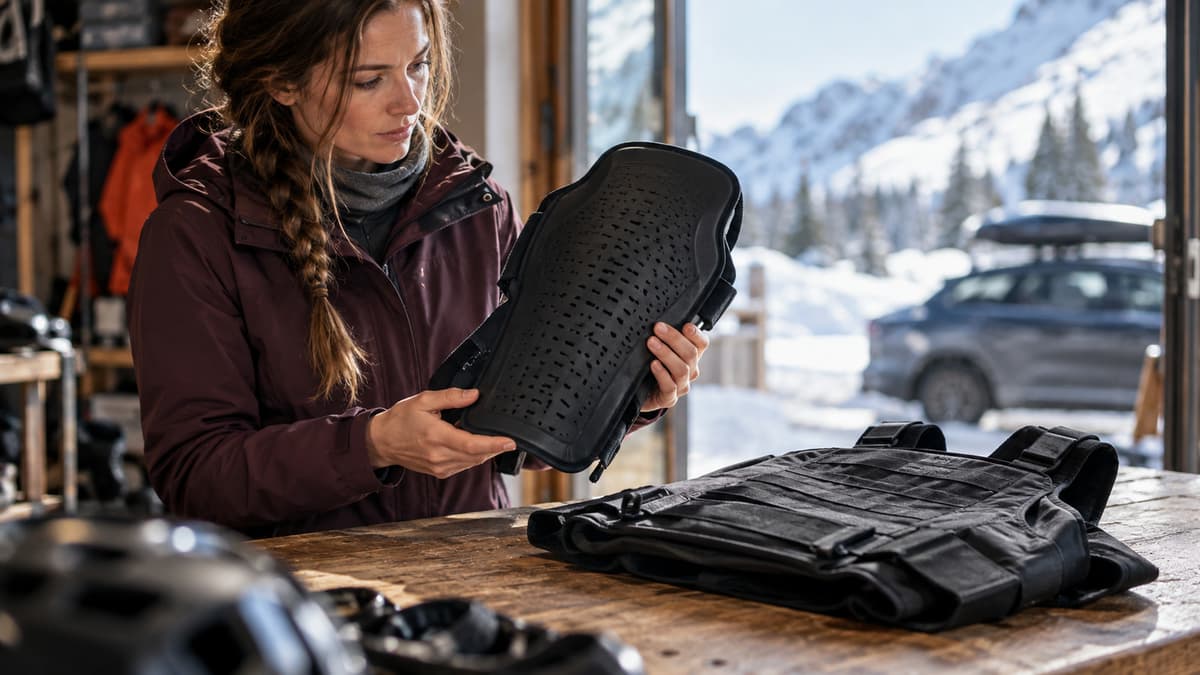
A back protector vs stab vest is not a close call. See what two Salomon snow-sports listings print on amazon.co.uk and why neither says anything about knives.
On this page
You are standing in a shop doorway or on a snowy car-park step, holding a slim black pad with a Salomon logo on it, and a thought arrives: it is a hard-wearing back protector, so surely it must do something against a blade. That is the back protector vs stab vest question in one breath. The honest answer is that the two garments are built for different accidents, and the amazon.co.uk pages we captured say nothing that would bridge the gap.
In short
The two Salomon Flexcell Pro listings we captured on 15 October 2026 are snow-sports body protection, and neither prints a knife-resistance level or a protection standard. EN 1621-2 is an impact test for backs, not a knife test, and it is not printed on those pages. A ski pad is the wrong object for a knife, and a steel stab vest is the wrong object for a fall on snow.
What the two Salomon titles say, and where they disagree
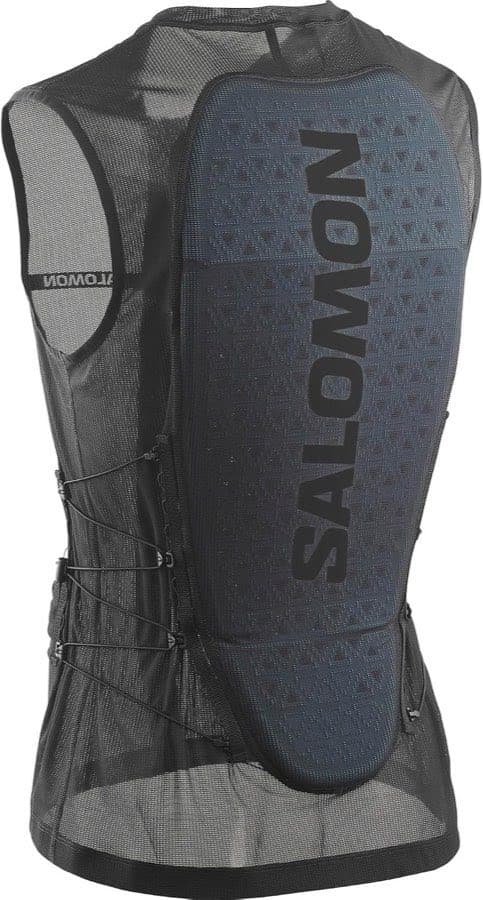
Our comparison of stab-claim products on amazon.co.uk picked up two Salomon rows that do not belong with the knife vests. They are the women's Flexcell Pro, ASIN B0F2TL87NT, at £67.99, and the men's Flexcell Pro, ASIN B0F2TMRG49, at £97.95. Both are priced as of 15 October 2026, and prices on amazon.co.uk move, so treat them as a snapshot rather than a quote.
The women's page carries 4.3 stars from 14 ratings. Its details list a weight of 700 g, a PVC material, a pull-on design and snowboarding as the activity. The men's page carries 4.8 stars from 24 ratings, also at 700 g, with a zipper and a use line of ski and hiking. In both cases the title describes adult body protection for snow sports. That part is consistent, and it tells you what the manufacturer intends the pad to do.
That absence matters more than the mismatch. If a garment could resist a blade, the seller would want the buyer to know, and a serious one would print the standard, the level and the certificate. These pages do none of that, so any knife claim you put onto them comes from you rather than from the listing. Our stab-protection vest comparison keeps these two rows in the table so you can see the contrast, but it does not rank them as armour.
What an impact standard is for
The standard that sometimes appears near back protectors is BS EN 1621-2. It covers motorcyclists' back protectors: the requirements and the test methods for protection against mechanical impact. The BSI catalogue entry describes the scope as impact protection plus size and labelling. A preview of the method describes a kerb-like striker, which tells you the picture the test has in mind. A rider goes down, the back meets something hard and blunt, and the pad has to take the force and share it out.
That is a sensible job for a ski pad too, which is why snow-sports brands often borrow motorcycle impact language. A fall on a frozen piste, a hit from a jump rail, a collision with a tree stump: these are blunt, broad, repeated events. The protective idea is to spread force across a large area and let a flexible foam or a similar material absorb it. Flexibility matters because you have to bend, twist and carry on skiing in it, which is probably why the German reviews dwell on comfort.
Why German reviews are not a UK test
Both listings carry review text, and it is headed Reviewed in Germany. The themes are consistent enough to summarise. Buyers describe a flexible back pad worn for skiing or snowboarding, they say it is light, and on the women's side they mention a removable pad. Several are happy with how little it gets in the way under a jacket. It is a fair picture of what a comfortable snow-sports protector feels like.
It is not a UK customer verdict. Those reviewers were posting on a German storefront, and we know nothing about their sizing, their slopes or their weather. We have not turned that into a British star rating, and we would be wary of any page that did. The star averages above, 4.3 and 4.8, come from the listings themselves, and we cannot say how many of the ratings are from UK buyers.
A knife vest will not do this job either
The mistake works in both directions, so it is worth saying the reverse out loud. The stab-claim listings in the same comparison are steel-layer or soft-panel shirts and vests that use knife language in their titles. They are not back protectors, and nothing in their pages describes an impact test for a fall.
Think about what you would be asking of one on a mountain. Steel-layer vests are often heavy and stiff. Our stab-protection vest comparison lists steel-layer titles with printed weights near 2 kg, for example 1.93 kg on the £25.99 security title, against 700 g printed for the Salomon pads. A stiff panel under a ski jacket changes how you bend and how you carry a fall, and a panel that is built to stop a point or edge is not designed to spread a blunt blow across the spine. We have not seen a listing that says otherwise, so we cannot recommend one for snow.
Cost is the other trap. A vest at the low end of the stab-claim range can sit at under £30, and the pull of that figure is obvious next to £97.95 for a branded pad. But the price tells you nothing about the test. A cheap listing that uses 24J or a knife word is a claim until a certificate names the model, and a dedicated snow-sports pad that prints no standard is a claim of a different kind. Neither price is a measure of safety, and paying less for a wrong-category product is still paying for the wrong thing.
What to check on the garment label later
You do not need a lab to make a better decision than the listing gives you. You need the garment in your hands, or a manufacturer page that is specific enough to replace it. Here is a short checklist for a back protector, and a matching one for a vest sold as armour.
For a snow-sports back protector, check these four things:
- The standard printed on the label or in the instructions, such as EN 1621-2, with its level if there is one.
- The model name and size on the label, matched against the product you ordered, because these listings already disagree about their own ASINs.
- The pad's coverage on your frame. A protector that stops short of your lower spine, or rides up when you bend, leaves the area you wanted covered exposed.
- The manufacturer's guidance on replacement after a heavy fall, since impact foam can be compromised by a big hit even when it looks fine.
For a vest sold as stab armour, ask different questions. Which standard and level does the seller name, such as KR1 or KR2 under the Home Office 2017 standard? Does a certificate name this exact model? Does the label on the garment match the document? Our comparison page separates the stab-claim products from the sports pads so that you can see which listings print a claim and which print nothing at all.
Common questions
Will a ski back protector stop a knife?
Is the Salomon Flexcell Pro EN 1621-2 certified?
Why do the Amazon bullets talk about a children's running vest?
Are the Salomon reviews from UK buyers?
What does EN 1621-2 actually test?
How much do the two Salomon pads weigh?
Which Salomon listing is for skiing?
Can I use a stab vest for skiing?

Products Compared publishes British-English buying guides based on amazon.co.uk listings and public UK sources. We do not run a lab and we do not invent test scores.
Related articles
Rugby protection vest: why it is not stab armour
Padding made for one sport is tested for that sport. Here is why it tells you nothing about knives.
KR1 KR2 body armour: what the UK knife levels mean
Learn what the UK resistance levels mean before treating a product claim as proof.

24 joule stab vest: why 24J is not a certificate
A test-energy figure can describe a claim, but it does not identify the tested model or prove certification.