Covert stab vest under a shirt: what fit can and cannot do

A covert stab vest under a shirt should sit label-in, over a thin layer, with no hard objects beneath. Bulk shows, and a shirt closes no gaps in cover.
On this page
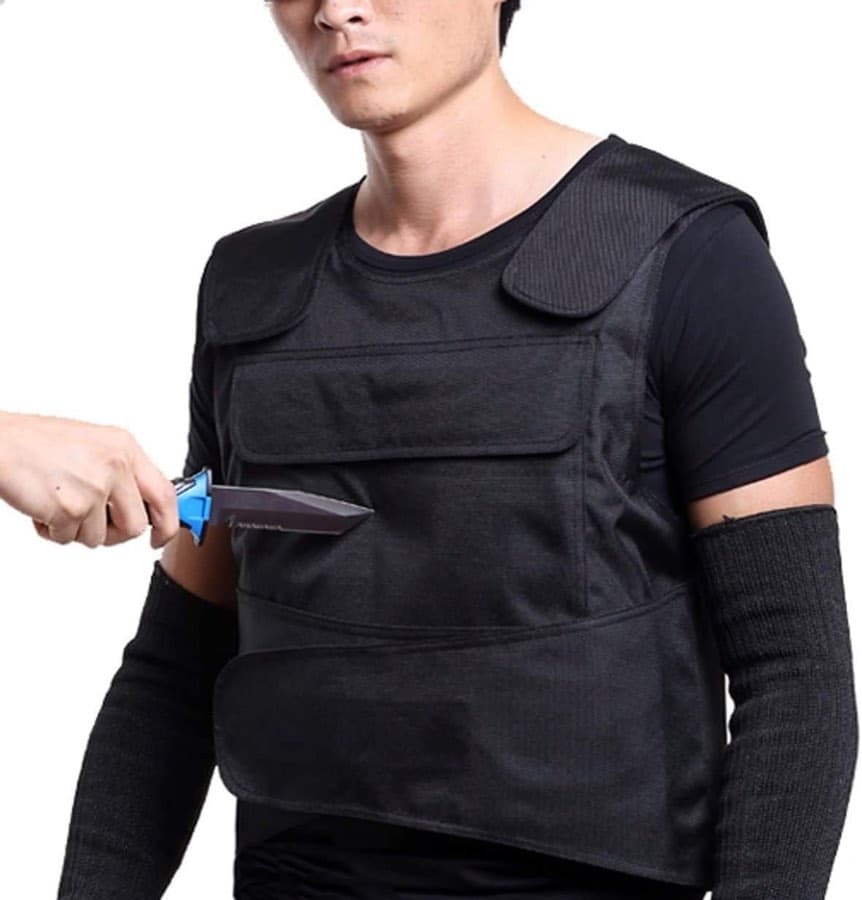
You put the vest on in the hallway, button a pale work shirt over it and turn side-on to the mirror. The collar sits fine, but the shirt pulls across the stomach and there is a faint line at the shoulder. That small check tells you more than any product title will. A covert vest is only useful if you can wear it all shift, and only protective if it sits the way it was tested.
In short
A covert stab vest is meant to sit under ordinary clothes, label side towards your body, over one thin layer, with nothing hard beneath it. Bulk shows, heat builds, and a shirt adds no side or neck cover that the panel lacks. Treat concealment as a comfort and fit question, not as proof of protection.
Covert is a cut, not a promise
Covert body armour is simply armour designed to be worn under normal clothing. The National Protective Security Authority describes covert as discreet under everyday clothes and overt as visible, usually a carrier worn over the top. That is a description of the carrier, how thin and flexible it is and how it fastens. It is not a performance rating, and it says nothing about what the panel inside will stop.
That distinction matters when you shop on amazon.co.uk. Titles use words such as "concealed", "hidden" or "under clothes" because they sell. The stab-protection vest comparison shows what each captured title prints, and a concealment word is not the same as a certified protection level. If you want the letters explained, the KR1 and KR2 article covers them. Here the question is narrower: what does wearing a vest under a shirt change?
Three things, mostly. You gain a little discretion, which many people want at work. You lose airflow, because a close-fitting panel under a shirt traps heat. And you lose the ability to inspect the vest at a glance, since you cannot see a twisted strap or a shifted panel through a shirt. So covert is a trade, and the trade is only worth it if you accept all three parts.
One limit is worth stating plainly. Covert does not mean smaller panel by magic. A slimmer carrier usually means less coverage, less padding at the edges, or a different construction, and you should check which of those you are buying before you trust the word on the listing.
The label and the layer underneath
Home Office body-armour guidance gives a short list of fit rules, and they apply whether the vest is covert or overt. The side marked as the body side goes against you. A thin layer goes between the carrier and your skin. Nothing hard sits underneath. The vest is fastened firmly so the panel stays where it was tested.
Start with the label. Panels carry a mark showing which face is meant to be towards the body, because the layers are not symmetrical. Fitted back to front, the panel is no longer in the configuration that was tested, and you have no way of knowing what that does. If you cannot find the label, or the carrier hides it behind a pocket, read the manufacturer's instructions before you wear it.
Then the layer. The guidance asks for something thin, and the manufacturer advice that turned up in the research says the same: one base layer, panels smooth, not worn too low. A thin cotton vest or t-shirt is the common choice. A thick fleece, a padded shirt or two layers works against you, because the bulk pushes the carrier away from the body and makes the whole thing show more.
What these reviews say about hiding a vest
The captured listings give a small and uneven picture, and it is better to say so than to rank anything. There are three concealment claims in the file, and none comes with a certificate in the capture.
The FiveFire concealed steel vest says in its bullets that it can be worn under or over clothes. Reviewers split. Some say they hid it under a hoodie. Others found it hot, bulky and short of side cover, and one point worth noting is that a disc was not included. That mixed set of comments is the most useful evidence in the file, because it shows both outcomes for the same product: it can work for some bodies and some shirts, and not for others.
A soft shirt, listed as B0F9YKQMB6, claims concealment at £325. The capture has just one reviewer who wore it under a shirt for a long shift, and another who called it not fit for purpose. Two reviews are a thin base. A single positive and a single negative do not average out to a verdict, so treat the product as unproven rather than as good or bad.
A SafeGuard listing carries a review saying the vest did not show through clothes. That is one text, and the capture shows no certificate for it.
Gaps that a shirt does not close
A shirt over a vest looks like extra protection. It is not. A cotton or polyester work shirt will not stop a blade, and it will not extend what the panel covers. Anything the carrier leaves open is still open.
Look at four places. The sides are the first, because many slim carriers are a front and a back panel joined by straps, with a gap on each flank. The listing photos usually show this, and one FiveFire reviewer specifically described the cover as short at the sides. The neck and upper chest are the second: a panel that stops below the collarbone leaves a gap you will see in the mirror as a shirt that sits flat. The lower abdomen is the third, since a vest cut short to avoid showing under the shirt hem leaves you uncovered when you sit or bend. The shoulders are the fourth, where narrow straps trade protection for comfort.
None of this is a reason to avoid a covert vest. It is a reason to know what yours does not cover, and to stop assuming that "under a shirt" means "all round". Compare the stated panel size on the listing with your own torso measurements, and do it before you buy. The comparison page lists panel claims alongside prices so you can see where a listing is vague.
After the shift
How you store the vest matters as much as how you wear it. The Home Office guidance says to hang the vest or lay it flat, away from heat and sun, and to check the cover before the next use.
In practice, that means a coat hanger on a wide hook or a flat shelf, not a heap on the floor. Do not leave it on a radiator or in a hot car. Do not fold the panel, and do not stack other kit on top. Sweat is the other risk after a hot shift: let the carrier air before you put it away, and follow the washing instructions for the cover. Panels are not usually meant to be washed, and the cover is.
Then look it over. Check the stitching on the straps, the cover for tears or thin patches, and the panel pocket for any sign that the panel has shifted or bunched. A cover that has split can let the panel slide, and a panel that has been bent or soaked may no longer behave as it was tested. If the manufacturer states an expiry or replacement date, write it down somewhere you will see it.
Common questions
Will people see a covert vest under a shirt?
What should be against my skin?
How tight is too tight?
Does covert mean the sides are covered?
Which listing in the comparison is described as covert?
Where should I keep it after work?
Does hiding it make it safer?

Products Compared publishes British-English buying guides based on amazon.co.uk listings and public UK sources. We do not run a lab and we do not invent test scores.
Related articles

Is body armour legal in the UK? What buyers should know
A high-level guide for private buyers who want to understand the legal context before ordering armour.
KR1 KR2 body armour: what the UK knife levels mean
Learn what the two Home Office knife levels measure, and what a label has to show before you rely on it.

24 joule stab vest: why 24J is not a certificate
A test-energy figure can describe a claim, but it does not identify the tested model or prove certification.