Independent comparisons. We may earn from shop links. More info

Voltage tester screwdriver

The best voltage tester screwdrivers, compared.

Top pick: Bosch SL3x65 phase tester – Highest score, 84. The listing names DIN VDE 0680-6 and AC 120–250 V, with 4.6 from 793 reviews and no battery. It is not a two-pole dead test. Best value: Rolson 28110 2-piece pair – About £4.23 for two slotted lengths at 100–250 V, rated 4.4 from 1,913 reviews. A dim neon and chipped tips stay in the reviews. Updated October 2026.

Peter F.
Peter F.Editor

A voltage tester screwdriver on amazon.co.uk is usually a single-pole neon phase tester: a slotted driver with a neon, used to see if a terminal looks live. A glow means you treat the point as live. No glow means the lamp did not strike, not that the conductor is dead. Buyers are householders and tradespeople who want a pocket check, not a dead test. That is a phase-tester claim, not an HSE approval. Reviews include a dim neon and chipped tips. The [voltage tester screwdriver buying guide](/hub/hand-tools/voltage-tester-screwdriver/sub/voltage-tester-screwdriver-buying-guide) sets range, tip and standard before you use this ranking. You rest a finger on the cap and put the tip on a conductor. Safe isolation uses a two-pole indicator to BS EN 61243-3, proved before and after. NICEIC’s steps use that indicator and a proving unit.

A voltage tester screwdriver on amazon.co.uk is usually a single-pole neon phase tester: a slotted driver with a neon, used to see if a terminal looks live. A glow means you treat the point as live.

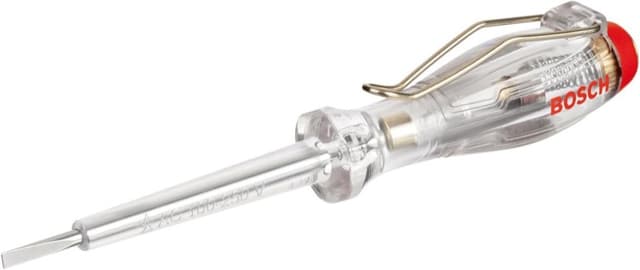
Bosch SL3x65 phase tester

Best overall

Bosch SL3x65 phase tester
8.6/10∼ £6

28 products checked · 56 hrs invested · +17,200 readers

8 of 8: Best voltage tester screwdrivers compared

Swipe for more

1-2 of 8
Best overall
Bosch SL3x65 phase tester
PaulStore 2-piece slotted pair
ebuyerfix 2-piece 100–250 V pair
Best value
Rolson 28110 2-piece pair
Eightwood 220 V tester pen
KAIWEETS contact and non-contact pen
ZenithQuest 2-piece 12–220 V pair
Cfanibo 2-piece 12–220 V pair
8.6/10
7.2/10
7.9/10
7.9/10
6.7/10
6.6/10
4.9/10
3.0/10
∼ £6
∼ £4
∼ £4
∼ £4
∼ £7
∼ £17
∼ £7
∼ £6
4.6(793)
4.6(315)
4.5(170)
4.4(1,913)
4.3(1,584)
4.3(216)
4.2(8)
1.0(3)
View offer
View offer
View offer
View offer
View offer
View offer
View offer
View offer

The best voltage tester screwdrivers in detail

Bosch SL3x65 phase tester

Rank 1

Bosch SL3x65 phase tester

Our view

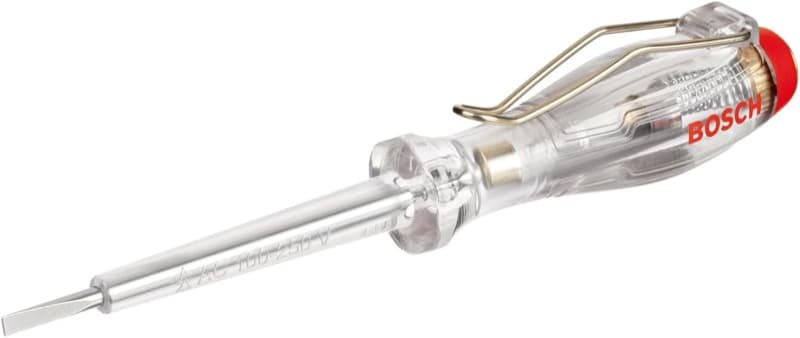
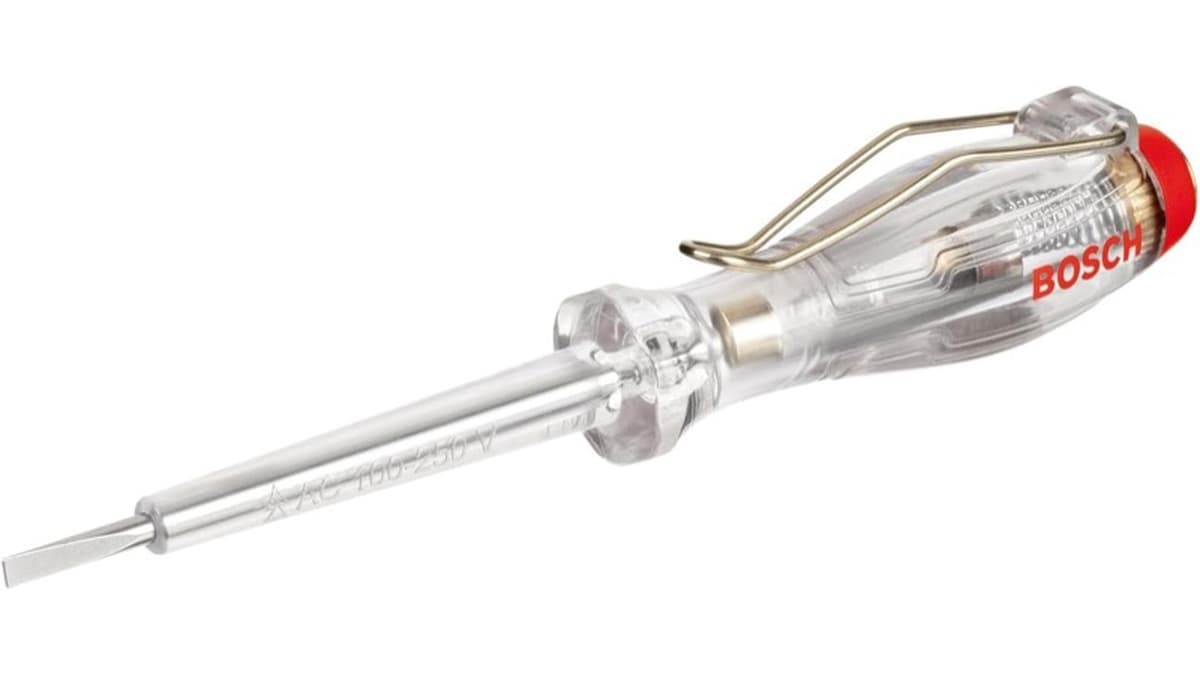
The Bosch SL3x65 is one slotted glow-lamp phase tester at £5.99, with AC 120–250 V and DIN VDE 0680-6 named on the listing. The first 50 reviews, inside a 4.6 rating from 793, mostly say it is simple and needs no battery. They do not repeat a dead lamp or a snapped tip. The measurement-type line still says voltmeter. The standard named is a single-pole phase-tester claim, not a two-pole proving-dead test.

Pros

  • 4.6 from 793 reviews, without a repeated dead-lamp theme in the first 50
  • DIN VDE 0680-6 named, range AC 120–250 V
  • No battery
  • Pocket clip claimed

Cons

  • One tester, not a spare length
  • Measurement type on the listing says voltmeter
  • No CAT figure on the listing
  • Made in China on the listing

Best for: A single mains phase tester with a named DIN VDE 0680-6 line and no battery

Less suitable: A second blade length in the same pack, or a 12 V vehicle check

Specifications

Model
Bosch SL3x65 phase tester
Brand
Bosch Professional
Price
∼£6
Customer rating
4.6/5(793)
Voltage
AC 120–250 V
Indicator
Glow lamp
Tip
SL3x65 slotted
Pieces
1
Battery
No
Standard
DIN VDE 0680-6
Non-contact
No

Common questions

What voltage does the Bosch SL3x65 claim?

The listing says AC 120 V to 250 V, with an integrated glow lamp. It does not claim a 12 V range.

Does it need a battery?

The power-source line says hand powered. Reviews praise the lack of a battery. Nothing in the included-components line is a cell.

Which standard is named?

The bullets say certified according to DIN VDE 0680-6. The listing does not mention GS38 or a CAT rating.

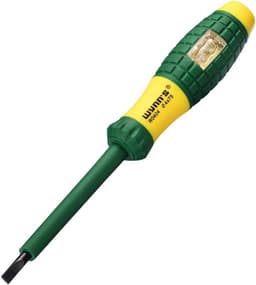
PaulStore 2-piece slotted pair

Rank 2

PaulStore 2-piece slotted pair

Our view

The PaulStore pair is £3.99, rank 3 in Voltage Testers on the listing, with 4.6 from 315 reviews. The bullets describe two slotted lengths and 100–250 V. The title says 100–500 V and VDE rated. In the first 50 reviews people use both sizes on lights and fuses, and others report no light, a dead small tester, or a bent tip.

Pros

  • 4.6 from 315 reviews
  • Two slotted lengths used on lights and fuses
  • £3.99
  • Bestseller rank 3 in Voltage Testers on the listing

Cons

  • Title range and bullet range disagree
  • VDE, TÜV and GS appear without a number
  • Some sets do not light
  • Tips called easy to bend

Best for: A cheap two-length neon pair if you quote the bullet range, not the title range

Less suitable: Anyone who needs the title and the bullets to state the same voltage

Specifications

Model
PaulStore 2-piece slotted pair
Brand
PaulStore
Price
∼£4
Customer rating
4.6/5(315)
Voltage
100–250 / 100–500 V
Indicator
Neon
Tip
Slotted 140 and 190 mm
Pieces
2
Standard
VDE, no number
Non-contact
No

Common questions

Which voltage figure should you read?

The title says 100–500 V AC. The bullets say 100 V to 250 V. Those are different claims. The listing does not resolve them.

What is in the pack?

The bullets list a 3 x 140 mm and a 3.5 x 190 mm slotted tester. The included-components field says Handle, and number of items says 1.

Does the listing name a standard number?

The title says VDE rated. The bullets say TÜV and GS approval. No standard number, such as DIN VDE 0680-6, is printed on the listing.

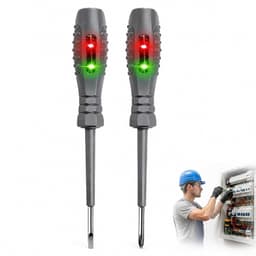
ebuyerfix 2-piece 100–250 V pair

Rank 3

ebuyerfix 2-piece 100–250 V pair

Our view

The ebuyerfix pair is two flat-head pens at £3.89, and 100–250 V is the same figure in the title and the bullets. Reviews, 4.5 from 170, praise the price and the two lengths. Several say the blade is soft, a head snapped on a UK plug, or the ends broke on first use. One review says a unit did not work. No DIN, VDE or IEC number is on the listing.

Pros

  • Title and bullets both say 100–250 V
  • 4.5 from 170 reviews
  • Two lengths praised for tight terminals
  • Lowest price in this set at £3.89

Cons

  • Soft blade and snapped heads in reviews
  • Number-of-items field says 1
  • No named standard
  • One review says it did not work

Best for: A low-price slotted pair when the voltage lines on the listing match

Less suitable: Driving screws hard, or a buyer who wants a standard number on the page

Specifications

Model
ebuyerfix 2-piece 100–250 V pair
Brand
ebuyerfix
Price
∼£4
Customer rating
4.5/5(170)
Voltage
100–250 V
Tip
Flat, two sizes
Pieces
2
Non-contact
No

Common questions

Do the title and the bullets agree on voltage?

Yes. Both say 100 V to 250 V. The minimum and maximum operating-voltage fields match.

How many testers are in the pack?

The title, unit count and number of packs say 2. The number-of-items field says 1.

Is a standard named?

No standard number appears on the listing. The bullets claim an insulated blade sheath.

Rolson 28110 2-piece pair

Rank 4

Rolson 28110 2-piece pair

Our view

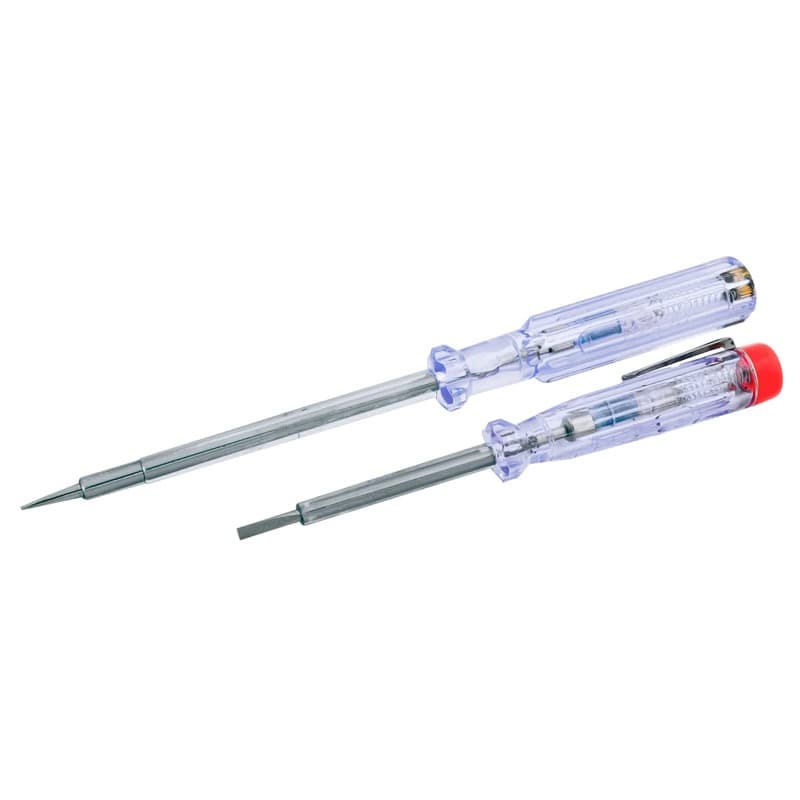
The Rolson 28110 is two slotted neons at £4.23, 100–250 V in the bullets, with IEC 1010 on the specification line. The first 50 reviews, inside 4.4 from 1,913, often call both lengths good value and say there is no battery. The same sample includes a dim neon, a tip that chipped or folded, and one pair that did not work on arrival. The power-source field does not match the reviews.

Pros

  • 4.4 from 1,913 reviews
  • 100–250 V agrees between bullets and the voltage fields
  • Two slotted lengths
  • £4.23

Cons

  • Neon called dim in bright light
  • Tips chip, splinter or fold in some reviews
  • Power-source line says corded electric
  • One review says both were dead on arrival

Best for: A cheap two-length slotted pair with a large UK review count and a 100–250 V range

Less suitable: A driver you will lean on, or a check in bright daylight where a dim neon is hard to see

Specifications

Model
Rolson 28110 2-piece pair
Brand
Rolson
Price
∼£4
Customer rating
4.4/5(1,913)
Voltage
100–250 V
Indicator
Neon
Tip
Slotted 140 and 190 mm
Pieces
2
Battery
No
Standard
IEC 1010
Non-contact
No

Common questions

What sizes are in the Rolson pair?

The bullets list 190 x 3.5 mm and 140 x 3 mm, both with a plain slot blade and a transparent handle.

Does it use a battery?

The power-source field says corded electric. Reviews say it has no battery and is not corded. The bulbs are the neon type.

What standard is printed?

The specification line says IEC 1010. The included-components line says two-piece GS tester. GS38 is not on the listing.

Eightwood 220 V tester pen

Rank 5

Eightwood 220 V tester pen

Our view

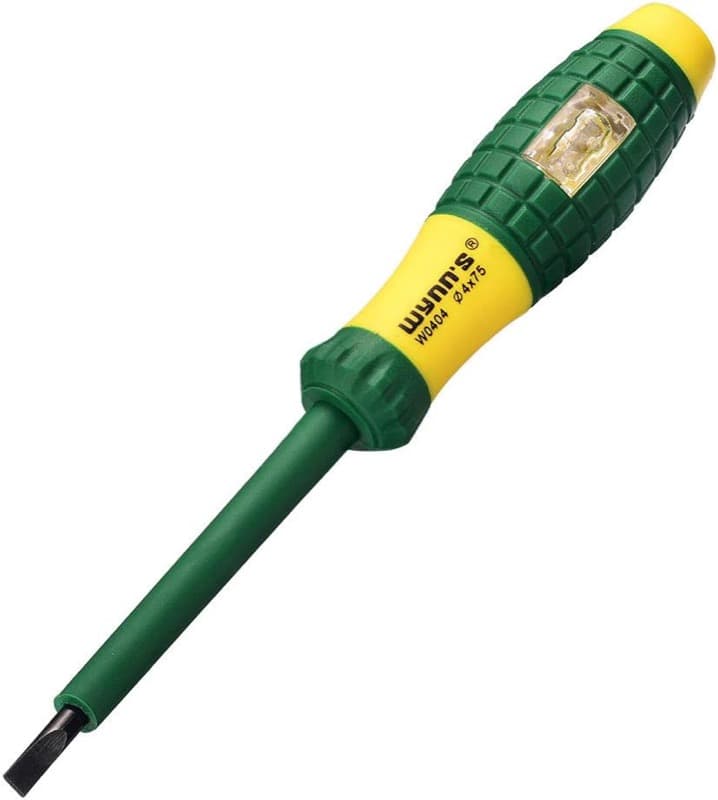
The Eightwood pen is £6.99 with 4.3 from 1,584 reviews. The bullets state 220 V, a 75 mm length and a 4 mm tip, plus CE and RoHS. Across the first 50 reviews the neon is repeatedly called dim, including indoors, and some units did not work or were returned. A wide blade is a separate complaint. Number of items says 10 against a one-pen bullet.

Pros

  • 4.3 from 1,584 reviews
  • Chrome-vanadium blade claimed
  • Some reviewers like the grip and the tip on ordinary electrical screws
  • CE and RoHS named

Cons

  • 220 V printed as a single figure
  • Dim neon is a repeated review theme
  • Dead on arrival in several reviews
  • Item count says 10

Best for: A single pen only if you accept a 220 V figure and a neon that reviews call dim

Less suitable: A 230 V range you can read as 100–250 V, or a spare second length

Specifications

Model
Eightwood 220 V tester pen
Brand
Eightwood
Price
∼£7
Customer rating
4.3/5(1,584)
Voltage
220 V
Indicator
Neon
Tip
4 mm, 75 mm long
Pieces
1
Standard
CE, RoHS
Non-contact
No

Common questions

Is 220 V a range?

The bullets and both voltage fields say 220 V, not 100–250 V. UK mains are nominally 230 V. The listing does not add a tolerance.

How long is the blade?

The bullets say overall length 75 mm and tip diameter 4 mm. One review says that blade is too wide for small terminal screws.

How many are in the box?

The bullets say one tester pen. Number of items says 10. Included components says no.

KAIWEETS contact and non-contact pen

Rank 6

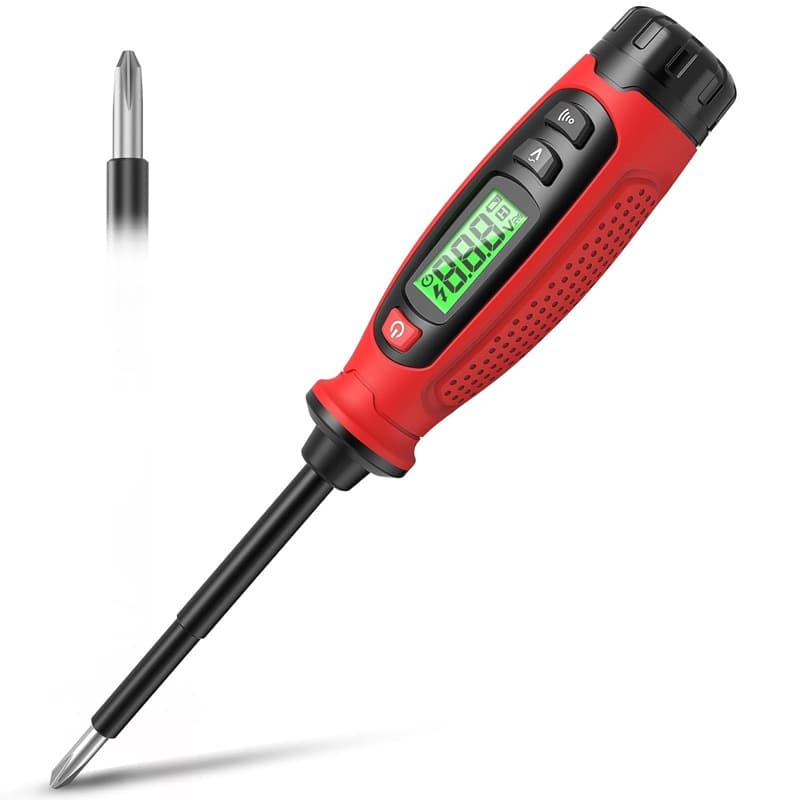
KAIWEETS contact and non-contact pen

∼£17

Our view

The KAIWEETS pen is £16.98, 4.3 from 216 reviews, with a contact claim of 3–500 V AC, an LCD, a beep, non-contact mode and a Phillips tip. The specification names CE, EN 61010-1, RoHS and UKCA, and no CAT figure. Model lines say both KTS02 and KTS01. Included components say two AAA cells; reviews describe one. Contact readings are praised. 12 V DC is a repeated miss, and non-contact mode is called too broad.

Pros

  • LCD and a beep, so the result is not only a dim neon
  • Contact and non-contact both claimed
  • EN 61010-1 and UKCA named
  • 3-year warranty on the listing

Cons

  • Does not read 12 V DC in several reviews
  • Non-contact mode called too sensitive
  • Phillips only
  • Battery count and model number disagree on the listing

Best for: A pocket AC check with a screen, if you do not need a slotted terminal driver

Less suitable: 12 V DC on a vehicle, or UK faceplate screws that want a slotted tip

Specifications

Model
KAIWEETS contact and non-contact pen
Brand
KAIWEETS
Price
∼£17
Customer rating
4.3/5(216)
Voltage
AC 3–500 V
Indicator
LCD and beep
Tip
Phillips
Pieces
1
Battery
AAA
Standard
EN 61010-1
Non-contact
Yes

Common questions

Does the KAIWEETS pen test without touching the conductor?

The bullets claim a non-contact mode as well as contact AC testing from 3 V to 500 V. Reviews say the non-contact alarm is very sensitive.

Will it read 12 V DC?

Several reviews say it does not read 12 V vehicle supplies or 9 V DC. The listing measurement types are AC voltage, continuity, live wire and non-contact detection.

What tip does it have?

The style name is a Phillips head. Reviews note there is no interchangeable blade.

ZenithQuest 2-piece 12–220 V pair

Rank 7

ZenithQuest 2-piece 12–220 V pair

Our view

The ZenithQuest pair is £6.59 with a 12–220 V claim, a neon, and magnetic flat and cross-head tips in the bullets. Only two UK review texts are stored, against a 4.2 rating from 8. One says the tool is smaller than expected. The other says the tips sheared on first use. No standard number is printed. The 220 V ceiling sits under nominal UK mains of 230 V.

Pros

  • Flat and cross-head both claimed
  • Neon indicator described
  • Two pieces
  • Light, at 20 g on the listing

Cons

  • Only two review texts, one of them a sheared tip
  • 12–220 V ceiling
  • No named standard
  • Called smaller than the buyer expected

Best for: No stored review describes a job this pair completed

Less suitable: A UK 230 V socket, or any screw you need the tip to survive

Specifications

Model
ZenithQuest 2-piece 12–220 V pair
Brand
ZenithQuest
Price
∼£7
Customer rating
4.2/5(8)
Voltage
12–220 V
Indicator
Neon
Tip
Flat and cross-head
Pieces
2
Non-contact
No

Common questions

What voltage is printed?

The bullets say 12 V to 220 V. There is no 230 V or 250 V figure on the listing.

What did the reviews say?

One of the two reviews says it is smaller than expected. The other says the tips sheared on first use and calls it a waste of money.

Is a standard named?

No. The listing claims a neon, a PVC handle and magnetic flat and cross-head tips.

Cfanibo 2-piece 12–220 V pair

Rank 8

Cfanibo 2-piece 12–220 V pair

Our view

The Cfanibo pair is £6.46 with a 12–220 V AC claim and two pieces. The amazon.co.uk rating on the listing is 1.0 from 3 reviews. The only review text is negative and gives no detail. Rank on the listing is 145 in Voltage Testers. No standard is named.

Pros

  • Two pieces claimed
  • Flat and cross-head both named in the bullets
  • Neon indicator described

Cons

  • 1.0 from 3 reviews
  • The only text review is negative and vague
  • 12–220 V ceiling
  • No named standard

Best for: No stored review describes a job this pair completed

Less suitable: Anyone using the star rating as a filter. The listing shows 1.0 from 3 reviews

Specifications

Model
Cfanibo 2-piece 12–220 V pair
Brand
Cfanibo
Price
∼£6
Customer rating
1.0/5(3)
Voltage
12–220 V AC
Indicator
Neon
Tip
Flat and cross-head
Pieces
2
Non-contact
No

Common questions

What does the only review say?

The title is Bad and the text is No good. The rating line is 1.0 from 3. The other two reviews are not stored.

What voltage is claimed?

The bullets say AC 12 V to 220 V. The minimum operating voltage field says 12 V. There is no 250 V figure.

Is a standard named?

No. The bullets claim a neon, an insulated PVC handle and magnetic flat and cross-head tips.

How we compared

Scores run from 0 to 100 on the amazon.co.uk listings captured on 15 October 2026. Stars, review volume, listing clarity, fit to UK 230 V mains and price are weighted below. Deductions cover a dead-on-arrival theme, sheared tips, a 12 V claim the reviews reject, and a power-source line the reviews contradict. There is no lab test. The top pick is the highest score. The Rolson pair takes best value: it ties the ebuyerfix pair on that reading, and the higher UK review count takes the badge.

1

Stars

40%

The amazon.co.uk star rating, divided by 5 and scaled out of 40. No star line is borrowed from another shop.

2

Review volume

20%

Out of 20, from the amazon.co.uk review count on that listing. Under 5 reviews scores 2. 1,000 or more scores 18.

3

Listing clarity

15%

Out of 15, for voltage lines that match, a named standard, and a stated tip and piece count. A title that disagrees with the bullets scores low.

4

UK mains fit

15%

Out of 15, for a printed range that covers nominal 230 V and a slotted tip. A 220 V ceiling or a Phillips-only tip scores lower.

5

Price

10%

Out of 10, from the amazon.co.uk shelf price in the 15 October 2026 capture. Under £5 scores 9. Over £15 scores 4.

Independent review
Last updated: October 2026
9 sources checked

Choosing a voltage tester screwdriver

Decide what the glow is allowed to mean before you compare the price. A lamp that strikes means you treat the point as live. A lamp that stays dark is not a dead circuit. Prices below are the eight amazon.co.uk shelf prices captured on 15 October 2026. We did not run a lab test. DIN VDE 0680-6 on a listing is a phase-tester claim. It is not an HSE GS38 approval, and it does not prove the installation dead.

What is a voltage tester screwdriver?

A voltage tester screwdriver in UK shops is usually a single-pole neon phase tester. It is a slotted driver with a neon and a metal cap. You rest a finger on the cap and put the tip on a conductor. If the lamp glows, treat that point as live. If it does not glow, the lamp did not strike. That is not proof the conductor is dead. Safe isolation uses a two-pole indicator to BS EN 61243-3, proved before and after. NICEIC’s steps use that indicator and a proving unit.

Best for

  • A householder who wants a slotted mains indication and will not treat a dark lamp as dead
  • A tradesperson who already owns a two-pole kit and wants a pocket live check

Not ideal for

  • Proving a circuit dead, including work under the Electricity at Work Regulations
  • A 12 V vehicle check, or a buyer who needs the title and the bullets to state the same voltage

Mistakes to avoid

  1. 1

    A title range merged with the bullets

    The PaulStore title says 100–500 V and VDE. The bullets say 100–250 V. Quote the line you can point at. Do not stitch the two figures into one range.

  2. 2

    A 12–220 V neon bought for a car

    A 12 V figure on a neon is not a credible strike voltage. ZenithQuest and Cfanibo print 12–220 V. KAIWEETS reviews say 12 V DC does not read. Leave vehicle electrics out of this category.

  3. 3

    A dim neon read as off

    Reviews often call the neon dim in daylight. On the Eightwood pen that theme includes indoor use, and some units did not work. A lamp you cannot see is not an off circuit. Prove the tool on a known live point, and do not trust only one driver in a pair.

What to weigh up

Voltage range and what a glow means

High

UK mains are nominally 230 V. Read the title and the bullets as separate lines. A printed 100–250 V or 120–250 V covers 230 V. The Bosch SL3x65 prints AC 120–250 V. The Rolson 28110, the ebuyerfix pair and the PaulStore bullets print 100–250 V. The PaulStore title also says 100–500 V. Do not merge those into one range. Eightwood prints 220 V as a single figure, with no tolerance on the listing. ZenithQuest and Cfanibo print 12–220 V.

Tip, indicator and the named standard

High

UK terminals want a slotted blade. The pairs quote about 140 mm and 190 mm. A Phillips-only pen is a poor terminal driver. The KAIWEETS style is a Phillips head, and reviews note there is no interchangeable blade. Cheap tips bend and shear. Rolson reviews include a tip that chipped or folded. ebuyerfix reviews include a snapped head. One ZenithQuest review says the tips sheared on first use. Reviews often call a neon dim in daylight.

Which option suits you?

Three typical situations, each with a recommendation from this comparison.

One named mains tester

You are changing a pendant or a socket and you want one slotted tester with a named phase-tester standard. You will not read a dark lamp as dead. The Bosch SL3x65 is about £5.99, rated 4.6 from 793 reviews, AC 120–250 V, with DIN VDE 0680-6 on the listing.

Two slotted lengths

You want two slotted lengths for terminals of different reach, a low shelf price and a long UK review file. The Rolson 28110 is about £4.23, rated 4.4 from 1,913 reviews, at 100–250 V. Some reviews call the neon dim and the tips easy to chip.

A screen instead of a neon

You want an LCD and a beep, including a non-contact mode, and a Phillips tip is acceptable. The KAIWEETS pen is about £16.98, rated 4.3 from 216 reviews. Reviews say 12 V DC does not read, and the listing names no CAT figure.

Common questions about voltage tester screwdrivers

Which voltage tester screwdriver is the top pick in this comparison?
The top pick is the Bosch Professional SL3x65 at about £5.99, rated 4.6 from 793 amazon.co.uk reviews. It is one slotted glow-lamp phase tester, AC 120–250 V, and the listing names DIN VDE 0680-6. That is a phase-tester claim to 250 V AC, not a GS38 approval, and it does not prove a circuit dead. The measurement-type line still says voltmeter. A dark lamp means the neon did not strike.
How much does a voltage tester screwdriver cost on amazon.co.uk?
On these eight listings, captured on 15 October 2026, shelf prices run from about £3.89 to about £16.98. Entry is about £3.89 to £4.23: ebuyerfix, PaulStore and the Rolson 28110 pair. Mid is about £5.99 to £6.99: the Bosch SL3x65, Cfanibo, ZenithQuest and Eightwood. The KAIWEETS pen is about £16.98. A higher price here buys a screen and a beep, not a two-pole dead test.
What should you check before you buy a voltage tester screwdriver?
Read the voltage in the title and the bullets separately. UK mains are nominally 230 V, so 100–250 V or 120–250 V covers that, and a 220 V ceiling is tight. UK terminals want a slotted tip. A dim daylight neon is a repeated review complaint. A named standard such as DIN VDE 0680-6 is narrower than the word VDE with no number. Prove the tool on a known live point before and after use.
Does no glow mean the wire is dead?
No. A glow means treat the point as live. No glow means the lamp did not strike. HSE GS38 says single-pole and non-contact detectors identify live equipment and must not prove equipment dead. Proving dead needs a two-pole indicator to BS EN 61243-3, proved before and after. A dim neon, a failed lamp, or a glow from a nearby conductor are known faults. What a neon screwdriver cannot prove states that limit.
Is DIN VDE 0680-6 a safe-isolation certificate?
No. On the Bosch listing it is a phase-tester claim to 250 V AC. The published scope is a phase tester, not a meter, not a test for the absence of voltage, and not for rain. GS or VDE in a title without a number is weaker. GS38 is HSE guidance, not a sticker on the handle. The KAIWEETS listing names EN 61010-1 and UKCA. It states no CAT figure. That line is not a category rating.
When should you use a two-pole tester instead?
Use a two-pole indicator, proved on a known live source before and after, when you need to know a conductor is dead. A screwdriver here does not meet BS EN 61243-3 by name. At work, the Electricity at Work Regulations 1989, regulations 12 and 16, expect secure isolation and a dead test by a competent person. A householder’s DIY is a different duty. The injury risk remains if you trust a dark neon.
When should you stop, and is a VDE screwdriver the same tool?
Stop and call a competent person for a consumer unit, a burnt or buzzing accessory, a circuit you cannot isolate, a workplace or a rented installation, and three-phase. Paid electrical work falls under regulation 16. This screwdriver is not the dead test. An insulated driver with no lamp is a different product. A VDE screwdriver is for turning screws within its insulation rating, not for proving a circuit dead.

Our verdict

The top pick is the Bosch Professional SL3x65 at about £5.99, rated 4.6 from 793 reviews: one slotted glow-lamp tester, AC 120–250 V, with DIN VDE 0680-6 named on the listing. That line is a phase-tester claim, not a GS38 approval, and the measurement-type line still says voltmeter. The best value is the Rolson 28110 at about £4.23, two slotted lengths at 100–250 V, rated 4.4 from 1,913 reviews. The ebuyerfix pair scores the same 77 and costs about £3.89, with fewer reviews and no named standard, so it does not take the badge. A dark neon is not a dead circuit.

Best overall
Bosch SL3x65 phase tester

Bosch SL3x65 phase tester

Highest score, 84. The listing names DIN VDE 0680-6 and AC 120–250 V, with 4.6 from 793 reviews and no battery. It is not a two-pole dead test.

View offer
Best value
Rolson 28110 2-piece pair

Rolson 28110 2-piece pair

About £4.23 for two slotted lengths at 100–250 V, rated 4.4 from 1,913 reviews. A dim neon and chipped tips stay in the reviews.

View offer

Editorial

Peter F. - Editor
Editor
Voltage tester screwdriversamazon.co.uk listingsUK electrical safety

Products Compared publishes British-English buying guides based on amazon.co.uk listings and public UK sources. We do not run a lab and we do not invent test scores.

Updated: October 2026
9 sources checked

Guides to voltage tester screwdrivers

Guides on what to look for, how to use a product, and common mistakes.

Related comparisons

Sources

Public UK sources and the amazon.co.uk listings in this comparison. Listings captured 15 October 2026. Page updated October 2026.

  1. HSE GS38: Electrical test equipment for use on low voltage electrical systems (retrieved 15 October 2026)
  2. Electricity at Work Regulations 1989, regulation 12 (retrieved 15 October 2026)
  3. Electricity at Work Regulations 1989, regulation 16 (retrieved 15 October 2026)
  4. HSE HSR25: Memorandum of guidance on the Electricity at Work Regulations 1989 (retrieved 15 October 2026)
  5. NICEIC: Safe isolation procedure in 10 easy steps (retrieved 15 October 2026)
  6. DIN VDE 0680-6:2021-08 phase tester (retrieved 15 October 2026)
  7. DIY FAQ: Neon screwdriver (retrieved 15 October 2026)
  8. Neon tester training note (retrieved 15 October 2026)
  9. amazon.co.uk listings captured 15 October 2026 (retrieved 15 October 2026)

This page contains affiliate links to amazon.co.uk (tag pcuk26-21). If you buy through them, we may earn a commission at no extra cost to you. Prices, stars and review counts are from the amazon.co.uk listings captured on 15 October 2026. We did not run a lab test.