Independent comparisons. We may earn from shop links. More info

Voltage tester for changing a light

Updated: October 2026

You have a pendant to swap, the wall switch is off, and a voltage tester for changing a light is in your hand. The switch is not a dead ceiling rose. A permanent live often still arrives at the rose, and the switch only returns a switched live, so the lamp can be dark while a terminal is live. A dark neon is still not proof. The listings are on the [voltage tester screwdriver comparison](/hub/hand-tools/voltage-tester-screwdriver). The Products Compared editorial team used the 15 October 2026 extracts, Checkatrade, Toolstation, and HSE GS38. There is no laboratory test. A qualifying purchase through our links can earn a commission at no extra cost to you.

You have a pendant to swap, the wall switch is off, and a voltage tester for changing a light is in your hand. The switch is not a dead ceiling rose.

Our top picks

On this page

What you are actually changing

This page is a like-for-like pendant or wall light in an ordinary room. It is not a new circuit, a move, or a bathroom. Checkatrade says that kind of swap is usually not Part P notifiable in England and Wales, unlike a new circuit or bathroom work. Usually is their word. If you are unsure, ask. It is not a ruling for Scotland or Northern Ireland. PaulStore and Rolson reviews mention lights and fuses, and also a dim neon and soft tips. The Bosch SL3x65 is one blade, not a pair. If the rose is burnt, buzzing, or full of cores you cannot account for, stop. The socket method is on how to use a voltage tester screwdriver.

Off at the consumer unit is the start, not the proof

The wall switch does not, by itself, remove a permanent live from the rose. Toolstation starts with the consumer unit off, then a test. Find the lighting breaker, switch it off, and check the lamp stays off. If you cannot tell which device feeds the lights, stop, rather than guessing along the row. A neon can then add only a possible live indication: prove it, touch one terminal, prove it again. A glow means that terminal is still live. No glow means the lamp did not strike. GS38 will not let a single-pole screwdriver prove the rose dead. If your only known live point was on the breaker you just opened, plan another reference first.

Where a slotted tester helps, and where it fails

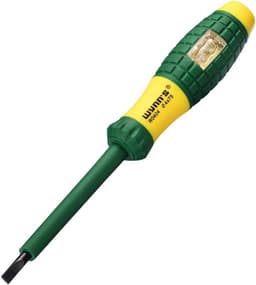
The pairs quote about 140 mm and about 190 mm. The longer slotted blade reaches a screw set back in the rose without bridging the next terminal. A short blade is the failure: you come in at an angle and the tip spans two conductors. Eightwood's bullets say 75 mm and a 4 mm tip, which is short and wide for a small lighting screw. That 4 mm is blade width, not a safety mark. The Bosch is one SL3x65, so there is no spare length. Rolson reviews mention soft tips, including a folded tip. The KAIWEETS pen is Phillips, so it will not seat in a slotted rose screw. Use a slotted blade to turn the screw. Do not expect either tool to confirm there is no current.

Colours, a photo, and when to stop

Photograph the rose before you release a screw, as Toolstation suggests. Brown or red is live, blue or black is neutral, and green-and-yellow is earth. Red and black are the older pair beside brown and blue. A switched live is what the wall switch sends back. This page will not invent a loop-in diagram. Extra cores, or two browns you cannot explain, are a stop. Stop as well if a metal fitting has no earth, if the room is a bathroom, or if the accessory is burnt. Paid work and a breaker you cannot identify belong to a competent person. The dead test is on neon screwdriver versus a two-pole tester. A pocket indication is on the best voltage tester screwdriver page.

Common questions

Is switching off the wall switch enough?
No. The wall switch can leave a permanent live at the ceiling rose and only interrupt the switched live, so the lamp is off while a terminal is still live. Switch off the lighting circuit at the consumer unit, and confirm you have found the right device. That is the start. It is still not proof that every conductor in the rose is dead.
Which blade length helps in a rose?
The two-length pairs quote about 140 mm and about 190 mm, and the longer slotted blade is the one that reaches a recessed screw. Eightwood's bullets say 75 mm and a 4 mm tip, which is short and wide for a small terminal. The Bosch is a single SL3x65, with no spare length. A soft or folded tip, which Rolson reviews mention, stops helping as soon as it bends.
What colours are live, neutral and earth on a modern UK light?
Brown or red is live, blue or black is neutral, and green-and-yellow is earth. Toolstation names both the modern pair and the older red and black. Photograph the connections before you undo them. If both colour generations appear, or a blue core is sleeved as a live, do not invent the mapping. Unexplained conductors are a reason to stop.
What is a switched live, and when do you stop guessing?
A switched live is the conductor the wall switch sends back to the fitting. The rose may still contain a permanent live. Stop guessing when you cannot match the cores to live, neutral, and earth, when a sleeve is missing, or when the photo you took does not match what you are about to reconnect. A neon prod will not identify those conductors for you.
Does a like-for-like pendant swap need Building Regulations approval?
Checkatrade says a like-for-like swap in a standard room is usually not Part P notifiable in England and Wales, unlike a new circuit or work in a bathroom. Keep the word usually, and ask if you are unsure. That line is not a statement that Part P never applies, and it does not cover a bathroom, a new circuit, or a ruling this page has not sourced for Scotland or Northern Ireland.

Related pages

Sources

Public UK sources and the amazon.co.uk listings in this comparison. Listings captured 15 October 2026. Page updated October 2026.

  1. HSE GS38: Electrical test equipment for use on low voltage electrical systems (retrieved 15 October 2026)
  2. Electricity at Work Regulations 1989, regulation 12 (retrieved 15 October 2026)
  3. Electricity at Work Regulations 1989, regulation 16 (retrieved 15 October 2026)
  4. HSE HSR25: Memorandum of guidance on the Electricity at Work Regulations 1989 (retrieved 15 October 2026)
  5. NICEIC: Safe isolation procedure in 10 easy steps (retrieved 15 October 2026)
  6. DIN VDE 0680-6:2021-08 phase tester (retrieved 15 October 2026)
  7. DIY FAQ: Neon screwdriver (retrieved 15 October 2026)
  8. Neon tester training note (retrieved 15 October 2026)
  9. amazon.co.uk listings captured 15 October 2026 (retrieved 15 October 2026)