Independent comparisons. We may earn from shop links. More info

How to use helping hands soldering for one clean joint

Updated: October 2026

How to use helping hands soldering well is mostly about where the clips go, and where your face does not. The stand holds the work. It does not aim the iron or take the fume away. This page is the setup, not a ranking. Prices are in the [third hand comparison](/hub/hand-tools/third-hand). Products Compared wrote it on 15 October 2026 from UK review patterns, the CXI1 electronics practical, and Health and Safety Executive guidance, with no lab test of a pose. A qualifying purchase through our links can earn us a commission at no extra cost to you.

How to use helping hands soldering well is mostly about where the clips go, and where your face does not. The stand holds the work. It does not aim the iron or take the fume away. This page is the setup, not a ranking.

Our top picks

On this page

What the stand does, and what it does not

A helping-hands stand frees both hands for the iron and the solder. It will not keep a large board still. CXI1, a UK electronics practical, says a vice is the better hold once the work is larger than the jaws. A finding under a torch belongs on the jewellery setup. Choosing the stand is the buying guide. A missing foot or a thread that will not grip is a 30-day rejection under the Consumer Rights Act 2015. If the board is larger than the clips can span, use the PCB holder page.

Set the base, the sleeves, and the clip

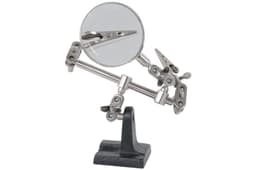
Put the feet on a flat bench. On the C100AE the clamp range is 5–50 mm. Glass is outside it, and a UK review reports a pinch in the articulated sections. Fit the sleeves before the clips touch the work. CXI1 notes that fierce teeth may need plastic wire insulation over them. A Nomiou review still describes a pressure switch punctured through the sleeve. One UK review says grippers melted under hot air. Do not use those sleeves as a hot-air fixture. Clip the wire, the lead, or the board edge. Do not clip the pad or across two tracks. Pose the gooseneck, let go, and watch. Preciva reviews say the neck springs back, worse with a heavy lens. If it walks back now, it will walk back when the solder is molten.

Heat the work, not the clip

Line the parts up before you pick up the iron. Peter Vis's soldering guide, a teaching page and not a UK regulator, puts the wires in the clips and only then applies heat. Heat the work, not the clip. Metal jaws sink heat. CXI1 says they pull warmth from a fine wire clamped beside the joint. Leave a little length, or clip the insulation if the part cannot roll. BEEYUIHF reviews say stiff, bolted arms can drag the board mid-joint. If the work moves, stop and reset the clip. On the auryee, arms can still shift under hard desoldering pressure. Swing a lens in after the clips are set, and turn that glass by the collar. A UK review says it can come free if you twist the glass itself.

Face, fume, and when to stop

Keep your face out of the plume. The Health and Safety Executive says to extract rosin fume, not to overheat the iron, and not to put your head in the smoke. INDG248 treats cough, wheeze, and a tight chest as symptoms to report. Set the lens so you can sit back. Stop if the board is mains-side work and you cannot make it safe and dead. A clip stand does not isolate a live circuit. Stop and get medical advice for wheeze or a tight chest after flux fume. Stop if the torch job is one you have not been shown. If you employ solderers and there is no extraction, that is a COSHH duty. New clips do not discharge it.

Common questions

Where do I put the clips?
Clip the wire, the lead, or the edge of a small board, and leave the pad clear. Leave a short length so the jaw does not sink the heat. Do not clip across two tracks. CXI1 notes that classic jaws open only a few millimetres. Pose the arm, let go, and confirm it stays before you heat anything.
Why do the arms spring back?
Goosenecks are a spring as well as a pipe. Preciva reviews say they return toward straight, and that the magnifier is too heavy for its arm. Set the pose, release it, and watch. If it walks back, shorten the reach or tighten the end fitting.
Should I cover the teeth?
Yes, whenever the part can mark. CXI1 suggests plastic wire insulation over fierce teeth. A sleeve is not a guarantee: one Nomiou review describes a punctured pressure switch, and another plate's grippers melted under hot air. Polished jewellery wants tweezers.
Do the clips steal heat from the joint?
They can. CXI1 treats the metal jaws as a heatsink. If you clamp bare copper beside the pad, the wire stays dull. Clip the insulation, or move the jaw further along the lead. The iron should touch the joint, not the clip.
Where does my face go if I use the lens?
Sit so the fume rises past you. The Health and Safety Executive says to keep your head out of the plume and not to overheat the iron. A lens tempts you to lean in. Swing the glass in after the clips are set. If you cannot see the pad without crowding the smoke, drop the stand lens.
When do I stop and get help?
Stop if the circuit is mains-side and you cannot make it safe. Stop and get medical advice for wheeze, a tight chest, or a rash after flux fume. Stop if the job is a torch you have not been shown how to quench. No extraction for employed solderers is a COSHH question. A clip that fails on day one is a 30-day rejection, not a posture tip.

Related pages

Sources

Public UK sources and the amazon.co.uk listings in this comparison. Listings captured 15 October 2026. Page updated October 2026.

  1. HSE: Solderer (retrieved 15 October 2026)
  2. HSE SR20: rosin-based solder flux fume (retrieved 15 October 2026)
  3. Consumer Rights Act 2015, section 22 (retrieved 15 October 2026)
  4. GOV.UK: General Product Safety Regulations 2005 (Great Britain) (retrieved 15 October 2026)
  5. GOV.UK: Electrical Equipment (Safety) Regulations 2016 (retrieved 15 October 2026)
  6. ESR: helping hands and magnifiers (retrieved 15 October 2026)
  7. amazon.co.uk (retrieved 15 October 2026)