Independent comparisons. We may earn from shop links. More info

Third hand for jewellery soldering: tweezers, not clips

Updated: October 2026

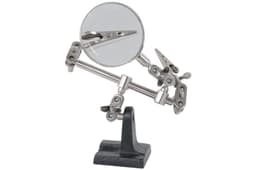
A four-arm plate with a jewellery word in the title is an electronics stand. A third hand for jewellery soldering is a weighted base and cross-lock tweezers, used over a surface that can take the flame. The clip will mark polished metal. The rubber sleeve is not a charcoal block. The twelve-row table is the [third hand comparison](/hub/hand-tools/third-hand). Products Compared wrote this on 15 October 2026 from that table, UK jewellery-tool shops, and the UK reviews on the tweezer listing, with no torch test. A qualifying purchase through our links can earn us a commission at no extra cost to you.

A four-arm plate with a jewellery word in the title is an electronics stand. A third hand for jewellery soldering is a weighted base and cross-lock tweezers, used over a surface that can take the flame.

Our top picks

On this page

Two different third hands

Crocodile teeth let go when you let go of the handles. Cross-lock tweezers, also called reverse-action, stay shut until you squeeze them open. UK jewellery shops sell that base, not a four-arm plate. Curious Gem in Edinburgh lists cross-locking tweezers at £13.90 including VAT. Cooksongold states a 65 mm base, with an ear post as the example. A sleeve is still the wrong jaw for polished silver. One UK review in this set says rubber grippers melted under hot air, and a torch is hotter. If your search was for wires, use the buying guide.

What the bench tool is

A ball joint or a vice slot aims the tweezers. Bellore Rashbel lists a wooden-grip tweezer at £10.25 excluding VAT, on a 60 mm base. That is not the same as £13.90 including VAT until you add the tax. Toolsmith, which dispatches in the UK, lists a holder base at £11.99 without tweezers. Fibre on the matching Amazon listing is a grip surface, not a flame rating. A 60 mm or 65 mm base is not a 24 cm electronics plate. The best helping hands page ranks clip stands for boards. It does not rank this tweezer base as the top pick for electronics.

The heat still needs a block

Tweezers hold the finding. They do not replace the surface under it. Curious Gem lists a charcoal block at £15.20 beside its third hand. Toolsmith describes charcoal for small work such as ear posts, and honeycomb for larger silver. This page does not invent a charcoal temperature. A rubber sleeve is a scratch guard, not a torch surface. If nobody has shown you how to heat, flux, and quench a piece you cannot afford to melt, the next step is a class or a bench jeweller. The electronics clip page is about rosin fume and an iron. It is not a torch lesson.

The Amazon tweezer set, and the watch warning

Jewellers Tools is a base vice and four angled tweezers at about £11.99, listed at 600 g, with fibre stated, no magnifier, and a United Kingdom origin line. The manufacturer is AL Findings Ltd. The rating is 4.6 from 428 reviews. UK reviewers hold findings and small wire, and several call the base weighty enough. One UK review says the steel is highly magnetic. The listing does not claim otherwise, so keep the set away from a watch movement. Another says there is no rubber underside, so the base can spin, and that the stand is shorter than the picture: two steps, where the photo showed three. Use it over charcoal or honeycomb. Do not use a crocodile plate because the title said jewellery.

Common questions

What is a jeweller's third hand?
A weighted base that holds cross-lock tweezers, so a finding stays put while you use the torch. The tweezers stay shut until you squeeze. A crocodile clip grips only while you hold it closed. It is not a four-arm plate, even when the title mentions jewellery.
Can I use helping-hands crocodile clips on silver?
They are a poor choice on polished silver. The teeth mark the metal, and a rubber sleeve is not a surface for a flame. A UK review says grippers melted under hot air, which is cooler than a jewellery torch. Cross-lock tweezers are the jaw the UK tool shops sell.
What is cross-lock?
The tweezers spring shut and open only when you squeeze, so the finding stays put while the torch is in your other hand. A crocodile clip does the reverse. Cooksongold and Curious Gem sell the cross-lock type. The Amazon row that matches it is the Jewellers Tools set.
Do I still need a charcoal block or a honeycomb?
Yes, if you are soldering with a torch. The tweezers hold the piece. The block takes the heat. Curious Gem lists charcoal at £15.20 beside its third hand. Toolsmith describes honeycomb for larger silver. A rubber sleeve is not a substitute, and this page states no charcoal temperature.
Are the tweezers magnetic?
The listing does not say. One UK review says the steel is highly magnetic and a poor match for watch work. Treat that as a review, not a printed spec, and keep the set away from a movement. The same tweezers are still used for findings and small wire.
When should a beginner stop and take a class?
Stop before you heat a piece you cannot afford to melt, if nobody has shown you how to flux, where to put the flame, and how to quench. The base holds the finding. It does not teach the torch. A class, or time with a bench jeweller, is the next step. Another four-arm plate will not supply it.

Related pages

Sources

Public UK sources and the amazon.co.uk listings in this comparison. Listings captured 15 October 2026. Page updated October 2026.

  1. HSE: Solderer (retrieved 15 October 2026)
  2. HSE SR20: rosin-based solder flux fume (retrieved 15 October 2026)
  3. Consumer Rights Act 2015, section 22 (retrieved 15 October 2026)
  4. GOV.UK: General Product Safety Regulations 2005 (Great Britain) (retrieved 15 October 2026)
  5. GOV.UK: Electrical Equipment (Safety) Regulations 2016 (retrieved 15 October 2026)
  6. ESR: helping hands and magnifiers (retrieved 15 October 2026)
  7. amazon.co.uk (retrieved 15 October 2026)