Soldering fumes at home UK: the stand is not extraction

Rosin flux fume can cause asthma. A clip stand holds the board and leaves the plume in the air. Copy HSE extraction and posture advice on a UK home bench.
On this page
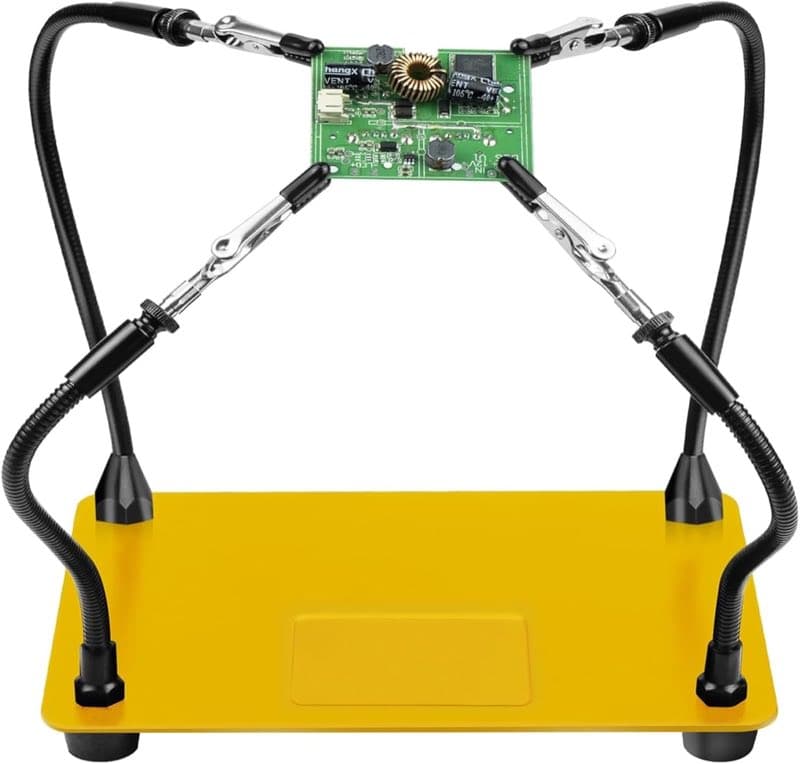
The board is finally still in the clips, and a thin plume rises off the flux into the gap under your nose. Soldering fumes at home UK are still rosin flux fume. The Health and Safety Executive calls rosin-based solder flux fume a top cause of occupational asthma, and it tells solderers to extract the fume, avoid overheating the iron, and keep their head out of the plume.
Those lines were written for workplaces. The flux on a hobby reel is the same material. This page follows HSE's solderer page, employee leaflet INDG248 (September 2015), employer leaflet INDG249 (September 2015), and COSHH essentials sheet SR20 (March 2025). We did not sample workshop air, and we did not test fans, boxes, or clip stands.
In short
Rosin, also called colophony, gives off fume when you heat it, and that fume can cause asthma and can sensitise the skin. Keep your face out of the plume, run the iron at the lowest temperature that still makes a sound joint, and capture the fume so it is not blown back into the room. A helping hand holds the work. Extraction and the position of your face deal with the fume.
What the plume is
The fume in that warning is what heated flux gives off. On a typical electronics reel the flux is rosin, also called colophony, in the core of the wire. The alloy melts and wets the pad. The flux cleans the metal, then boils off. The wisp shows where that contamination is going.
INDG249 calls rosin-based solder flux fume a common cause of occupational asthma, and contact with the fume and its residues can cause dermatitis. SR20 adds that rosin fume is a potential skin sensitiser, and that soldering can also generate metal fumes. A lead-free alloy changes the metal. A rosin core can remain, and that core is the fume HSE is describing.
Lead-free, silver bearing, and electronics name the alloy or the market. Look for rosin, colophony, resin, rosin-free, and rosin-reduced on the reel or the safety data sheet. A no-clean line describes residue after the joint cools. INDG249 and SR20 both point to crimps, wire wrap, or rosin-free and rosin-reduced solder. Some adhesives can themselves cause asthma and dermatitis, so read the safety data sheet before you swap.
The controls HSE puts first
INDG249 starts before the fan. Eliminate the soldered joint where you can, then substitute the rosin flux, and only then add ventilation, a temperature-controlled iron, posture, and local exhaust if rosin remains. Respiratory protection sits last. It should not stand in for extraction on production soldering.
INDG249 says fume levels can triple between 250°C and 400°C. SR20 says use the lowest temperature that still makes an acceptable joint. A station left at the top of the dial makes more fume than a small pad needs. The reel and the iron's instructions set the range. An iron so cool that the solder will not wet the pad is a bad joint.
Posture fails when you chase a tiny pad with your nose. INDG249 says place the work so your head stays out of the fume, and its example raises the workpiece. The plume rises, so your eyes can sit above it and your nose behind it. An open window is general ventilation. SR20 also says keep the joint away from draughts that disturb extraction and carry the plume with them.
INDG248 says use fume extraction for rosin-based flux, and also for other fluxes if you solder more than a few minutes a day. Those few minutes belong to the other fluxes. A short repair with a rosin core is still rosin work.
Fume extraction for hobby soldering
The solderer page says a soldering booth is best, on-tip extraction blocks swiftly, and bench-mounted boxes are of limited use unless fitted with a HEPA filter. INDG249 prefers a ventilated enclosure when the work fits inside. A chassis that will not fit needs a hood or a tip system at the joint you actually have.
In INDG249's capturing-hood example, reliable capture is only about one to two hood diameters, roughly 50-100 mm. A hood parked by the solder reel misses the pad. Move it with the joint, and keep the iron rest inside the zone. A hot tinned tip keeps fuming on an open stand.
On-tip extraction is a tube about 5 mm across, travelling with the bit. Sticky flux fills the bore. SR20 tells workplaces to clear those tubes at least once an hour. On a short session at home, look through the tube before the first pad. A blocked tube is only a clip on the iron, and when you lift the iron the nozzle leaves the hot joint.
INDG249 calls the carbon-pad box a fume disperser, including units sold as absorbers. HSE's tests found those coarse filters remove only a small proportion of the harmful constituents, and the exhaust still contains fume. They can suit very intermittent, low-volume work if the outlet misses other people. SR20 says bench units that return air to the room need a HEPA filter. Particles are typically 0.5-1.0 micron.
A kitchen extractor serves the hob. HSE's local exhaust for this fume is a booth, a capturing hood at the joint, or on-tip extraction with a clear tube. A USB fan across the desk moves the plume along the bench, or out into the rest of the flat.
What a home bench can copy
INDG249 is for employers under the Control of Substances Hazardous to Health Regulations 2002. Soldering your own kit does not produce that assessment, that training record, or a 14-month examination of local exhaust. SR20 expects health surveillance where asthma is a reasonable likelihood. If someone solders as paid work, follow INDG249. Northern Ireland workplaces should check HSENI, because these leaflets are Great Britain HSE guidance.
At home, copy the physics. Crimp, or use a rosin-free or rosin-reduced flux, where the joint and the safety data sheet allow. Set the lowest temperature that wets the pad. From 250°C to 400°C the fume can triple. Raise the board so your face stays behind the plume. For rosin, put extraction at the joint and keep the iron rest in that zone. A bench box that blows air back into the room needs a HEPA filter, changed when flux loads it. Keep other people out of that exhaust.
SR20 says that when the controls on the sheet are applied properly, exposures below 0.05 mg/m³ as an eight-hour average can be achieved. That figure is a workplace with those controls in use, not a spare-room legal limit. A clip stand has no route to it.
What a third hand changes
A third hand holds the wire or the board so one hand can take the iron and the other the solder. The plume still rises off the flux. A heavier base, sleeves on the jaws, a tray, or a lamp can improve the hold. The fume stays in the air.
The lens changes how much of that air you breathe. Stands in the third-hand comparison include glasses listed at 3× and at 6×. You bring your eye to the glass, and your nose follows. Raise the work, or move the lens, until you can see the pad with your face behind the plume.
Judge the stand on the hold, then stop. That comparison sets out the clips, the base, and the lens. Extraction is a separate tool. A qualifying purchase through links on that comparison can earn us a commission at no extra cost to you.
Symptoms to take to a GP
INDG248 names coughing, wheezing, runny eyes or nose, and a tight chest. These can be symptoms of occupational asthma or other serious illness, and they worsen if you keep breathing the fume after it has made you ill. Tell a GP that you solder, whether the reel says rosin, and when the symptoms arrive. This page cannot diagnose the cough. Add skin soreness or a rash. INDG249 links residues to dermatitis, and SR20 calls the fume a potential skin sensitiser.
Health surveillance, where asthma is a reasonable likelihood, is an employer duty in SR20 and on the solderer page. A hobby bench does not come with that file. Stop and get advice when those symptoms show up, rather than finishing the board on the hope that a tight chest was the weather.
Common questions
Is rosin flux fume only a factory problem?
Does lead-free solder remove the fume?
Is a bench-top fume box enough?
Where should my face be when I solder?
Does a magnifier make solder fume exposure worse?
What solder fume symptoms should I take to a GP?
What does a helping hand change about solder fume?
When is home soldering a workplace COSHH matter?

Products Compared publishes British-English buying guides based on amazon.co.uk listings and public UK sources. We do not run a lab and we do not invent test scores.
Related articles

What a neon screwdriver cannot prove
A glowing neon in the handle is a single-pole glow. Safe isolation wants a two-pole tester proved before and after.

What VDE means on a screwdriver
VDE on a handle is an insulation standard. Electricity at Work still expects the circuit dead unless three conditions are met.
Prove a circuit dead before you open it
Lock off, prove the tester, test the circuit, then prove the tester again. A screwdriver is not that sequence.