Safe isolation proving unit UK: why off is not dead
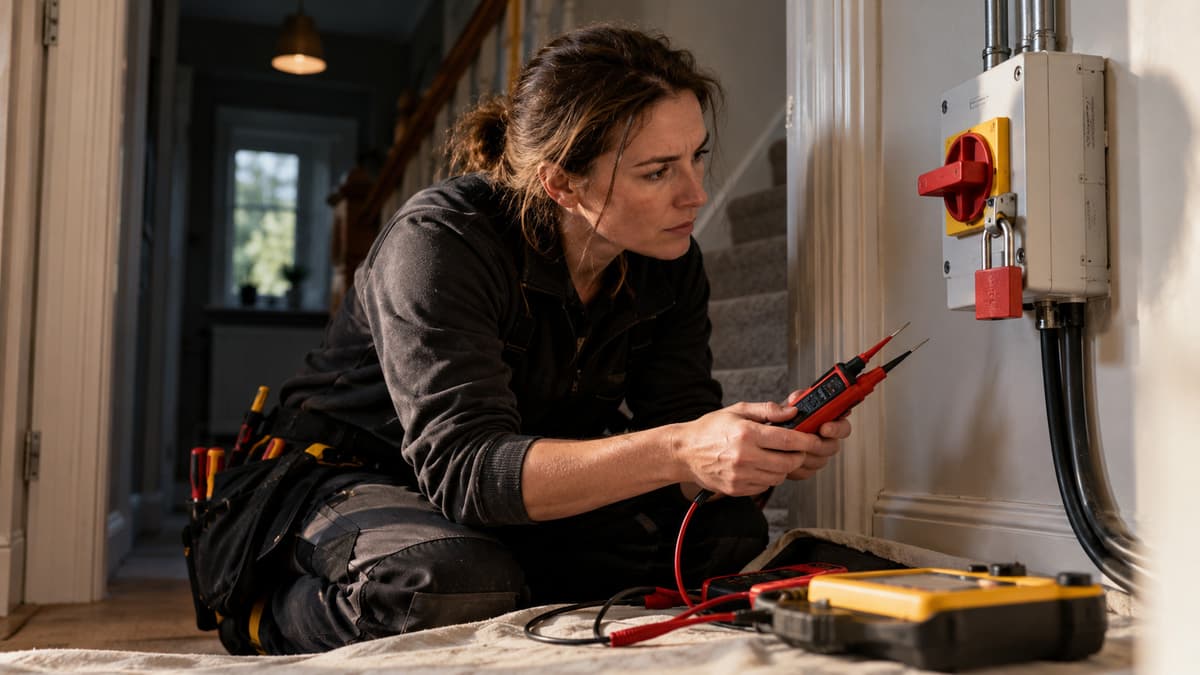
A breaker in the off position does not prove a UK circuit dead. Safe isolation proves the tester, tests the conductors, then proves the tester once again.
On this page
The landing is dark, the breaker handle is down, and the faceplate screws are next. You looked up a safe isolation proving unit UK electricians are told to carry, and the handle still feels like the answer. It has only moved. The unit sits inside an order: prove the tester, lock the isolation, test the conductors, then prove the tester again. Until someone competent has finished that order, the circuit has not been shown to be dead.
This page is from the Products Compared editorial team. It follows Best Practice Guide 2, issue 4.3 from Electrical Safety First, published in August 2026, SELECT's ten steps, and HSE GS38, fourth edition, 2015. We have not opened a consumer unit and we have not tested an instrument. Screwdriver listings appear here because those tools get mistaken for the procedure.
In short
Switching off sits inside safe isolation, and the switch position is not the proof. The published order uses a test lamp or a two-pole voltage detector, proved on a proving unit before the conductors are tested and proved again straight afterwards, with the isolator locked and the key kept. A neon screwdriver, a non-contact stick, and an insulated driver leave that order unfinished. If you are not the competent person those guides are written for, book a registered electrician.
Why off is still a guess
Electrical Safety First says it should never be assumed that equipment is dead because an isolation device is in the off position. The handle can belong to another circuit, and on an alteration the records may be wrong. A pencil label is a claim, not a measurement. A breaker that opens only the line leaves the neutral unanswered. A borrowed neutral, forbidden by BS 7671 and still common on lighting, can become live when disconnected if a load on the other circuit is still energised. Off on the line says nothing about the neutral or the protective conductor.
Generators, uninterruptible supplies, solar systems and battery storage can keep feeding the installation after the main switch has moved. In island mode, AC circuits may stay energised unless the inverter is isolated from the battery. A time switch, a photocell or a phone app can restore a load that was quiet when you looked. The Health and Safety Executive for Northern Ireland notes that 230 volts, normal mains, is the most common voltage in electrical accidents, and that many happen to skilled people on equipment they thought was dead. If you cannot point to the isolation point from a diagram or an authorised person, the cover stays on.
The order a safe isolation proving unit belongs in
SELECT publishes ten steps for people who already work on installations. Permission comes first. The isolation device is found with an authorised person and with diagrams, not by remembering which room went dark. The tester is inspected, then proved on a proving unit, on its own test facility, or, only as a last resort, on a known live source. After that prove, the device is switched off, locked, and the key is kept. A notice reading "do not switch on" is displayed. The circuit is verified dead, the tester is proved again, and only then does SELECT say the work may begin.
Electrical Safety First writes the same shape: identify the point, secure every isolation off, prove the conductors dead before they are touched, and apply a prohibition sign. Regulation 13 of the Electricity at Work Regulations 1989 requires precautions so that equipment made dead does not become charged during the work. The Northern Ireland 1991 Regulations say the same. Regulation 12 defines isolation as secure separation from every source of electrical energy. A handle anyone can move has been switched, not isolated. There is no instruction here for which device to move or how a consumer unit comes apart.
What the proving unit is for
A proving unit presents a known voltage to the tester you are about to rely on. Electrical Safety First describes it as a stepped-up voltage from a battery, used to confirm that the indication actually works. Some two-pole detectors carry that check inside the instrument. The unit answers a question about the tester. It does not answer a question about the circuit in the wall, and a fresh battery does not lock the isolator.
GS38, at paragraph 20, says any device used to prove dead may fail to indicate danger, for example a faulty lamp. Such devices should be proved before and after use, preferably on a proving unit, or otherwise on a known live source of similar voltage where precautions prevent danger. SELECT puts that live source last. The second prove is the one skipped when the circuit test was quiet: a dead circuit and a dead tester look the same. This page does not describe proving a tester on a socket. If the proving unit is missing and this is not your trade, book an electrician.
Instruments that cannot prove dead
The instrument named for the test is a proprietary test lamp or a two-pole voltage detector, as GS38 recommends. Electrical Safety First expects every line, neutral and protective conductor to be checked and proved dead. A single contact cannot compare conductors with each other. Single-pole and non-contact detectors, sometimes called voltage sticks, are for identifying live equipment, not for proving dead. If the indicator shows live, treat it as live. If it stays quiet, do not assume the cable is dead. Multimeters, makeshift devices and a homemade lamp of a bulb and two bare wires are advised against, because that use has caused accidents.
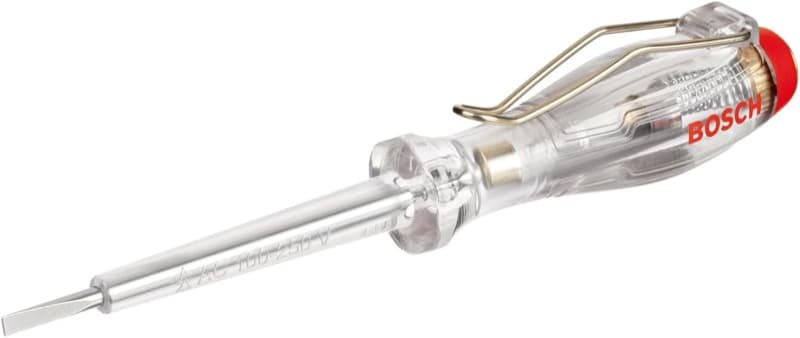
A neon screwdriver is the single-pole case, built into a handle. Listings for that shape sit in the voltage tester screwdriver comparison. The handle is not a two-pole detector, and a dark neon has not been proved. Even the correct two-pole detector fails the order if it is used once and not proved before and after.
An insulated screwdriver is not the test
An insulated screwdriver turns a screw. A VDE mark and a double triangle point to an insulation standard for a skilled person using a safe method. The claim is about the sleeve on the shaft. It does not present a known voltage, indicate between two conductors, or hold an isolator off. GS38's list for testing is probes, leads, lamps and voltage detectors. HSG85 keeps insulated tools and test instruments as separate precautions. The VDE screwdriver comparison is a buying table for drivers. Use it when the purchase is a driver, and leave it when the question is whether a circuit is dead.
Insulating tape over a circuit-breaker is not an acceptable lock, and Electrical Safety First says it will not meet the Electricity at Work Regulations 1989. The guide asks for a lock-off arrangement, a padlock opened by a unique key, and a prohibition sign. It does not recommend combination locks, because other people may know the code. Regulation 16 keeps people off work that needs technical knowledge or experience unless they have it, or they are properly supervised. A parcel of screwdrivers supplies neither.
Where you stop
Stop when the isolation point is a guess, when a label is untrustworthy, or when the board has no schedule. Guessing from which lights went out locks the wrong device. Stop when solar panels, a home battery, a generator or a UPS is present: island mode can leave AC circuits energised until the inverter is isolated from the battery. That job is an electrician's. Stop when a time clock, a photocell or an app can still switch the load, and stop when the distributor's service fuse would have to be withdrawn. Electrical Safety First says that fuse may be pulled only by the supplier, the distributor, or someone they have authorised.
Stop when the only tester in the drawer is a screwdriver, neon or insulated. You are missing the test lamp or two-pole detector, and both proves. The Health and Safety Executive for Northern Ireland says only competent persons should work on electrical systems. HSE's construction guidance on electrical systems in buildings says safe isolation must be followed at all times. In England and Wales, some dwelling work has to be notified unless a registered competent person self-certifies. Scotland and Northern Ireland keep their own rules. If this job is not yours, a registered electrician carries the lock, both proves, and the decision to begin.
Common questions
Is switching the breaker off enough to prove a circuit dead?
What does prove, test, prove mean?
What instrument is used to prove a circuit dead?
Why does the isolator have to be locked?
Can I prove the tester on a live socket instead of a proving unit?
Where does a neon screwdriver fail this test?
Does an insulated screwdriver replace the test?
When should I stop and call an electrician?

Products Compared publishes British-English buying guides based on amazon.co.uk listings and public UK sources. We do not run a lab and we do not invent test scores.
Related articles

What a neon screwdriver cannot prove
A glowing neon in the handle is a single-pole hint. Safe isolation wants a two-pole tester proved before and after.

What VDE means on a screwdriver
VDE on a handle is an insulation claim. It does not lock an isolator or prove that a circuit is dead.
Torx, Pozidriv or Phillips on UK kit
Pozidriv, Phillips and Torx look related and are not. The wrong tip chews the screw even on an insulated driver.