Pozidriv or Torx screwdriver UK: stop a chewed head
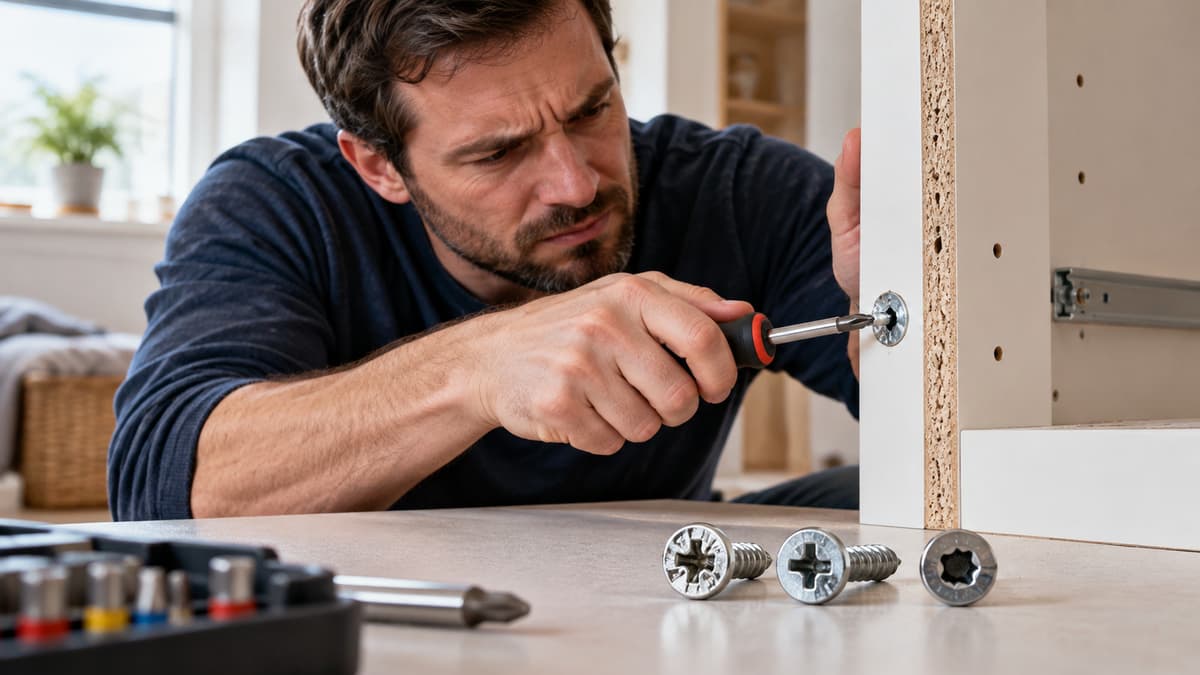
Pozidriv, Phillips and Torx are different recesses. Match the ticks or the star before you turn, or the tip cams out and chews a hinge screw on UK kit.
On this page
The wardrobe side is half on, the chipboard screw has gone shiny, and the driver keeps climbing out of the cross. That is how a Pozidriv or Torx screwdriver UK job goes wrong: the tip looks close enough, you add pressure, and the recess becomes a shallow dish. Pozidriv, Phillips and Torx are three recesses. The mark on the head chooses the tip.
This page follows UK fastener sellers on those shapes, BuildWiz’s size notes for timber and plasterboard screws (updated 13 October 2026), and the amazon.co.uk listings in our Torx screwdriver set comparison. We have not laboratory-tested a driver or a screw. A qualifying purchase through our links can earn us a commission at no extra cost to you.
In short
Extra ticks between the arms mean Pozidriv, a plain cross means Phillips, and a six-point star means Torx. A Phillips tip risks a Pozidriv head, a Pozidriv tip does not seat in a Phillips screw, and a star takes the size printed on the box. This page matches the tip and sets no torque figure.
Three recesses on the screw
Tell them apart on the screw, under a lamp, before you fit a driver. Pozidriv is the cross with ticks between the arms. On a British bench you will also hear Pozi, and some sellers print Pozidrive for the same recess. Shop4Fasteners describes lines etched between the four arms. BuildWiz describes four small lines at 45 degrees, so the head looks like a cross laid over a faint star. The bit carries extra ribs, and the marking is PZ.
Phillips is the plain cross. The four blades taper towards the tip, and the marking is PH. Pages written for the United States often call every cross a Phillips. On UK timber the ordinary wood screw is commonly Pozidriv, so a mixed cross-head set slips in a hinge that looked familiar. Confirm the plain cross on the head, especially on imported hardware.
Torx is the six-point star, marked TX or T and a number. BuildWiz places it on decking screws, structural timber screws and concrete screws. A star tip will not repair a chewed cross, and a cross tip will not turn a star. If the head is painted or already polished, compare it with a fresh screw from the same box. The ticks are shallow, and in a shadow they disappear.
Why a Phillips tip chews a Pozidriv screw
The outlines are close and the walls differ. Bolts describes the Phillips recess as tapered, and designed to cam out under heavy torque so the head is less likely to be torn off. The driver splines taper in at the tip. A Pozidriv recess is parallel, so more torque can be used without that slip. Cam-out is the climb: the tip rides up, the screw stops, and the cross goes bright.
A PH2 bit in a PZ2 screw touches too few faces and spins out. A PZ2 bit in a PH2 screw sits at the wrong depth. Bolts allows a Phillips driver on a Pozidriv screw only when you have no other option, only at low torque, and still warns that the head can be damaged. A Pozidriv driver, the same seller says, will not enter a Phillips recess fully and will only damage it. Shop4Fasteners agrees the Pozidriv driver does not fit.
A worn bit does the same damage. BuildWiz describes a sound PZ2 or PH2 as crisp edges and a defined point, and a worn one as rounded and polished. There is no reliable screw-count for a bit. BuildWiz reports one tradesperson, on hundreds of 5 mm screws a day, seeing standard bits last from a morning to half a dozen screws. Keep a spare PZ2 and a spare PH2 in the case.
What PZ2 and PH2 are actually for
PZ2 means Pozidriv size 2. PH2 means Phillips size 2. The shared number leaves them as different shapes, so PZ2 or PH2 is the wrong question until you have looked at the head. Pozidriv runs from PZ0 to PZ4. BuildWiz says the ends of that range rarely appear on a house, and that PZ1, PZ2 and PZ3 cover the work, with PZ2 doing most of it. A 50 mm bit and a 25 mm bit with the same marking are the same recess.
BuildWiz ties the Pozidriv bit to diameter on wood and multi-purpose screws. Under 3.5 mm, given there as No.4 and No.5, takes PZ1, for small hinges, drawer runners and catches. From 3.5 mm to 5.0 mm, No.6 to No.10, takes PZ2: battens, trim, kitchen carcasses, door hinges, shelving, floorboards and wall units into plugs. From 6.0 mm, No.12 upwards, takes PZ3. Leaving PZ2 in the chuck for that larger screw is how the head rounds.
Plasterboard is the Phillips exception
BuildWiz says UK plasterboard screws are almost universally Phillips, so a 3.5 mm board screw takes PH2 when the box says Phillips or PH. Swap when you leave the timber, and swap back for the hinge. Cam-out is a poor depth stop on the paper face; a collar sets the depth. A flat-pack cam, or a screw supplied with an appliance, can ignore that diameter table. No ticks means you treat the head as Phillips only when it is a plain cross, and you leave it alone when the mark is gone.
Where a Pozidriv or Torx screwdriver belongs
Use Pozidriv on the ticked timber screws in that list, and Torx where the head is a six-point star. BuildWiz meets the star on decking, structural timber screws and concrete screws, including 7.5 mm concrete screws used as frame fixings. Two 5 mm decking screws from different brands can need different stars. A chart that says 5 mm means TX25 is guessing. The number is on the box. BuildWiz calls TX20 and TX25 the sizes that turn up most often on construction screws, and still says to confirm the box before the first screw.
Appliance stars stay on the fastener
A Cromwell trade sheet lists Torx as common on machinery, cars and domestic appliances. That line is a catalogue note. It names no T20 for a brand of washing machine, hob or laptop, and this page will not invent one. Look at the recess you can see. A pin in the middle of the star needs a bored tip. A plain Torx driver sits on the pin and chews the lobes.
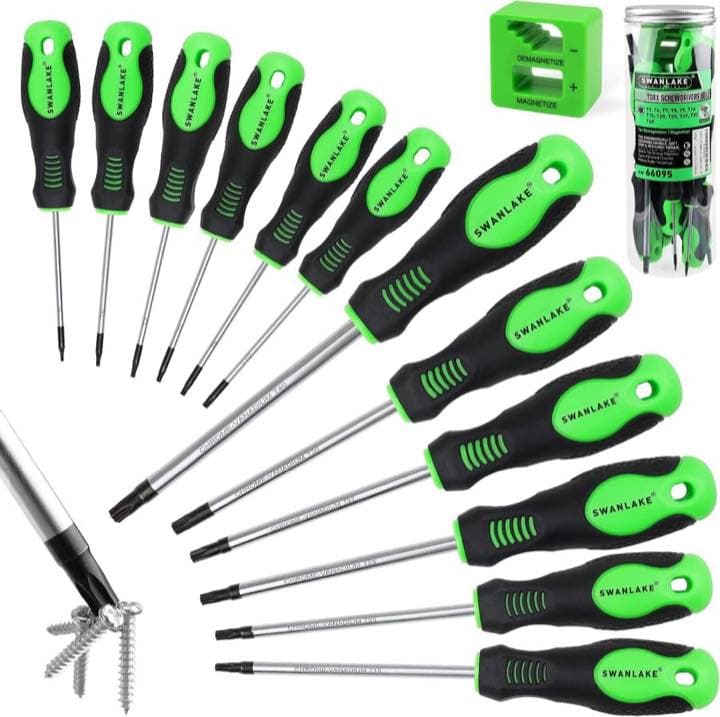
The Torx screwdriver set comparison lines up star drivers. Its top pick for plain screws from T5 to T40 is the SWANLAKE 13-piece, listed at £11.99, with 4.6 from 1,814 amazon.co.uk reviews: twelve fixed drivers plus a magnetic retriever. Reviewers mention car lamp fittings. Several say the tips hold a screw only after the included block. Skip a centre pin, anything smaller than T5, and heavy torque. Prices on amazon.co.uk move. The Wera screwdriver comparison lists Pozidriv sets and Phillips sets as different contents. Read the PZ or PH line before the grip decides the purchase.
What this page will not torque
Seat the tip fully and in line before you turn. BuildWiz treats a half-engaged bit as a cam-out on the first revolution, and a slight angle as a lever out of the recess. On a combi drill, pressure behind the bit keeps it seated: start slowly, then one continuous run. An impact driver makes its own forward blows, so extra leaning fights it, and a standard bit under those blows rounds and cams out. If that is the driver in your hand, look for impact on the packet. Set a combi clutch low, test on an offcut, and stop when the head is flush. An impact driver has no clutch, so ease off as the head meets the surface.
None of that is a torque for a hinge, a decking screw or a laptop fastener. This page gives no newton-metre figure. A tip that fits can still snap a small screw under a full-size driver, because feel is a poor measure on those fasteners. If the recess is already a round dish, stop. Another tip from the same family has nothing left to grip. Drilling the head off sits outside this page, as does any screw you cannot see, including one beside a live terminal.
Common questions
How do I tell Pozidriv from Phillips?
Can I use a Phillips driver in a Pozidriv screw just this once?
What does the six-point star mean?
Which size is PZ2 for?
Are appliance screws always Torx?
What is cam-out?
Which comparison lists Torx screwdriver sets?
Does this page set a torque for the screw?

Products Compared publishes British-English buying guides based on amazon.co.uk listings and public UK sources. We do not run a lab and we do not invent test scores.
Related articles

A torque screwdriver for small screws
Feel is a poor measure on laptop and appliance screws. Match the tip here, and take the torque figure to that comparison.

What VDE means on a screwdriver
VDE names an insulation claim on the handle. The stamp still needs the right tip, and it does not permit live work.

Oil and a dry place for steel tools
Bare steel drivers rust in a damp British shed. A thin film and a dry cupboard store them better than vegetable oil.