Independent comparisons. We may earn from shop links. More info

How to use a honing guide without rounding the edge

Updated: 22 October 2026

The chisel is in the jig, the roller is on the stone, and the edge still comes out rounded or out of square. How to use a honing guide is three habits: use the numbers printed for the guide in your hand, keep the roller on the abrasive for the whole stroke, and take the burr off with the back flat. A 25° primary and a 30° hone are workshop practice, not a British Standard. The [chisel honing guide comparison](/hub/hand-tools/chisel-honing-guide) is the product table, with GBP prices. Peter F. followed Faithfull's sheet and Trend's instruction PDF. We did not time a set of strokes. A qualifying purchase through our links can earn a commission at no extra cost to you.

The chisel is in the jig, the roller is on the stone, and the edge still comes out rounded or out of square.

Our top picks

On this page

Set a Faithfull or Eclipse-pattern guide

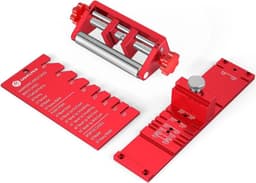
Name the guide before you trust a millimetre. On the Faithfull FAIHG chisel jaws, 30 mm of projection is 30° and 40 mm is 25°. On the plane jaws, 38 mm is 30° and 50 mm is 25°. The longer projection is the lower angle. One UK retailer prints 60 mm for 25° on the plane jaws. Faithfull prints 50 mm. Use the maker. The middle V is for fully bevelled paring chisels. The lower flat jaws are for mortise chisels and part-bevel chisels. Tighten with a screwdriver. Paint in the jaws is a common reason the blade sits proud on one side. Seat the blade, then measure from the jig to the edge on the jaws you used. A plane iron in the chisel jaws gives a believable number and the wrong angle. Those millimetres do not transfer to a Trend block. When the blade is too short to reach the marks, that is the short chisel problem.

Set a Trend guide

The Trend DWS/HG/SET uses its own setting device. The manual's first projection is about 35 mm, and the step then sets 25°, 30°, 35°, or 40°. That device fits this guide. Faithfull's 30 mm does not mean 30° on the Trend. Chisels are 10 mm to 32 mm, plane irons go up to 60.3 mm, and the manual limits thickness to 7 mm. Firmer chisels and short-blade butt chisels are excluded. The listing does not print the 75 mm minimum, which is in the manual for 25°. Keep the roller on a diamond stone at least 63 mm by 178 mm. If it drops off the end, the bevel becomes a curve. UK reviews say the stone was not in the box. Square the edge, register the stop, then put the roller down. Which mechanism you should have bought is the side clamp or angle fixture page.

Hone, then the back

Lap the back before you chase the bevel. Trend's manual puts that lap first. Keep the stone still, and keep your hands behind the edge. Faithfull's sheet is explicit about that. A slip on a freshly honed chisel is a cut. Push the roller the length of the stone without lifting it. Lift at the end and the edge dubs over. On a narrow chisel in a Faithfull, a lean rocks the small wheel. If the scratch pattern is only on one corner, reset the blade. The burr is the wire that folds onto the back. Feel it with a fingertip drawn away from the edge. Take it off with the back flat on a fine stone. Scrap wood knocks the wire off and leaves the back untouched. A ruler trick is for a plane iron, not a chisel back. A 400 then 1000 plate will raise a burr. It will not leave a polish.

When the projection will not fit

Stop when the edge is chipped into the shoulder, the back will not lap, or you do not know which bevel a laminated chisel uses. A jig will not invent that geometry. More pressure is how a chip becomes a shorter chisel. Shortening the projection so a butt chisel reaches the stone makes a steeper angle, not the 25° you wrote down. Forcing a Trend block onto a butt chisel contradicts the maker's exclusion. If you have not chosen between a side clamp and a block, start with the buying guide. Rinse slurry out of the roller before you put the guide away.

Common questions

How far should the chisel stick out of a Faithfull guide?
On the chisel jaws, 30 mm gives 30° and 40 mm gives 25°. Measure from the jig to the cutting edge after the blade is seated. Those figures are for this Eclipse-pattern guide. A thick blade, or a different jig, changes them. The longer projection is the lower angle.
What are the plane-iron projections?
On the Faithfull plane jaws, 38 mm is 30° and 50 mm is 25°. Do not use a retailer's 60 mm figure in place of the maker's 50 mm. Do not put the plane iron in the chisel jaws and expect the chisel numbers to hold. Measure after the blade is seated.
Can I use those millimetres on a Trend block?
No. The Trend block is marked 25°, 30°, 35°, and 40°, and its setting device starts from about 35 mm of projection before the step sets the angle. The device fits the Trend guide only. Faithfull's 30 mm is not 30° on that block.
Do I lap the back before or after the bevel?
Lap the back first, then hone the bevel until a burr appears, then take the burr off with the back flat again. Trend's manual puts the face lap first. A rounded back will not sit in a paring cut however square the jig was.
How do I know the burr is there, and how do I take it off?
You feel a fine wire on the back, drawing a fingertip away from the edge. Remove it with the back held flat on a fine stone. Scrap wood knocks the wire off and leaves the back untouched, which is the step to avoid. A ruler trick is for a plane back, not a chisel.
What happens if the roller leaves the stone?
The blade tips, the bevel dubs, and the edge you just squared becomes a curve. Keep the roller on the abrasive for the whole stroke. On a Trend guide the stone wants to be at least 63 mm by 178 mm so the roller has somewhere to stay.

Related pages

Sources

Public UK sources from the research digest, last checked on 19 October 2026. Shelf prices and star lines are the amazon.co.uk figures in the display file.

  1. Faithfull Tools, FAIHG honing guide (retrieved 19 October 2026)
  2. Faithfull honing guide instructions (retrieved 19 October 2026)
  3. Trend DWS/HG/SET diamond honing guide set (retrieved 19 October 2026)
  4. Trend DWS/HG instruction sheet (retrieved 19 October 2026)
  5. GOV.UK, General Product Safety Regulations 2005 (retrieved 19 October 2026)
  6. Consumer Rights Act 2015, goods remedies (retrieved 19 October 2026)
  7. HSE, woodworking standards (retrieved 19 October 2026)
  8. Common Woodworking, using a honing guide (retrieved 19 October 2026)