Independent comparisons. We may earn from shop links. More info

Bee hotel or bug hotel

Updated: 22 October 2026

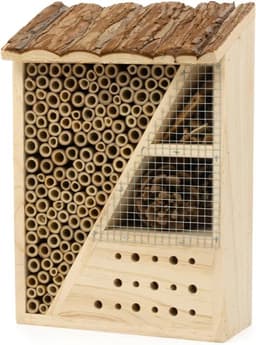
The listing says insect hotel and the photo shows bamboo tubes beside a pocket of pine cones, as if mason bees and ladybirds booked the same room. Bee hotel or bug hotel is the choice underneath that cottage picture: a nest tunnel for cavity-nesting solitary bees, or a dry crevice shelter for overwintering predators, or a mixed box you buy with both jobs named. The [insect hotel comparison](/hub/garden-supplies/insect-hotel) shows which of the nine amazon.co.uk products lean which way. A qualifying purchase from that page can earn us a commission at no extra cost to you. This page is not a price ranking. Fix the box still, in sun, for tubes, and keep crevice shelters dry and still.

The listing says insect hotel and the photo shows bamboo tubes beside a pocket of pine cones, as if mason bees and ladybirds booked the same room.

Our top picks

On this page

A bee hotel is a nest

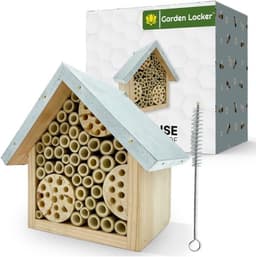
The Natural History Museum describes a bee hotel as a long-term nest from egg to adult, not an overnight stay. Mason bees and leafcutters lay in closed-backed tubes, seal the entrance with mud or leaf, and leave the next generation inside until emergence. That is why depth and diameter matter, and why the insect hotel buying guide spends time on 10–15 cm and 2–10 mm. A shallow decorative tube fails that job even when the roof is pretty. Wildlife Gardening Forum’s science note says bee hotels serve a few of the solitary species. It cites 240 or so solitary species in that discussion. Buglife’s broader UK bee figure is roughly 270 species, mostly solitary, and most of those nest in the ground. Do not merge those two counts into one statistic. A fence box helps some cavity nesters and does nothing for bumblebees or honeybees. Garden Locker’s target line says solitary bees. Pet Ting, Gate 35, and Pelle & Sol sit in the same tube-facing group when the face is bamboo or drilled wood. Hole width remains unstated on all of them.

A bug hotel is a hiding place

Wildlife Gardening Forum’s bug-hotel page says not to mix a bug hotel up with a solitary bee box. A bug hotel is sticks, straw, dry leaves, and similar fill for overwintering ladybirds, lacewings, and beetles. The Natural History Museum’s ladybird lodge is pine cones, twigs, and dry leaves under a roof for adults in diapause. A mesh pocket on a fence cottage is only a small hanging version of that idea. Pine cones do not bring mason bees. They offer crevices. If you named ladybirds because of aphids on roses, buy for crevices and leave the tubes for another purchase, or accept a mixed box as two products. Solitary wasps may use bee tubes. That is a different insect in the same cavity niche, not proof the box failed.

Mixed boxes in this set

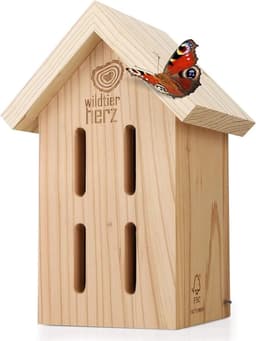
CKB LTD’s bullets are the cleanest split in this comparison: bamboo and drilled holes for mason and leafcutter bees, mesh with twigs and pine cones for ladybirds, lacewings, and other invertebrates. That is two jobs on one bark-roof frame. The title size is 29 × 20 × 10 cm and the item line is 29 × 29 × 29 cm, so the outer box fights itself, but the ecological split on the bullets is clear. ADEPTNA’s bullets also name bees, ladybirds, and lacewings in different rooms without printing hole sizes. Read it as a small mixed cottage, not as a measured dual nest. Garden Locker stays a tube house on the solitary-bee target line. Wildtier herz is a third thing entirely: narrow vertical hatches for butterflies to rest and overwinter, untreated wood claimed, assembly required. It is neither a bee tube nest nor a pine-cone ladybird lodge. If slits are what you want, leave this decision and open the butterfly house comparison. None of these nine ASINs is a pallet bug mansion.

What to buy for the insect you named

If you named mason or leafcutter bees, buy tubes with a solid back and the deepest tunnels you can verify, then site the box south or south-east and still. Detail is on where to put a bee hotel. Prefer Garden Locker when a stated metal overhang matters, or Pet Ting or ADEPTNA when review volume and price matter more than a printed roof. If you named ladybirds, buy crevice fill and a dry place. If you want both, buy a mixed listing such as CKB with eyes open, or hang a tube box and a separate crevice shelter so one failure mode does not empty both niches. Buy a mixed cottage when you can point at the tube face and the mesh face and say which insect each is for. Stars and rank do not turn pine cones into nests.

Common questions

What is the difference between a bee hotel and a bug hotel?
A bee hotel is a nest of closed-backed tubes for cavity-nesting solitary bees. A bug hotel is dry crevice shelter, pine cones, twigs and straw, for ladybirds, lacewings, and similar insects. Wildlife Gardening Forum asks you not to confuse the two.
Will pine cones bring in mason bees?
No. Pine cones are crevice habitat. Mason bees need tunnels of suitable depth and diameter.
Where do ladybirds actually spend winter?
As adults in dry crevices. The Museum’s lodge uses pine cones and leaves under a roof. A mesh compartment on a shop cottage is a small hanging take on that idea.
Can one box do both jobs?
Yes, as two products nailed together. CKB’s bullets already split tubes and mesh. Success on one side does not prove the other.
Are solitary wasps a problem in the tubes?
They are another cavity nester. They are not proof the hotel failed. Leave management advice to specialist guidance. This page only separates the product types.
Is a butterfly house either of these?
No. Vertical slits for butterflies are a third product. Wildtier herz in this set is that type.
Does a mixed box help more species?
Only if each compartment matches a real need. A mixed face is not automatically more useful than one good tube nest plus forage.

Related pages

Sources

Public UK sources from the research digest, and amazon.co.uk listings captured on 19 October 2026.

  1. RHS — Habitats for wild bees (retrieved 19.10.2026)
  2. Bumblebee Conservation Trust — A brief guide to solitary bee nest boxes (retrieved 19.10.2026)
  3. Buglife — How to be the best bee hotel manager (retrieved 19.10.2026)
  4. The Wildlife Trusts — How to build a bug mansion (retrieved 19.10.2026)
  5. Natural History Museum — How to make a bee hotel (retrieved 19.10.2026)
  6. Wildlife Gardening Forum — How to create and maintain bee hotels (retrieved 19.10.2026)
  7. GOV.UK — General Product Safety Regulations 2005 (retrieved 19.10.2026)
  8. Wildlife and Countryside Act 1981 (retrieved 19.10.2026)