Independent comparisons. We may earn from shop links. More info

Where to put a bee hotel

Updated: 22 October 2026

You have the box in your hands and a fence panel, a brick wall, or a tree, and the listing only says hang it. Where to put a bee hotel is aspect, height, and a fixing that does not swing, the three decisions that decide whether the tubes get used. The [insect hotel comparison](/hub/garden-supplies/insect-hotel) lists the nine amazon.co.uk products these notes refer to. A qualifying purchase from that page can earn us a commission at no extra cost to you. This page does not rank them. Hole diameters stay on the buying guide. Balconies in more detail sit on the small-garden page.

You have the box in your hands and a fence panel, a brick wall, or a tree, and the listing only says hang it.

Our top picks

On this page

Face and height

Solitary bees that use tubes warm up in morning sun. Friends of the Earth and the Bumblebee Conservation Trust both ask for full sun on a south or south-east face. A north wall that never sees that sun is the wrong place. If the only free brick is north-facing, move the box or wait for a sunny elevation. Height bands differ by source, so keep both. Friends of the Earth and the Trust say at least 1 m up. The RHS habitats page gives about 0.5–3 m on a wall or fence, and says you do not need a garden at all. Keep the entrance clear of leaves and trailing plants. Shaded holes stay cold and damp.

Fix it so it cannot swing

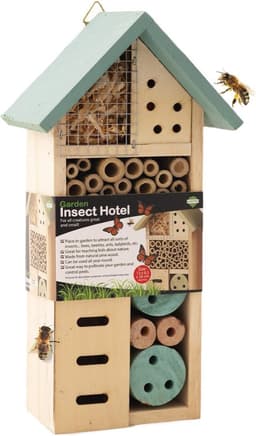
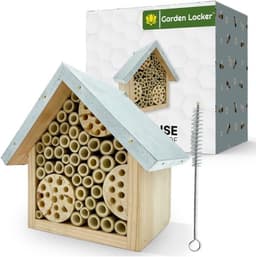
The Trust is explicit: the box must not sway. Damp, not cold, kills larvae, and a moving house puts bees off before damp gets a chance. Pet Ting reviews already describe bees ignoring a box left on a rope that moved in the wind. Screw or nail the hang tag into a post, a solid fence rail, or a wall plug. Garden Locker’s listing expects a nail or screw through the metal hang tag. A branch on a long cord fails the sway test even when the aspect is perfect. A flexing fence panel that bangs in the wind is a poor mount next to a stiff post. Balcony rails that vibrate under footfall are the same failure mode. The insect hotel for a small garden page covers that case. Pre-drilled holes, as on the orange-roof hanging hotel, still need a still substrate. Temporary placement is fine for a weekend test of sun, then fix it.

Flowers, mud, and a clear entrance

A hotel without forage is décor. The Natural History Museum notes that solitary bees forage within about 300 m. Friends of the Earth says pots and window boxes count, because the flight range is short. You do need open flowers through spring and early summer when mason bees are active, and some bare soil or a damp muddy patch if mason bees will seal tubes with mud. A sterile gravel yard with no blooms is a weak bet. Keep the entrance open. A climbing rose that flops over the holes turns a south wall into shade by June. Mud and leaf plugs in the tube mouths are the sign of use. If you want ladybird mesh rather than bee tubes, the shelter still wants a dry, still place, but aphids on plants matter more than bee flowers. Split that purchase on bee hotel or bug hotel.

If it stays empty, and what to do in winter

Wait until October before you call the site a failure. The Museum’s practical line is that if nothing has plugged a tube by then, move the hotel. Moving means a sunnier, higher, stiller place, not a twin box beside the empty one. Check that the face is still south or south-east and that nothing has grown over the holes. Re-read the insect hotel buying guide only if the tubes themselves look wrong. Siting will not fix a tunnel that was never deep enough. Winter advice depends on the box. Garden Locker’s bullets say do not clean during winter, which aligns with larvae still inside. That is a product line, not a full cleaning manual, and cleaning method stays off this page. A roofed hotel fixed to a dry wall is not the same case as an open bundle. Do not oil or varnish the entrances as a winter ritual from this article.

Common questions

Which way should a bee hotel face?
South or south-east, in full sun, according to Friends of the Earth and the Bumblebee Conservation Trust. Morning sun on the entrances matters more than a view from the house.
How high should it be?
At least 1 m for Friends of the Earth and the Trust. The RHS band is about 0.5–3 m. Stay inside those bands and keep the holes clear of leaves.
Can I hang it from a branch?
Only if the fixing cannot swing. A rope that moves in the wind fails the Trust’s rule, and Pet Ting reviewers already report bees ignoring a moving box.
Is a fence post better than a fence panel?
A stiff post or wall is usually steadier than a thin panel that flexes. The panel can work if the screw bites solid timber and the face stays still in wind.
What if the only wall is north-facing?
Do not expect tube nesters to use it. Move the box to a sunny elevation when you can, rather than buying another hotel for the same shade.
Do I need flowers as well?
Yes, within a few hundred metres. Pots and window boxes count. A hotel alone does not invent forage.
When do I bring it in, if at all?
Only if your box is a temporary, poorly sheltered nest and damp is likely. Follow the Trust and Friends of the Earth on dry storage for those cases. A fixed, roofed box on a dry wall is a different situation. Do not invent a universal indoor rule here.
How long should I wait before deciding it has failed?
Until about October. Plugged tubes are the evidence. Empty tubes after one warm week in April are not a verdict.

Related pages

Sources

Public UK sources from the research digest, and amazon.co.uk listings captured on 19 October 2026.

  1. RHS — Habitats for wild bees (retrieved 19.10.2026)
  2. Bumblebee Conservation Trust — A brief guide to solitary bee nest boxes (retrieved 19.10.2026)
  3. Buglife — How to be the best bee hotel manager (retrieved 19.10.2026)
  4. The Wildlife Trusts — How to build a bug mansion (retrieved 19.10.2026)
  5. Natural History Museum — How to make a bee hotel (retrieved 19.10.2026)
  6. Wildlife Gardening Forum — How to create and maintain bee hotels (retrieved 19.10.2026)
  7. GOV.UK — General Product Safety Regulations 2005 (retrieved 19.10.2026)
  8. Wildlife and Countryside Act 1981 (retrieved 19.10.2026)