Independent comparisons. We may earn from shop links. More info

Insect hotel buying guide

Updated: 22 October 2026

You are about to hang a wooden cottage on a fence and the amazon.co.uk page says bees, bugs, and insects as if they were one purchase. An insect hotel buying guide is the pass-or-fail before that click: cavity depth, hole width, a solid back, and a roof that sheds water, versus a pretty box that never gets used. The [insect hotel comparison](/hub/garden-supplies/insect-hotel) holds the nine-row table and the shelf prices in pounds. A qualifying purchase from that page can earn us a commission at no extra cost to you. This page is the checklist. It does not name a winner, and height and aspect stay on the siting page.

You are about to hang a wooden cottage on a fence and the amazon.co.uk page says bees, bugs, and insects as if they were one purchase.

Our top picks

On this page

What an insect hotel can and cannot do

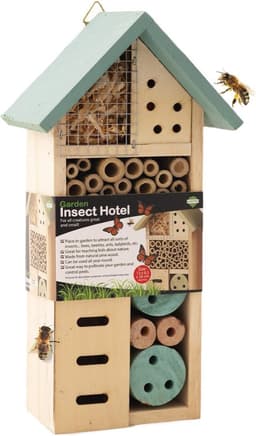
Most UK bee species nest in the ground. Buglife’s bee-hotel note puts that majority at about four in five. A tube box on a fence is for the minority that nest in cavities, mason bees and leafcutters among them, not for honeybees and not for bumblebees looking for a mouse hole. The Natural History Museum describes a bee hotel as a long-term nest from egg to adult, not an overnight stay. Ladybirds, lacewings, and beetles want dry crevices: pine cones, twigs, straw, not a smooth bamboo tunnel. Wildlife Gardening Forum says not to mix a bug hotel up with a solitary bee box. A listing that shows both in one cottage is two jobs nailed together. The bee hotel or bug hotel page splits those jobs.

The measurements that matter

Charities publish the numbers the listings leave blank. Friends of the Earth asks for tunnels at least 100 mm deep and diameters about 6–10 mm. The Wildlife Gardening Forum says at least 10 cm and no treated timber. The Bumblebee Conservation Trust asks for 15 cm minimum, diameters 2–10 mm, a solid back, and no plastic. Buglife warns that tubes under about six inches can skew the sex ratio. None of the nine amazon.co.uk listings in this set states an internal diameter or a tunnel length. Pet Ting’s 13 × 26 × 8 cm and ADEPTNA’s 13 × 25.5 × 8.5 cm are outer sizes. An 8 cm depth on the outside does not prove an 8 cm tube, and it is already short of the Trust’s 15 cm ask.

Roof, wood, and fixing

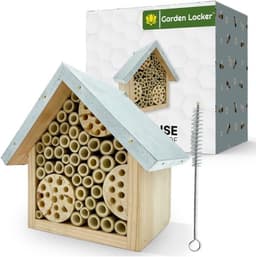
Damp kills larvae more reliably than cold. A roof that overhangs the entrances, untreated wood, and a mount that does not swing matter once the tubes are at least plausible. Garden Locker states an overhanging metal roof and a cleaning brush, and the bullets say not to clean during winter. Some reviewers say the brush was missing, so the claim is on the page and not always in the parcel. Pelle & Sol’s material line is bamboo and pine; one reviewer says a metal-roof line on the page is plastic, so this guide does not award that roof. Wildtier herz states untreated wood and FSC on a butterfly house with vertical slits, useful only if slits are what you wanted. Fix the box still to a wall, fence post, or solid panel. A rope that swings puts bees off, and Pet Ting reviews already say so. Aspect and height are one sentence here and the full method on where to put a bee hotel.

How to read this set when the tube length is missing

Price and stars still sort the shelf. Pet Ting is about £7.99 with 4.5 from 2,704 reviews and Insect Hotels rank 1. ADEPTNA is about £9.33 with 4.6 from 602. Garden Locker is about £15.99 with a stated metal roof. The multi-compartment house at about £20.99 shows 5.0 from one review, and that count is not a season of use. Gate 35 is about £19.99 with 4.5 from 807, and the review notes include shallow tubes and boxes that fell apart outdoors. The orange-roof hanging hotel has no review line on the capture. Do not read any of them as a measured 15 cm nest. When you want a named pick from this silence, open the best insect hotel UK page.

Common questions

How deep should the tubes be?
Wildlife Gardening Forum asks for at least 10 cm. Friends of the Earth says at least 100 mm. The Bumblebee Conservation Trust asks for 15 cm. Buglife warns about tubes under about six inches. None of the nine listings print those figures, so you cannot confirm depth from the product page alone.
What hole width suits UK solitary bees?
Friends of the Earth uses about 6–10 mm. Buglife and the Trust use 2–10 mm. Smooth entrances matter as much as the number. No ASIN in this set states an internal diameter.
Does a bark roof or a metal roof matter more than the tubes?
A roof that sheds water helps against damp. It does not replace tunnel length. Prefer a stated overhang when you can see one, then still ask whether the tubes are deep enough.
Are pine cones a bee nest?
No. Pine cones and twigs are crevice shelter for ladybirds and similar insects. Mason and leafcutter bees need closed-backed tubes of the right depth and width.
Should I buy untreated wood if the listing is silent?
Prefer listings that say untreated, such as wildtier herz on the butterfly house. Silence is not proof of treatment or of safety. Do not varnish the entrances. That advice is not on this page as a product instruction.
Is a 5.0 score from one review meaningful?
Not as a ranking signal. The multi-compartment house at about £20.99 has that line. Pet Ting’s 2,704 reviews and ADEPTNA’s 602 are the volume leaders in this set.
Will this box help bumblebees?
No. Tube hotels are for cavity-nesting solitary bees. Bumblebees nest differently. Ground-nesting solitary bees will not use the fence box either.

Related pages

Sources

Public UK sources from the research digest, and amazon.co.uk listings captured on 19 October 2026.

  1. RHS — Habitats for wild bees (retrieved 19.10.2026)
  2. Bumblebee Conservation Trust — A brief guide to solitary bee nest boxes (retrieved 19.10.2026)
  3. Buglife — How to be the best bee hotel manager (retrieved 19.10.2026)
  4. The Wildlife Trusts — How to build a bug mansion (retrieved 19.10.2026)
  5. Natural History Museum — How to make a bee hotel (retrieved 19.10.2026)
  6. Wildlife Gardening Forum — How to create and maintain bee hotels (retrieved 19.10.2026)
  7. GOV.UK — General Product Safety Regulations 2005 (retrieved 19.10.2026)
  8. Wildlife and Countryside Act 1981 (retrieved 19.10.2026)