Remove cement from paving: haze, film and hard lumps
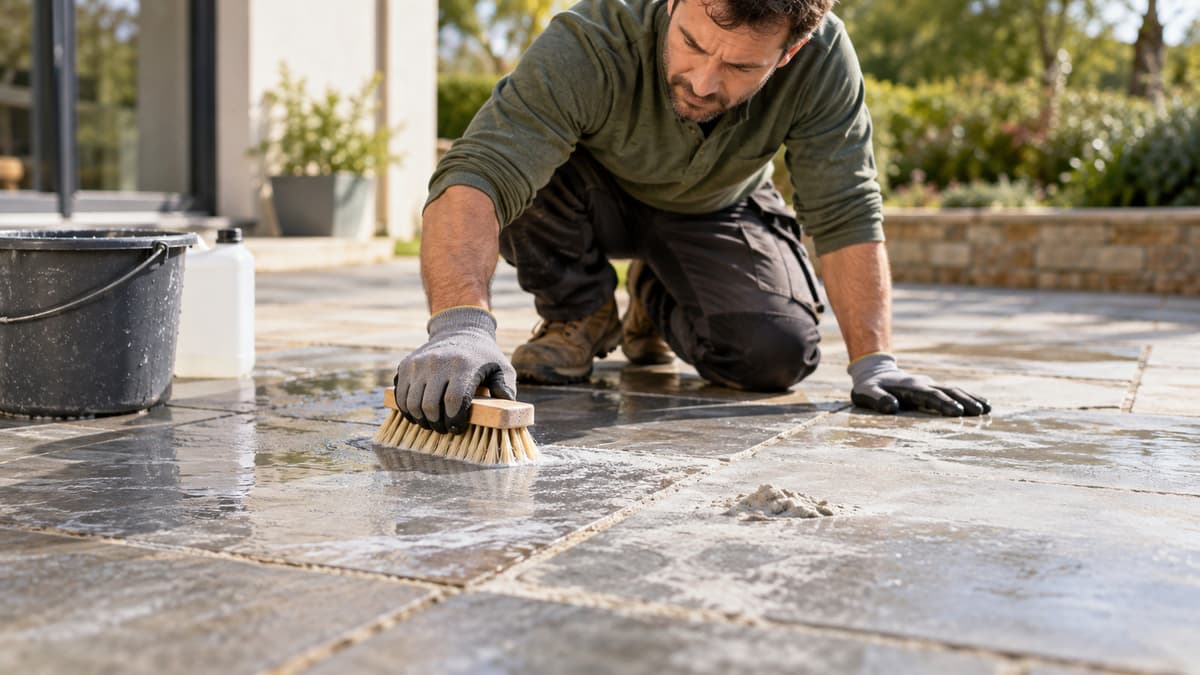
A soak leaves cured cement on new paving. Split haze from hard lumps, keep brick acid off Indian sandstone, and scrub a labelled film remover for five minutes.
On this page

The new flags looked finished until the pointing dried and a pale veil sat across them. You tipped water over the worst of it and watched the same white film return as the stone dried. Remove cement from paving while that veil is still thin, with a labelled film remover and a scrub. Once the mortar has cured into a lump a nail can catch, a longer soak leaves the cement where the trowel put it.
The liquid in this set is HG product 31, the natural stone cement, grout and lime film remover, 5 litres, model 216500100, ASIN B00BQWOIIG. On amazon.co.uk it is £57.20, with 3.7 from 178 ratings, and the listing calls it acid-free. UK reviewers still describe hard scrubbing, traces that remain, and lumps they had to chip.
This page follows that listing, HG's UK method, London Stone, Pavingexpert on acid stains, and Lithofin's acid-sensitive list. There is no laboratory test here. The wider set sits in the stone cleaner comparison. A purchase through a comparison link can earn us a commission at no extra cost to you.
In short
Name the mark on dry flags: a thin haze, a chalky bloom, or a lump that stands proud. Wet the stone, apply the diluted film remover, leave it about five minutes, scrub and rinse, and keep one mix to about 10–15 square metres. A soak leaves cured cement, hydrochloric acid can rust-stain Indian sandstone, and a pressure washer can cut the joints while a bonded film stays put.
Haze, bloom and a lump are three stages
A new patio shows three marks that feel different under a nail. Haze is the thin milky veil, often a grout film on a patio, with the flag colour still showing through. Bloom is the chalky white as lime comes out of fresh mortar, the new patio white marks that return after a plain rinse. A lump stands proud of the joint, and a nail stops on it.
Let one bay dry fully, in daylight, beside a flag you left alone. Wet sandstone darkens in the pores, so a noon stain can be only water. If the white has gone once the stone is dry, it was water. If your nail skates, you have film. If the nail stops, lift the lump before any liquid.
UK buyers often meet mortar on Indian sandstone that has already cured. Cement haze on sandstone can still be a film job when the nail skates. A hard lump is a chip, then a film job on the smear. Sweep loose dust off first. The limit is that dry pair of flags, because a wet patio hides the result until the next morning.
Remove cement from paving with a short dwell
Product 31 is built for the film. Dilute it, wet the surface, work about 10–15 square metres from the 500 ml in a 5 litre mix, leave it about five minutes, scrub, and rinse. Confirm the pack before you pour, because those figures belong to this lime film remover.
Wet the flags first, or a dry sandstone drinks the mix and leaves a tide mark around a weak patch. Keep each bay inside 10–15 square metres so you can time the five minutes. A 30 square metre terrace is two or three mixes.
Scrub during the dwell. UK reviews on Indian black limestone and sandstone say the haze shifted with hard scrubbing, and a soak with the brush still in the bucket often failed. Use a nylon brush or a deck brush. A wire brush cuts soft sandstone. Rinse until the water runs clear, then judge the bay only once it is dry.
Dilution and a one-flag test for the wider set are on the how to use a stone cleaner page. The limit is the label in your hand. If the pack print differs, the pack wins.
What UK buyers found when the cement had cured
The liquid works on Indian black limestone and sandstone when you scrub. It often fails on cured cement if you only soak it. Traces remain in the grain, and lumps need chipping. Another hour in the same puddle leaves a set crust at the same height.
Chip the proud pieces before you open the 5 litres. Keep the tool flat and lift the cement that stands above the flag. The smear that remains is the film job: wet it, dwell about five minutes, scrub, and rinse. Remover poured over an untouched lump wets the stone around it and leaves the lump.
Judge any faint cast the next day, dry, against an untreated flag. Leave a thin shadow in place. Another full-strength afternoon can raise a tide mark around the bay. A thick island goes back to the scraper. The best stone cleaner for the job page is the shortlist once the mark is film. The bottle follows the chip, and only on what the scraper left.
Why acid is a stain risk on these flags
Brick acid is hydrochloric acid sold for masonry. Pavingexpert documents the rust stains it leaves on Indian sandstone. The iron colour stays in the face after a later wash. Chip the lump, then treat the remaining film with the listing that calls itself acid-free, and a brush. That is the practical route for how to remove cured cement from sandstone without acid.
London Stone's patio guide carries a warning on acids, and Lithofin publishes an acid-sensitive list for natural stone. Indian sandstone sits with that warning. One bucket crosses a joint, so a limestone border sets the rule for a mixed patio.
A patch that turns orange or brown is the stop. This page has no reversal for that stain. If the flags have already shifted after brick acid, ask a paving contractor whether the face can be dressed. An acid stain can stay for the life of the patio.
A jet wash leaves the film and opens the joints
A pressure washer can cut the joints and still leave a bonded film. Cement keyed into the grain stays put while the lance moves water. A higher setting blows kiln-dried sand out of the joints, chips the edges, and stripes the face when the lance stops. On a new lay, empty joints let the flags rock, which is a trip and a frost break.
If you rinse after the scrub, use a wide fan, keep it moving, and stand back so you are flushing spent liquid. The five-minute dwell and the brush have to release the film first. A round patio head is a washer fitting for a compatible machine.
Surviving white goes back to the dry test and product 31. The limit is the joint. Film that remains still wants the scrub. An emptied joint is a laying repair.
Which HG bottle clears cement film
Product 31, model 216500100, is the cement, grout and lime film remover: the 5 litre listing B00BQWOIIG, at £57.20, with 3.7 from 178 ratings. The bathroom cleaner, the kitchen cleaner and the shine restorer are different HG products, each with its own dose. A shine restorer mops a floor you already maintain. A bathroom bottle is for indoor limescale and soap film. On a new patio those bottles leave the haze where you found it.
Read the model number, or the words cement, grout and lime film, before the cap comes off. The comparison sorts the bottles by the job on the label. A label about shine, a weekly mop, or a bathroom goes back on the shelf. Confirm the printed dilution on product 31. The 500 ml in 5 litres, the five minutes, and the 10–15 square metres live on that label alone.
Common questions
How do I remove cement haze from new paving?
Will soaking be enough?
Can I use brick acid on the haze?
What if the cement has gone hard?
Is HG film remover safe on Indian sandstone?
How long do I leave it on?
Will a jet wash blast the film off?
Which HG bottle is the cement one?

Products Compared publishes British-English buying guides based on amazon.co.uk listings and public UK sources. We do not run a lab and we do not invent test scores.
Related articles
How to clean a sandstone patio
Sweep dry, then separate film, black spots and cement. Acid and a close jet both mark sandstone.
How often to clean a patio
No British Standard sets an interval. Sweep when debris lands, and wash filmed flags instead of a hard annual jet.
Black spots on patio slabs
Dark dots that stay after the green film has gone are usually lichen. A closer jet or acid will not clear them.