How often to reseal sandstone patio: the bead test
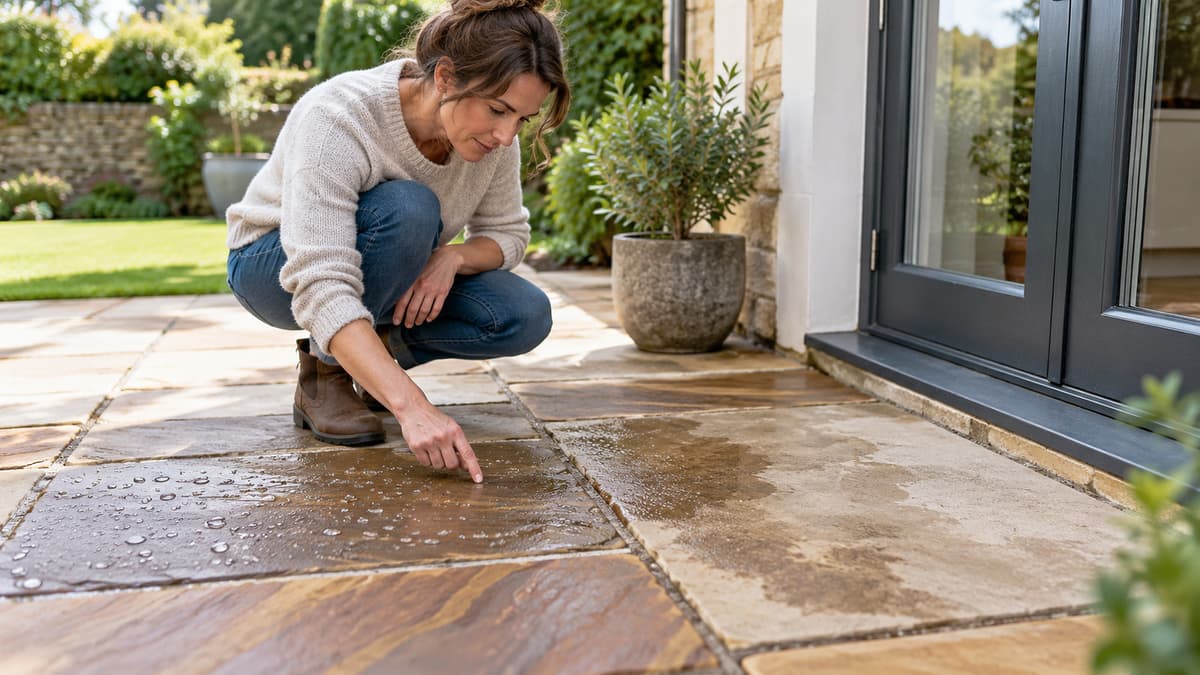
Makers quote two, three or five years, and the lines do not agree. On Indian sandstone, a water-bead check decides the next coat, not a calendar date.
On this page

Your Indian sandstone looked close to its wet colour the summer you treated it. Two winters later the path by the back door has gone pale, the middle still looks dark, and you are looking up how often to reseal sandstone patio stone before you buy another tin. One paving FAQ says check every two to three years. Another page quotes two to five.
A product page calls three years an average. Those are separate claims. None was measured on the amazon.co.uk bottles in this comparison. You recoat the slabs that drink water again, and you leave the slabs that still bead. Averaging two, three, and five hides which sentence you read.
Products Compared read the shop pages and the listings on 16 October 2026. Nobody here ran a weathering trial. If you buy through a link on the comparison, we can earn a commission at no extra cost to you. Links use the tag pcuk26-21. On the next dry morning, splash the faded path and a slab that still looks rich.
In short
How often to reseal sandstone patio stone is a check, then a local coat. UK shop pages quote about two to three years, two to five years, or an average near three, and they attach those figures to different products and easier or harder wear. The nine amazon.co.uk listings in this set print no patio life in years, so a water bead on dry Indian sandstone shows which slabs still shed water.
Why the year figures do not match
Paving Slabs UK's Indian sandstone FAQ tells you to check every two to three years. Three to five years appears only as a possibility, and only for a quiet patio in the sun. The same FAQ says there is no fixed schedule. A check is an inspection. A fresh coat on every flag, timed from the day you last poured, is a different job.
Lesta's care advice puts resealing at every two to five years in one line and every two to three years in the FAQ, and it points you at a water-bead test. PatioPerfect's Essential sandstone sealer colour boost calls a top-up about every three years an average, which belongs to that tin. A path to the bins and a quiet sunny terrace do not share one date. None of those pages is a weathering test of the amazon.co.uk bottles in this comparison. When you reseal Indian sandstone, you choose a slab and a tin, then you read that tin.
What each claim is attached to
LTP's maintenance line says touch up impregnating protection about every three to four years if the stone is maintained. Algae in the joints, or a harsh cleaner, sits outside that "if". The figure is a touch-up for impregnating protection that has been looked after. It is absent from the amazon.co.uk listings here, and it is the wrong caption for a wet-look film.
Universeal's expected wear runs up to five years on its limestone sheet, tied to traffic and cleaners. Up to five years is a ceiling on limestone, a different stone from Indian sandstone, and a busy path can wear out inside it. Pavingexpert says coatings may need repeat treatment every couple of years. A coating sits on the face, while an impregnator soaks in and is meant to stay matt.
Smartseal quotes up to five years as its own claim. That number is a poor fit for Kandla Grey, which often stays pale even when the liquid has soaked in. Universeal's patio guidance already expects little visible change on that grey, so water is the signal. How long a colour enhancer lasts depends on which family you bought.
A matt tin does not collect extra years simply by drying matt. The colour enhancer versus sealer page separates a matt impregnator from a gloss film before you buy a top-up of the wrong one. You still test the slab you have, because the shop interval and your path can disagree.
The water-bead check
After a coat, read the splash the other way from the first-coat test. Water gone within a minute means thirsty stone. Water still sitting after a few minutes means the face is shedding it. Before treatment, thirsty stone is what an impregnator needs.
Afterwards, thirsty stone on a slab that used to bead means the repellent has worn there. Lesta sends you to that check because its year range is too wide to time a Saturday. Use a dry day, because damp stone darkens from the rain.
- Splash a little water on the faded path and on a slab that still looks dark.
- Watch both spots for a few minutes.
- A bead that sits means that spot is still shedding water.
- Water that darkens the stone and sinks in within about a minute means that spot is drinking again.
- Recoat the drinking slabs once they are clean and dry, and leave the slabs that still bead.
Colour can stay dark after the bead has failed. The richer look may be pores still occupied, or dirt, algae, or stone that has not dried. Test the pale path and the dark middle.
Universeal says take excess off within 20 to 30 minutes, and a shiny patch means excess was left on a slab that was still shedding water. The splash is a water test for that morning. Stains and winter slip sit outside it.
Shade, traffic, and a barbecue
Paving Slabs UK allows three to five years only as a possibility on a quiet, sunny patio. A side path and a shaded corner sit outside that possibility. Universeal's limestone sheet ties wear to traffic and cleaners, under a ceiling of up to five years on that sheet.
Shade keeps stone damp, and a face full of water is a poor moment for an impregnator to soak in. A damp corner also looks darker without being better protected. Grease from a barbecue mimics a successful enhancer, and harsh cleaners can mark a treatment well inside any three-year average. This set has no timed trial of shade against sun on the amazon.co.uk bottles, so a halved life under the fence would be a figure added on top of the sources.
On the next dry day, splash the track from the door, the shaded corner, and a slab nobody walks on. Clean grease and growth off before you pour. The sandstone patio page sets out pale stone such as Kandla Grey. That limit still applies on a second coat.
Nothing in this set prints a patio life in years
The saved listings state no patio life in years. HG's natural stone colour intensifier, ASIN B0012719HI, is a 50 ml indoor bottle at about £14.80, with 3.8 from 168 reviews, and the interval is blank. Libéron's colour-enhancing stone floor sealer is an interior oil for York stone, slate, terracotta, and quarry tiles, and the year is blank there too. One 50 ml bottle will not finish a patio.
Measure the worn patch, then read the tin. Pack size sits on the buying guide. The nine listings sit on the stone colour enhancer comparison.
One Black Diamond review said the colour washed off after a spring rinse. Most texts in that shared pool were written in the United States or Canada, so the comment stays with that weather. It is a poor stand-in for a British winter.
Where a dry slab drinks again, a new impregnator can enter once the stone is clean and dry. Where water still beads, a fresh coat sits as excess, and a gloss film that is still a skin blocks the soak. The application steps cover the test patch.
Cure windows differ from service life. HG allows walking after about four hours and full use after about three days, Libéron asks for at least eight hours, and Universeal says keep the stone dry for up to 72 hours. Follow the label in your hand.
Common questions
Should I reseal a sandstone patio every year?
How do I know the enhancer has worn off if the colour is still dark?
Does a matt impregnator last longer than a gloss film?
Will shade and a barbecue shorten how long the colour enhancer lasts?
Should I recoat on a calendar date?
Can I put a new colour enhancer over the old one?
What recoat interval is printed for HG or Libéron in this set?
Is a shop line of up to 15 years evidence for these bottles?

Products Compared publishes British-English buying guides based on amazon.co.uk listings and public UK sources. We do not run a lab and we do not invent test scores.
Related articles

Water drop test for stone sealer: read the result
A drop on dry stone shows whether the slab can take an impregnator before you buy a colour enhancer.
Stone colour enhancer cost: budget for your patio
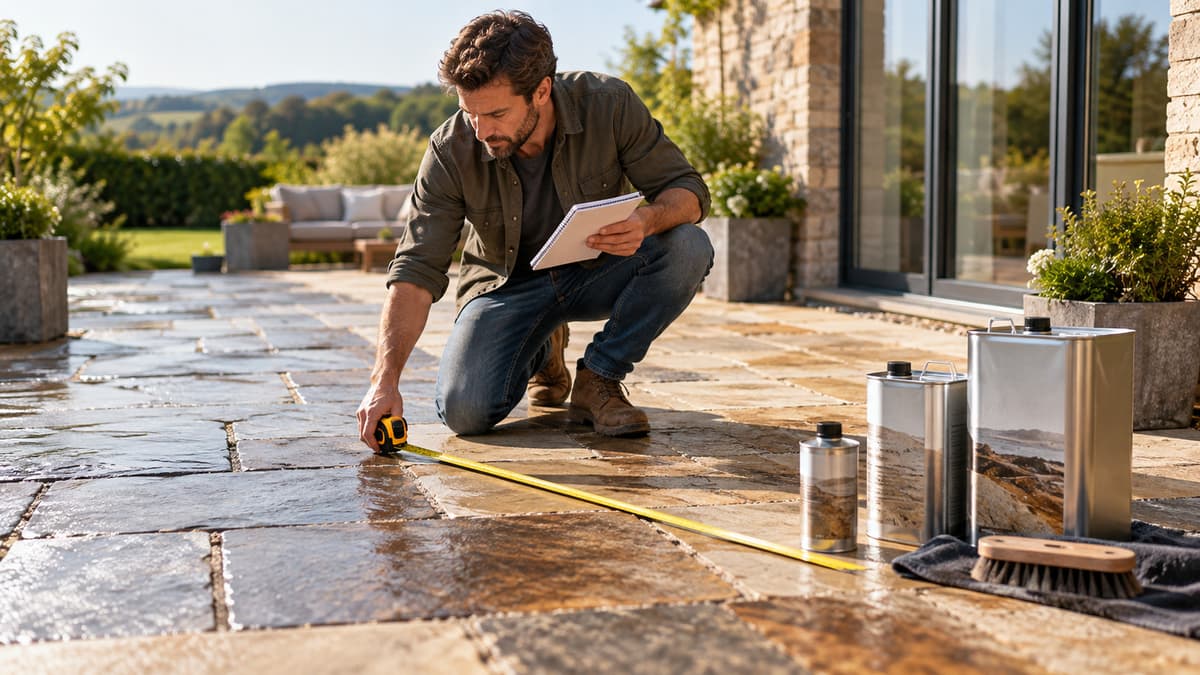
Use measured area and realistic manufacturer coverage to budget for treatment without overbuying.

Clean sandstone before sealing: lock in colour, not dirt
Algae, cement smear and old residue stop a new coat soaking in. Clean and dry the slab before you treat it.