Water drop test for stone sealer: read the result

Run a water drop test for stone sealer on dry paving, interpret absorption or beading correctly and know why a separate test patch still matters.
On this page

A water drop test for stone sealer tells you whether a clean, dry patch of paving absorbs water quickly, slowly or hardly at all. That can stop you putting an impregnating enhancer on dense stone, porcelain or an already treated surface. It cannot tell you, on its own, that sealing is necessary or which product to buy.
In short
Place similar drops on several clean, fully dry and representative slabs, then time and photograph what happens. Fast darkening and absorption indicate open pores. Prolonged beading suggests dense, saturated or already treated paving. Either result must be followed by stone identification and a product-specific test patch.
Prepare a dry, representative test
Choose a period when the paving is genuinely dry, not merely free from rain at the moment. Pressure-washed stone, a shaded patio after dew, or slabs over a damp base can hold moisture even when the face looks pale. Water already in the pores can make a porous surface appear resistant.
Clean loose dust with a method suitable for the stone, then let it dry. Skip detergent immediately before the test, because residue can change how a drop spreads. Note a visible coating rather than stripping a test spot without a plan.
Use clean water, a teaspoon or dropper, a timer, a way to mark locations, and a phone. Test at least three representative places with drops of similar size, including a sunny and a sheltered area if exposure differs. Keep away from joints, cracks, chipped edges and hollows. If the surface contains distinct stone types, treat each as a separate test group.
Run the timed observation
Place a few separate drops on the first marked area and start the timer. Photograph them immediately, after one minute, after three or four minutes, and at ten minutes if water remains. Record whether the drops bead, flatten, darken the stone, shrink gradually or disappear.
Pavingexpert uses a practical contrast between drops disappearing within a minute and still being present after three to four minutes. Libéron describes a ten-minute water-drop check for its stone floor product and says absorption indicates a need for sealing in that system. These are useful reference points, not one universal pass-or-fail standard for every stone and treatment.
The stone colour enhancer buying guide puts the result in the correct sequence: establish material and absorption first, then assess product suitability and finish.
What a thirsty stone result means
If drops spread, darken the paving and disappear quickly, the tested area is absorbing water. Open-pored sandstone often behaves this way, although absorption varies between individual slabs and even across one slab. This result indicates that an impregnating treatment may be able to enter. It does not show that every impregnator is compatible.
Do not convert the absorption time into a coverage rate. A drop disappearing in 30 seconds does not mean a litre will cover a predictable number of square metres. Use the low end of the published range until a measured product test area gives better evidence.
Absorption also does not prove that a colour enhancer will deliver the colour you expect. Universeal notes that light sandstone may show little colour change with its enhancer. Kandla Grey or another pale stone can drink water yet produce a subtle, uneven or unwanted tone. If drainage or persistent damp is the real issue, a treatment should not be used to conceal it.
Compare variation, not just speed
Compare the drops across the patio. If an exposed path absorbs immediately but sheltered slabs bead, an old treatment may have worn unevenly. If only one stone drinks water, natural variation or a replacement slab may explain it. Mark those outliers for the product test patches. A whole-area application based on the thirstiest point risks residue elsewhere, and adding more liquid will not force a dense patch to absorb evenly.
What beading or standing water means
A rounded bead that remains on the surface shows that water is not readily entering at that location. Lesta Paving uses continuing beading as a sign that an existing sealer is still working, and absorption as a sign that resealing should be considered. That reading applies when you know the paving was previously sealed.
The material may be naturally dense. Glazed porcelain is designed with a very low-absorption face, and Universeal excludes non-porous glazed surfaces from the stated use of its solvent enhancer. LTP likewise warns that its impregnators cannot treat a non-absorbent or moisture-saturated surface. Those two conditions can look similar during a casual test even though one is inherent and the other is temporary.
Wax, curing compound, oil or an unknown coating may hold the drop up without being a sound base for a new treatment. Water may also flatten across a smooth surface and still fail to penetrate. Judge absorption by persistent darkening and disappearance, not only by the shape of the drop.
If porcelain fails to absorb and looks dull, dirt, residue, wear or the tile's own finish may be the cause. Do not abrade the glaze or keep applying product to make it drink. The stone colour enhancer comparison helps distinguish products intended to penetrate natural stone from other finish types. Remove any option that excludes your material before comparing price or claimed appearance.
Rule out moisture saturation
Repeat the test after a proper dry interval if the patio was recently wet. A saturated porous slab can hold a drop, then absorb normally once it has dried. Applying an impregnator while it is saturated can cause patchiness, poor penetration or white haze. Do not force the diagnosis with strong heat. If the paving stays damp for an unusually long time, investigate drainage or construction.
Repeat the test after treatment
The same marked locations can show whether water behaviour changed once a suitable treatment has fully cured. Libéron's guidance says water should remain for 10 to 15 minutes after treatment with its product, while Lesta points to beading as a sign of continuing performance. Do not borrow those numbers as a warranty for another brand. Follow the cure time of the product actually used, and avoid testing so early that you disturb a curing finish.
Beading after cure shows changed water behaviour at that point. It does not prove resistance to oil, frost, staining or slip. If previously beading areas begin to absorb in the same conditions, clean, confirm that the old and new systems are compatible, and test again before resealing. Automatic annual recoating can build residue when the previous layer is still functioning.
If post-treatment drops reveal patchy behaviour alongside visible pale areas, consult the guide to white haze on sealed sandstone before doing more. Moisture, excess product and salts require different responses, and another coat can make diagnosis harder.
The product test patch comes next
The water test screens the surface. The product patch tests the proposed decision. Use the exact treatment on an inconspicuous but representative area, following every instruction for cleaning, dryness, quantity, dwell time, surplus removal and curing. A few drops of water cannot predict colour, sheen, odour, residue or compatibility with an old sealer.
Make the patch large enough to show an overlap and an outlier from the water test, without leaving a prominent permanent square. Do not judge the final colour while the product is wet unless the maker tells you to. Inspect the cured patch in sun and shade, dry and after permitted water exposure, for uneven darkening, haze, tackiness, unexpected gloss and changed grip. Little colour change on a stone that absorbed the product may be correct performance.
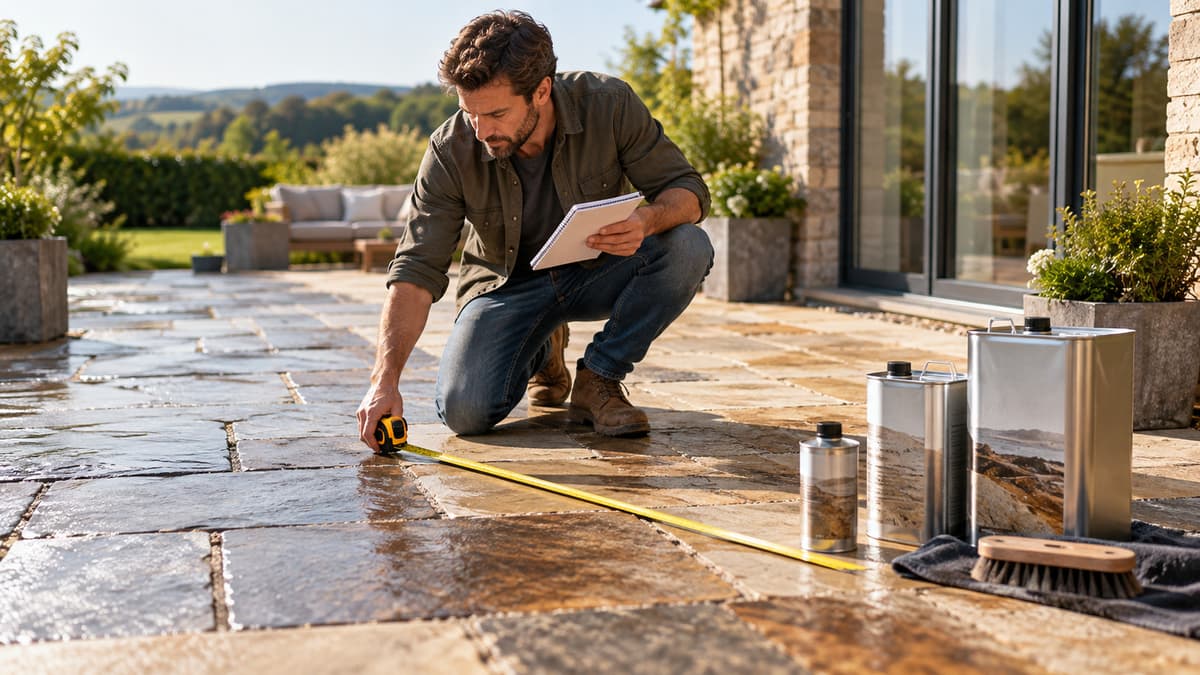
Only then calculate quantity. Measure the total suitable area and apply the manufacturer's realistic coverage range, allowing for observed variation. The stone colour enhancer cost guide explains why pack price, litres and square-metre coverage must be considered together.
Stop if the stone is unknown, the existing finish cannot be identified, the patio remains damp or the patch reacts badly. Contact the manufacturer with photographs and details, or use a stone-care professional for coatings and large remedial areas. A failed small patch has done its job by preventing a full-patio mistake.
Products Compared bases this guide on public manufacturer and UK paving guidance. We have not laboratory-tested your surface. A qualifying purchase through an amazon.co.uk link may earn us a commission at no extra cost to you. Those links use the tag pcuk26-21.
Common questions
How long should I watch a water drop on stone?
Does water soaking in mean the stone needs a colour enhancer?
What does it mean if water beads on paving?
Can I do the test on a wet patio?
Is testing one slab enough?
Does beading after sealing prove the treatment worked?
Can the water drop test predict whether paving will be slippery?

Products Compared publishes British-English buying guides based on amazon.co.uk listings and public UK sources. We do not run a lab and we do not invent test scores.
Related articles
Stone colour enhancer cost: budget for your patio
Use measured area and realistic manufacturer coverage to budget for treatment without overbuying.

Clean sandstone before sealing: lock in colour, not dirt
Clean sandstone before sealing so algae, salts and cement haze stay off the treated face.
Water based or solvent stone sealer: smell and the label
Compare treatment chemistries after confirming that your paving can accept an impregnating product.