Independent comparisons. We may earn from shop links. More info

Sandstone colour enhancer for a UK patio

Updated: 16.10.2026

Indian sandstone often looks richest just after rain, so it is natural to want that deeper colour without leaving the paving permanently wet. A sandstone colour enhancer can recreate part of that effect on porous, colourful stone, but pale slabs, new paving and the wrong formula can produce little change or a milky film. This guide focuses on outdoor sandstone rather than worktops or indoor floors. The [stone colour enhancer comparison](/hub/garden-design/stone-colour-enhancer) shows the current amazon.co.uk options; the first decision here is whether your patio is ready and whether the target appearance is realistic.

Indian sandstone often looks richest just after rain, so it is natural to want that deeper colour without leaving the paving permanently wet.

Our top picks

On this page

Aim for deeper stone colour, not instant varnish

A penetrating enhancer darkens mineral tones like a damp surface, while a wet-look coating creates a film and sheen. If you like the wet pattern but not gloss, start with a matt outdoor product that names sandstone or natural-stone paving. Before buying litres, clean a discreet slab and wet part with water. If colours become richer, an enhancer may move the dry appearance that way without matching the fully wet shade. After drying, apply a hidden test patch and judge it after curing. A soaking water drop suggests the stone can accept an impregnation; a bead may indicate dense stone or an existing treatment. Use your exact product’s coverage figure, not another brand’s rate. If you are uncertain whether you want penetration or a visible coating, read colour enhancer versus sealer before committing the whole patio.

Pale sandstone and new paving need restraint

Kandla Grey and other pale or low-colour slabs can respond weakly. Universeal says its colour-enhanced patio product may have little effect on Kandla Grey, while Smartseal excludes Kandla Grey from the enhancer named in its source page. A patch that remains pale after curing is a reason to stop, not to flood the surface with another chemistry. New paving introduces moisture, jointing products and salts. Resiblock calls for about eight weeks after laying and a 48-hour dry spell for its product. Joint-It makes a different claim for its own enhancer. If the patio stays wet from below, address drainage before sealing. Breathable does not mean the paving can be saturated during application. A dry afternoon followed by dew may be inadequate.

Which listings are actually shaped for patio use?

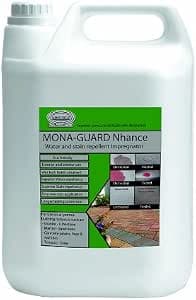
Mona-Guard Nhance is the clearest patio-positioned one-litre listing: its bullets name drives, patios and natural stone and say water-based. There is no rating, review text, coverage or finish. Black Diamond CE-T is another test option, listed as water-based for indoor or outdoor masonry. One UK review liked its sandstone result, but most review texts are North American and others mention residue, patchiness or slickness. Its 118.29 ml bottle suits a patch better than a full patio. HG Natural Stone Colour Intensifier 50 ml is poorly sized and centres indoor floors and walls. Do not extrapolate its coverage to a patio. Liberon’s one-litre oil names York stone but is an interior floor oil, so it is the wrong outdoor default. Once you have an approved outdoor product, use how to apply stone colour enhancer and follow the times on your own container.

Why sandstone turns white or patchy

Milky bubbles or white film can follow thick application, damp or cold stone, or rain before curing. Resiblock identifies those risks for its urethane. Do not immediately cover the evidence with another coat. White patches can also be efflorescence rather than milky resin. Ask the manufacturer which of those it is before removal. Patchy colour often follows variation within the stone. One slab may be more absorbent than the next, or old sealer may remain in sheltered areas. Test two or three representative slabs, not only the most colourful flag. A Black Diamond reviewer described a covered slate patio as slick. If steps are already slippery or a previous coating is peeling, ask a stone-care contractor to assess the surface before adding another layer.

Common questions

Will Indian sandstone go dark like it does in rain?
A compatible enhancer may deepen the same mineral colours, but it may not reproduce the fully wet shade or sheen. Product, porosity and stone colour all affect the cured result. Use a hidden patch and judge it when fully dry; if the change is weak, more liquid is not automatically the answer.
What about Kandla Grey or another pale sandstone?
Expect less predictable darkening. Universeal reports little effect from its product on Kandla Grey, and Smartseal excludes that stone from one enhancer. Those are product-specific statements, but they support a cautious conclusion: test pale sandstone before buying the full quantity and stop if the cured patch does not improve it.
How soon after laying can I enhance the patio?
Follow both the paving or jointing system and the enhancer maker. Resiblock specifies about eight weeks and a 48-hour dry spell for its own system; another brand may differ. Wait while moisture or efflorescence remains visible.
How many litres do I need?
Measure the patio and divide its area by the exact product’s first-coat coverage, then allow for texture and any approved further coat. At 4 m² per litre, a 12 m² patio needs roughly 3 litres for one coat; at 8 m² per litre, it needs about 1.5 litres. Do not borrow another brand’s rate.
Can I use the indoor Liberon tin outside?
The one-litre Liberon oil listing is for interior stone floors, despite naming York stone. That makes it a poor default for exposed paving. Choose a treatment whose current technical sheet explicitly permits outdoor sandstone and whose cure window suits UK weather.
Why did the patio turn milky after rain?
Rain may have reached an uncured coating, or moisture may have been trapped in the stone. Heavy application and low temperature can also create whitening with some formulas. Let the area dry as the maker permits, record the conditions and seek product-specific removal advice before adding more sealer.

Related pages

Sources

Public UK sources from the research digest. Listings dated 15 October 2026. Page updated 16.10.2026.

  1. Lithofin — Protect natural stones with impregnations (retrieved 15.10.2026)
  2. Pavingexpert — Impregnator versus coating (retrieved 15.10.2026)
  3. HG — Natural stone colour intensifier (retrieved 15.10.2026)
  4. Libéron — Colour-enhancing stone floor sealer (retrieved 15.10.2026)
  5. HSE — GB CLP regulation (retrieved 15.10.2026)
  6. Universeal — Patio stone sealer, colour enhanced (retrieved 15.10.2026)
  7. Floorseal — Natural stone colour enhancer (retrieved 15.10.2026)