Independent comparisons. We may earn from shop links. More info

Laminate underlay for underfloor heating

Updated: October 2026

You already have heating in the floor, wet pipes in the screed or an electric mat, and the acoustic rolls in front of you are sold as insulation. Laminate underlay for underfloor heating and a thick acoustic insulation layer pull in opposite directions. Heat has to reach the room. A high-tog foam is built to slow that heat down. In this amazon.co.uk set, none of the ten listings is shown as a low-tog heating underlay. This page stays on heat. The [acoustic underlay comparison](/hub/flooring/acoustic-underlay) is the product grid. Listings were read on 19 October 2026. No heat test was run.

You already have heating in the floor, wet pipes in the screed or an electric mat, and the acoustic rolls in front of you are sold as insulation.

Our top picks

On this page

Heat has to get through the underlay

A heated floor only works if the layers above the pipes or the mat let the warmth through. Interfloor’s underfloor-heating note, written for hard floors, treats under 0.4 tog as the ideal for the underlay, and it says standard polyurethane foam can block heat. The same note does not recommend laying an underlay on electric mats. That is one manufacturer’s guidance for their own range, not a test of these ASINs. Their product is not in this set. The point you can use is the direction: thicker insulation is the wrong way unless the heating maker has allowed that resistance. A published characteristic of BS EN 16354 says thermal resistance of the system over heating to EN 1264-3 should not exceed 0.15 m²K/W. These ten listings do not print an R value, so you cannot prove any of them sits under that cap. Do not convert a tog bullet into m²K/W yourself and call it compliance. The person who can allow a figure is the heating maker, or the plank maker where their sheet names a maximum tog or a maximum R. The underlay seller’s word insulation is not that permission. An electric mat sits just under the floor finish, so an extra foam sheet is directly in the path Interfloor tells you to leave clear. Pipes buried in screed already have the screed as their heat spreader, and a further underlay still adds resistance on top. If your heating instructions say no additional underlay, that sentence beats a gold roll with a warmth claim in the title.

The only tog on these pages

This comparison prints one thermal figure. FloorPro’s XPS boards, B0B324P5MB, say up to 2.2 tog and 23 dB. The pack is 21 boards, 590 mm by 790 mm, 9.79 m², at about £24.77, with 4.5 from 336 reviews. The page asks whether the boards suit underfloor heating and does not answer. Up to 2.2 tog is several times Interfloor’s under-0.4 tog ideal. It is a warning example, not the pick for a heated room. The 23 dB line is a sound claim with no named test, and it does not offset the tog. One review says the boards were used on screeded wet heating under engineered wood. That is a single user’s layout, not a measured heat output. Another review says the boards break easily and that moisture through the laminate means replacing the floor quickly. Barrier Pro X tape is advised and not included. Country of origin is Germany. None of that turns 2.2 tog into a low-tog heating underlay. Insulation keeps heat from crossing. Over a heated screed, that is heat kept in the slab instead of in the room, unless your system designer has allowed a high resistance. This file does not show that design. Skip the XPS pack when the floor is heated. It remains a board format for a small unheated room, which the acoustic underlay buying guide can still describe. Do not bring it back as a compromise because the sticker is about £24.77.
Royale Royale 2 mm white foam

Testsieger

Royale Royale 2 mm white foam
6.4/10about £12.99

What to do if the listing is silent

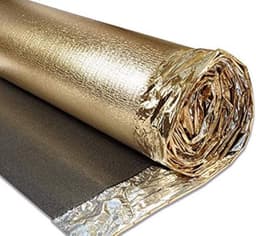
Silence is not a yes. AcuStick Sonic Gold at about £29.50 prints 24 dB and a gold foil moisture barrier, and the thermal field is empty. The two-roll gold title copies that silence at about £68.99. Royale Sonic Gold at about £29.34 asks whether it can be used with underfloor heating and does not answer, and no tog sits in the spec block. The 3 mm silver rolls, from about £18.50 to about £23.75 for about 15 m², name a foil membrane and no tog. Smoothfit’s short rolls do not print one either. The 2 mm white foam at about £12.99 has no foil line and no thermal line. A missing number is not a hidden 0.3 tog. On a cold concrete slab with no heating, a foam layer can make the surface feel less cold underfoot, because it slows heat leaving your feet. That is comfort on an unheated floor. It is not evidence that the same foam will pass heat upwards from pipes. Do not promote a warmer-floor review into a heating approval. If this set is silent, buy an underlay whose own page prints a low tog or a thermal resistance your heating maker accepts. That product is not among these ten. For a room with no heating, choose on foil, thickness, and coverage. For a room with heating, ask the heating maker what resistance is allowed, and do not lay the 2.2 tog boards, or a 5 mm gold roll with no tog, while you wait. If the mat is electric, treat no underlay on the mat as the default until the mat’s instructions say otherwise.

Ask the heating maker before you unroll

None of these ten listings is a low-tog heating underlay. The only printed figure, up to 2.2 tog, sits well above an under-0.4 tog ideal and the listing does not answer its own heating question. Empty thermal fields on the gold and silver rolls are not permission. If the instructions forbid an extra layer, a high star line does not overrule them. A qualifying purchase through our links can earn a commission at no extra cost to you.

Common questions

Can I use these acoustic rolls over underfloor heating?
Not on the evidence in these listings. None of the ten prints a low tog or a thermal resistance your heating maker can check. The only tog is up to 2.2 tog on the XPS boards, which is high against an under-0.4 tog ideal. Royale Sonic Gold asks about heating and does not answer. Treat the set as silent, and do not lay a thick acoustic roll over pipes or a mat unless the heating instructions allow that layer.
What tog is too high?
Interfloor’s hard-floor note calls under 0.4 tog the ideal over wet underfloor heating, and it does not recommend an underlay on electric mats. A system cap often cited with EN 16354 is 0.15 m²K/W for the heated floor build-up, and these pages do not print R, so you cannot tick that box from the bullet. Up to 2.2 tog sits well above the 0.4 tog line. Your heating maker’s limit is the one that counts if it is stricter.
What does up to 2.2 tog mean for heat?
It means the XPS pack is sold as insulation. A higher tog slows heat. Over underfloor heating, that is the opposite of what you want unless the system was designed for that resistance. The listing does not say the boards are a heating underlay. The page asks and does not answer. One review on screeded heating is a user’s story, not a lab result. Do not convert 2.2 tog into a pass.
Do the gold and silver rolls state a tog?
No. AcuStick’s gold roll states 24 dB and a foil moisture barrier, not a tog. Royale’s gold roll does not answer its own heating question. The silver rolls state a foil membrane and, at most, a vague sound line. Empty thermal fields are not a low tog. You would be guessing if you laid them over a mat because they are only 3 mm.
Is electric matting different from pipes in screed?
Yes. An electric mat is close to the floor finish, and Interfloor’s note does not recommend an underlay on those mats. Pipes in screed sit deeper, with the screed spreading the heat, and an underlay on top still adds resistance. Neither case is approved by a missing line on these amazon.co.uk pages. Read the mat or the pipe system’s own limit before you buy foam.
Does a warmer floor review mean the underlay passes heat?
No. Foam can feel less cold on an unheated concrete slab because it slows heat leaving your feet. That is not the same as transmitting heat from hot water or from a mat. A review of a warmer feel over ordinary concrete does not clear a heated floor. Look for a tog or an R value the heating maker accepts, which this set does not provide.
Who decides the limit, the underlay seller or the heating maker?
The heating maker, together with the plank sheet where it names a maximum. The underlay bullets here say insulation, sound, or nothing. They do not set the resistance your pipes or mat can cope with. If those instructions forbid an extra layer, a 4.6-star acoustic roll does not overrule them. If you cannot find the limit, do not guess with the 2.2 tog boards.

Related pages

Sources

Public UK and trade sources used for this comparison. Listing prices, stars, and review counts are from amazon.co.uk on 19 October 2026.

  1. Approved Document E: resistance to sound (retrieved 19.10.2026)
  2. East Lindsey Guidance Note 53: resistance to the passage of sound (retrieved 19.10.2026)
  3. Technical Booklet G (2012), Northern Ireland (retrieved 19.10.2026)
  4. Scotland building standards, section 5.1 noise separation (retrieved 19.10.2026)
  5. SITMA: sub-floor testing under Approved Document E (retrieved 19.10.2026)
  6. EPLF underlay materials bulletin, December 2022 (retrieved 19.10.2026)
  7. BS EN 16354:2018 laminate underlays (retrieved 19.10.2026)
  8. Interfloor: underfloor heating (retrieved 19.10.2026)
  9. EGGER UK: how to lay a laminate underlay (retrieved 19.10.2026)