Independent comparisons. We may earn from shop links. More info

Acoustic underlay for laminate

Updated: October 2026

You are about to order a roll for a click wood or laminate floor, and the amazon.co.uk titles all sound alike. Acoustic underlay for laminate, in this set, is a thin foam layer with or without a foil face, plus one pack of boards. Foil, millimetres, a printed decibel figure, the square metres, and seam tape are five separate facts. Mixing them up is how a short roll, or foam with no membrane, ends up on the wrong floor. The [acoustic underlay comparison](/hub/flooring/acoustic-underlay) is the product grid. Listings were read on 19 October 2026 and were not tested in a lab.

You are about to order a roll for a click wood or laminate floor, and the amazon.co.uk titles all sound alike.

Our top picks

On this page

Start with the floor, not the foil colour

The first check is the floor system, not the foil colour. These titles say wood or laminate. Pages that ask about carpet do not answer. Carpet underlay is a different product. Stay here for floating click laminate or engineered wood. If it is carpet, stop. On concrete or screed, EPLF treat a vapour-control layer as the normal extra, in the underlay or as a film, with a practical sd of at least 75 m. On a wood-based subfloor they say do not add that barrier, because the timber needs to breathe. A silver foil line on dry chipboard can be the wrong extra. White foam with no foil line on a new screed can be the wrong omission. Only then look at thickness. These rolls are 2 mm, 3 mm, or 5 mm, and the boards are 5 mm. The plank sheet sets the limit. Thick soft foam can let click joints move, and one review of the 5 mm AcuStick roll reports some board movement. If the sheet allows both, read 3 mm or 5 mm acoustic underlay.

Read the decibel line as a claim

AcuStick’s gold bullets say 24 dB. FloorPro’s XPS boards say 23 dB. The silver rolls, and Royale’s 5 mm Sonic Gold, print no decibel figure. The 2 mm white roll has no dB line. None of these pages names ISLam, ΔLw, or BS EN 16354. Where underlay is sold for footstep sound, EPLF’s ordinary bar is at least 14 dB ISLam, and 18 dB is the higher bar. A bare 24 dB is not that test until the method is named. England’s Approved Document E, as East Lindsey restates it, asks new separating floors for at least 45 dB DnT,w + Ctr and no more than 62 dB L’nT,w. The test is the finished floor. SITMA says loose laminate underlay is not the covering used in that test. A printed 24 dB does not mean the flat has passed. Scotland and Northern Ireland set their own figures. A test of a separating floor is a surveyor’s job.
Royale Royale 2 mm white foam

Testsieger

Royale Royale 2 mm white foam
6.4/10about £12.99

Coverage, weight, and the tape

Measure the floor, add a little for cuts, and match a figure the listing states. Long rolls here are about 15 m²: Royale silver at 15.0503 m², and several others at 15 m² from a 1 m by 15 m roll. FloorPro Smoothfit is 1 m by 7.5 m, so 7.5 m². The XPS pack is 9.79 m² from 21 boards of 590 mm by 790 mm. The two-roll AcuStick title says 30 m². Its item weight stays 3 kg, the same as the single 15 m² gold roll, and the saved reviews match that 15 m² ASIN, including a complaint that a stated 15 m² came up short. Do not treat about £68.99 as a proven 30 m² until the live page shows two rolls and a weight that fits. On 19 October 2026 the 15 m² silver rolls run from about £18.50 to about £23.75, and the 15 m² gold rolls are about £29.34 to about £29.50. Smoothfit’s about £16.50 is only 7.5 m², about £2.20 a square metre. A small room can suit a short roll. A 15 m² room usually wants the longer one. Seam tape is a separate buy on the pages that mention it. AcuStick, FloorPro silver, and Royale silver name Barrier Pro X tape. Royale silver calls the tape a warranty requirement. None of those bullets says the tape is in the box. Smoothfit and the 2 mm white roll do not name a tape. Open seams are a laying fault, which how to lay laminate underlay covers. The buying decision is whether the listing even tells you the tape exists.

Which type in this set

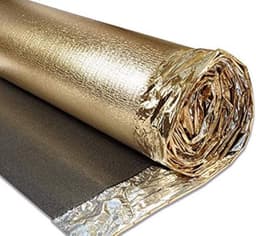
The 2 mm white Royale roll is the plain foam. It suits a dry timber subfloor that should not get a vapour barrier, if 2 mm is what the planks allow. It is a weak choice on concrete, because the bullets never name a membrane. The 3 mm silver rolls are the foil option at about 15 m². All three name a membrane and a tape you buy separately. None prints a decibel number. Smoothfit’s 3 mm roll is the same idea at 7.5 m². The 5 mm gold rolls are the thicker foam. Buy 5 mm only when the plank sheet allows it. AcuStick prints 24 dB and names gold foil. Royale Sonic Gold has 4.6 from 800 reviews and does not print a dB figure or a foil line. The XPS boards claim 23 dB and up to 2.2 tog. This page does not crown a winner. A missing tog is silence, not a yes for underfloor heating.

Order only after those checks

If the subfloor is concrete or screed, choose a listing whose bullets name a foil membrane, and buy the seam tape as a separate item. If the subfloor is timber that must breathe, do not add that barrier. If the plank sheet stops at 3 mm, stay with a 3 mm foil roll. If it allows 5 mm and you want a printed decibel claim, that claim is still not the result of the built floor. A qualifying purchase through our links can earn a commission at no extra cost to you.

Common questions

What should I check before the brand?
Check the floor system, then the subfloor, then the thickness your planks allow. Wood or laminate is what these titles claim. Carpet is a different underlay. On concrete or screed you usually want a vapour-control layer. On a timber subfloor, EPLF says not to add one. Brand and foil colour come after those three. A gold name does not tell you the roll covers the room.
Is a gold foil roll a damp-proof membrane?
Only if the bullets say so. AcuStick Sonic Gold names a gold foil moisture barrier. The silver rolls name a silver foil membrane. Royale Sonic Gold says high acoustic properties and does not name foil in the bullets. Even where foil is named, these pages do not print an sd value, so waterproof is not a measured 75 m. On a wet slab, stop and get the floor dried before any roll goes down.
Why do some pages print 24 dB and others print nothing?
AcuStick’s gold bullets print 24 dB. The XPS bullets print 23 dB. The silver rolls and the 2 mm foam do not print a number. None of them names the test. EPLF’s footstep figures are ISLam values with a method behind them. A blank is not proof the roll is silent, and 24 dB is not proof it is quieter than a silver roll in your room.
How many square metres do I order?
Measure the room and match a stated coverage, not the lowest sticker. Long rolls here are about 15 m². Smoothfit is 7.5 m². The boards are 9.79 m². The two-roll title says 30 m² while the weight field stays at 3 kg and the reviews match the 15 m² ASIN. A review on the gold rolls says a stated 15 m² came up short, so check the live parcel against the room before you start the planks.
Is seam tape in the box?
Not on the listings that name it. Barrier Pro X is the tape those bullets tell you to use, and Royale silver calls it a warranty requirement. The tape is not stated as included. Two listings in the set do not mention tape at all. Budget for a separate roll of tape if the underlay page tells you the seams must be joined.
Does 24 dB mean the flat passes Part E?
No. Approved Document E tests the built separating floor, with figures such as 45 dB DnT,w + Ctr and 62 dB L’nT,w for new work in England, as East Lindsey restates them. A product bullet of 24 dB is not that test, and SITMA says loose laminate underlay is not the covering used for it. Scotland and Northern Ireland set their own floor figures. If the floor must pass, you need a test of the floor, not a quieter-looking roll.

Related pages

Sources

Public UK and trade sources used for this comparison. Listing prices, stars, and review counts are from amazon.co.uk on 19 October 2026.

  1. Approved Document E: resistance to sound (retrieved 19.10.2026)
  2. East Lindsey Guidance Note 53: resistance to the passage of sound (retrieved 19.10.2026)
  3. Technical Booklet G (2012), Northern Ireland (retrieved 19.10.2026)
  4. Scotland building standards, section 5.1 noise separation (retrieved 19.10.2026)
  5. SITMA: sub-floor testing under Approved Document E (retrieved 19.10.2026)
  6. EPLF underlay materials bulletin, December 2022 (retrieved 19.10.2026)
  7. BS EN 16354:2018 laminate underlays (retrieved 19.10.2026)
  8. Interfloor: underfloor heating (retrieved 19.10.2026)
  9. EGGER UK: how to lay a laminate underlay (retrieved 19.10.2026)