Sharp sand or mortar for paving slabs: pick the right bed
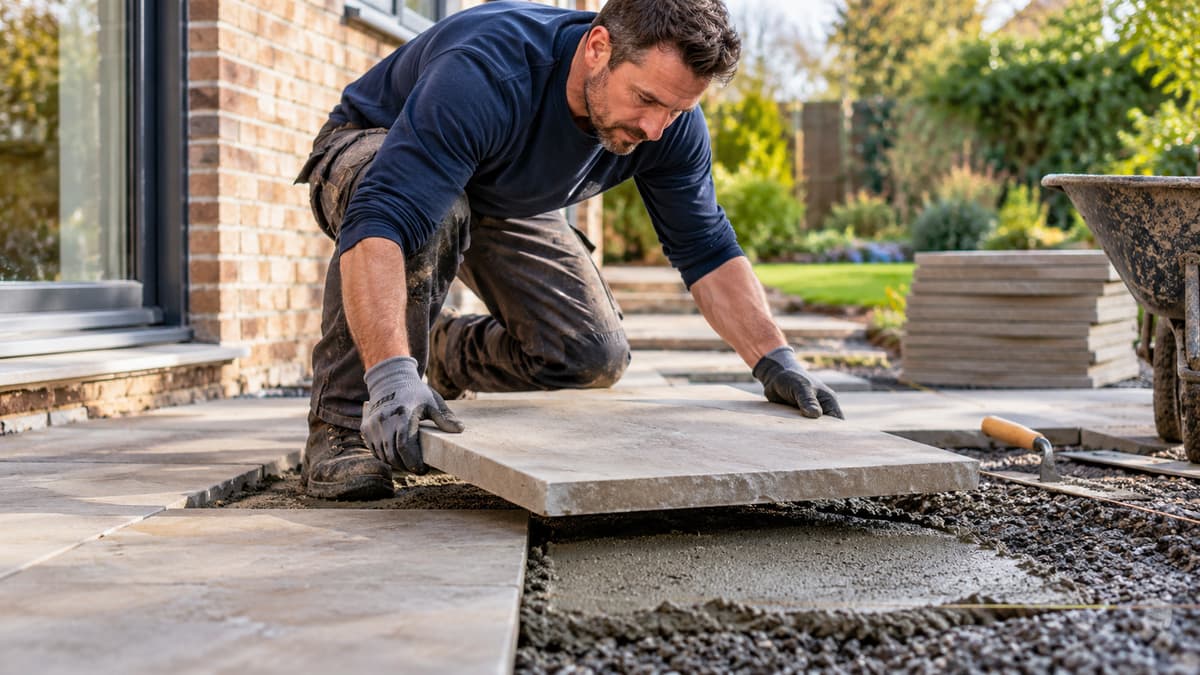
Sand beds drain and lift later; full mortar beds fix slabs in place. Match bedding, joints, and the compacted layer below before you lay flags.
On this page

You have compacted the hardcore, checked the fall away from the house, and the slabs are stacked on the path. The next decision is sharp sand or mortar for paving slabs, and whether you ever want to lift a flag without a breaker. Get that wrong and the patio can drain poorly, rock on the route to the back door, or lock you into smashing mortar every time a corner settles.
Sand versus mortar is only half the story if MOT Type 1 was raked flat and never compacted in thin lifts. These notes follow Wickes paving and patio guides, rigid installation sheets, and Pavingexpert on sub-bases, plus the amazon.co.uk listings in our tool comparisons. We did not lay your patio.
In short
Sharp sand or Slablayer in a full bed suits patios you may need to adjust, and it drains freely when the sub-base is already compacted. A continuous wet mortar bed fixes slabs in place and pairs with mortar joints when you want a rigid finish. Do not use five dabs of mortar on a heavily walked path and expect the same life as a full bed. Compact the stone below first. The bedding layer is not where the rammer belongs.
The bed is not the sub-base
The bedding layer sits between the slab and the compacted hardcore. The sub-base is MOT Type 1, or equivalent granular fill, built in lifts until it does not print under a firm heel. Wickes treats those as separate jobs. Mixing them up is how people buy sharp sand to firm up loose stone, or vibrate mortar already spread under a flag.
Confirm the sub-base before you open a bag. Typical patio builds quote roughly 100 mm of MOT Type 1, compacted in about 50 mm passes. Pavingexpert is blunt: if granular material moves underfoot, it is not compacted. No bedding mix replaces that density. Compact MOT Type 1 in thin layers covers lift height and when a plate beats a hand rammer.
Fall belongs in the sub-base and the bed together. Wickes's lay-a-patio guide quotes about 16 mm of fall per metre away from the house. A rubber mallet and a straight edge can fine-tune each slab. They cannot drain a bay if the hardcore slopes back toward the wall. Keep the finished surface about 150 mm below the damp-proof course, as Wickes's paving leaflet states.
A full mortar skin on 40 mm of loose dust will crack when the corner loads. A sand bed on the same soft stone will drain while the slab tilts. Heel-test a patch of hardcore before you mix.
Sharp sand when you may need to lift
A sharp sand bed, or proprietary Slablayer, suits a screeded layer that drains and can be lifted later. Wickes's paving leaflet describes sand bedding as liftable compared with a fixed mortar bed. You gain adjustment, and you accept less lock-in under foot traffic than a full mortar bed on the same stone.
Spread and screed sharp sand or Slablayer across the whole footprint so support is continuous. Wickes's patio guide quotes about 25 mm for Slablayer. Rake to fall, lay the slab, and tap level against a straight edge. A gap under the middle shows up later as a hollow tap and a rocking corner.
Sand beds suit many back-garden patios where flags are not drive-rated and you might relay a section after roots or drainage work. Five dabs under a heavy flag leave a void that flexes on the path to the kitchen door. Joint sand does not stabilise a rocking slab. If a flag already moves, fix the bed or the sub-base first, as patio slabs sinking after winter describes, then brush kiln dried sand or re-point.
Keep the hardcore firm and dry enough to screed on. Slurry worked into the sub-base blurs the layer line and can pump fines upward when you tap the slab. Cover stacked sand if showers are forecast. You are seating the flag on a controlled layer, not hydrating the bed like concrete.
A full mortar bed when you want it fixed
A full mortar bed bonds the slab across its underside, and adjustment later means breaking mortar. Wickes's rigid notes describe a 30–40 mm wet bed at 1:3 or 1:4 sharp sand to cement, laid as a continuous layer, not corner heaps. The lay-a-patio guide also quotes a 4:1 sand to cement mix by volume, or about 25 mm of Slablayer, depending on the product line.
Mix only the ratios the guide prints. Invented stronger mixes crack when the bed and the joint shrink at different rates. Beyond a couple of bags, a small electric cement mixer keeps batches consistent. The Hyundai HYCM63E on that comparison is a top pick for a stated 47 L mix on a 230 V UK plug, at about £188.99 with 4.2 from 49 reviews. A builder's barrow may not sit under the spout unless the frame is raised.
Butter the bed while it is workable, lower the slab, and tap both ways with a rubber mallet until it sits without rocking. Wipe squeeze before it sets on the face. Do not walk heavy loads across a fresh bed the same afternoon. Mortar gains strength over days, and loading a plastic corner is how lip edges appear.
Mortar beds suit paths you never plan to lift and jobs that will use mortar joints. They are a poor choice if you might still swap porcelain for stone after a dry fit. Once cured, you are cutting, not shimming. Large-format porcelain often needs a full wet bed rather than dots, because a void under the centre cracks under a point load.
Joints that match the bed
A sand-bedded patio with kiln-dried sand in narrow gaps behaves differently from a mortar-bed patio pointed in mortar. Wickes suggests kiln-dried sand for joints under 5 mm and dry mortar for joints between 5 mm and 10 mm. Measure the gaps on a dry lay. Kiln-dried sand does not glue the patio together, and it does not fix movement when the bed is already rocking.
Mortar joints add stiffness when the bed is already sound. Use a paving joint mortar matched to your gap and finish, or mix pointing mortar within published ratios if the guide you follow allows it. Wickes rigid notes warn against brushing dry sand-cement into joints as a cheat on rigid work. That powder sits on the surface, washes into the bed, and stains faces when rain arrives before you clean up.
A paving joint compound can fill a joint without a full pointing session, and it still assumes stable slabs. A compound that needs controlled wetting is not loose kiln-dried sand. Keep the width even with spacers. A 12 mm gap will not behave like a 4 mm gap, and fine sand that bridges the top leaves a cavity below.
The tool that must not hit the slab
Compaction belongs under the bedding, not on the slab face. An earth rammer or a hire plate densifies MOT Type 1 in overlapping passes. It does not seat flags, and it does not compact wet mortar or screeded sand without damaging the unit. Use a rubber mallet and a timber offcut to protect the arris. If the slab will not settle without violent blows, the bed or the sub-base is wrong.
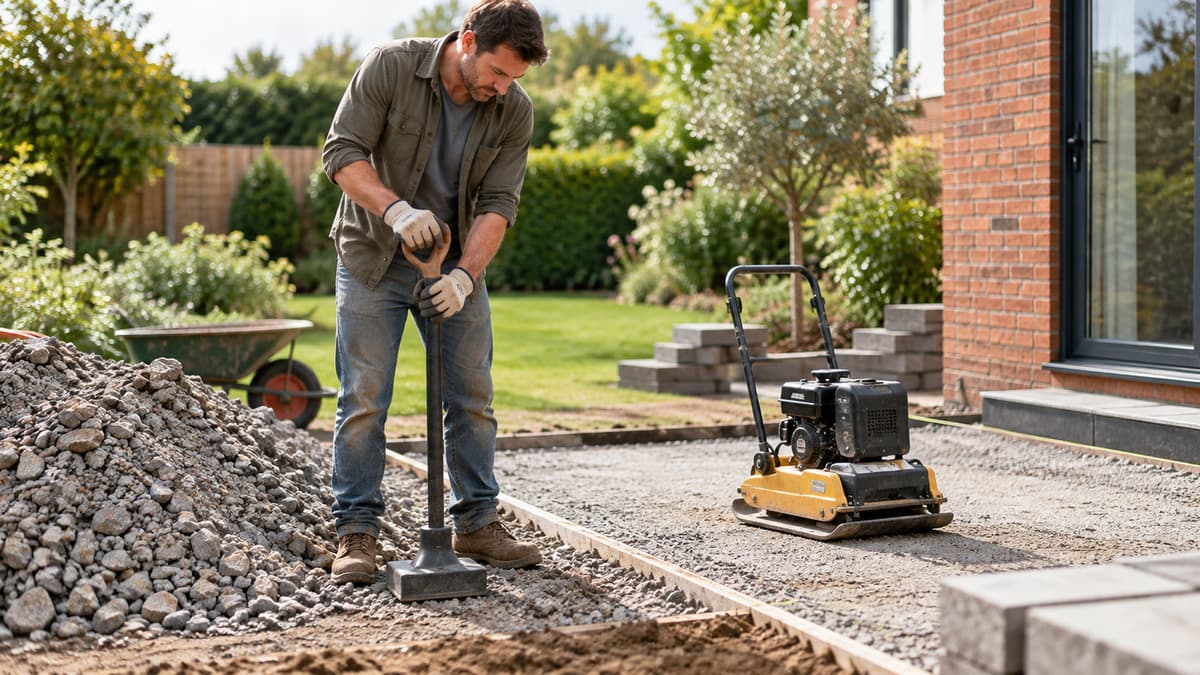
On a small bay, a hand rammer still has a job after the plate: the strip along the house, an edge the plate missed, or a narrow lift in the sub-base. Hand tamper or a day's plate hire prices that as plate for area and hand tool for corners. If the patio sponges, read what is under one lifted corner. The repair is stone and compaction, then a fresh full bed.
Peter F. prepared this in October 2026 from Wickes paving and patio guides, Wickes rigid installation notes, and Pavingexpert on sub-bases. We did not lay a patio or run a lab test. A qualifying purchase through our links can earn a commission at no extra cost to you.
Common questions
Should I use sharp sand or mortar under paving slabs?
Are five blobs of mortar enough under a slab?
What mix is a basic patio mortar bed?
What should I put in the joints between slabs?
Can I lift a slab later if it is on sand?
Do I compact the bedding with an earth rammer?
How deep should the whole build be below the DPC?
Does a mortar bed stop weeds in the joints?

Peter F. is the editor for DIY & tools at productscompared.co.uk. Comparisons in this category are checked against amazon.co.uk listings, review evidence and public UK sources.
Related articles

Compact MOT Type 1 in thin layers
The stone under your bed only works if each lift is compacted before the next. One dumped heap will still move.

Patio slabs sinking after winter
Rocking flags often mean loose hardcore or a hollow bed, not frost alone. Lift one slab and read the layers.
Hand tamper or a day's plate hire
Price the sub-base work before you mix mortar. A plate and thin lifts beat a thick sand skin on loose stone.