Patio slabs sinking: find the fault before you re-point

Rocking or puddling slabs after winter often mean a loose sub-base or a weak bed, not frost alone. Check fall, lift one slab, then fix bedding or stone.
On this page
You walked across the patio in March and one slab rocked under your heel. After the next shower, the same corner held a puddle while the rest drained. It is tempting to blame frost and buy jointing compound, but patio slabs sinking after winter usually reveal how the base was built, not a single bad season. The job is to separate a loose sub-base from a bedding layer that has washed or crushed, then repair the layer that actually failed.
Peter F. prepared these notes in October 2026 from Wickes patio and paving guidance, Pavingexpert on sub-bases, Screwfix layer advice, and the amazon.co.uk listings in our tool comparisons. We did not strip your patio or run a plate on your drive. A qualifying purchase through our links can earn us a commission at no extra cost to you.
In short
Rocking slabs, new puddles, and a lower edge on one side are signs that something under the paving has moved or washed away. Re-pointing joints fixes none of that if the bed or sub-base is loose. Check fall and drainage first, lift one slab at the worst spot, then decide whether you re-bed, re-compact stone, or strip a wider area.
What winter is showing you
Cold weather gets the blame because that is when you notice the fault. Rain through autumn already tested whether water runs off or sits in low spots. Freeze-thaw can lift an edge that was bedded on dots of mortar or a thin sand skin, especially where traffic crosses a corner. What winter rarely does on its own is compact a properly built sub-base or erase 16 mm per metre of fall across a whole bay.
Walk the patio when it is dry and note which slabs rock, where water last pooled, and whether any slab sits lower than its neighbour. One rocking unit often means a void under a corner or washed bedding. A line of low slabs can mean settlement in the hardcore. A hollow knock with a rubber mallet suggests a gap between slab and bed, which pointing will not fill for long.
Do not treat every movement as frost heave. Heave tends to push upward on clay soils and affects more than one isolated flag on a well-compacted granular base. On many UK back-garden patios the subgrade is imported MOT Type 1, and the usual story is incomplete compaction, a bed that was never a full mortar bed, or sand joints that let fines wash out.
Check the fall and the water
Before you lift anything, confirm where water is supposed to go. Wickes’s lay-a-patio guide quotes roughly 16 mm of fall per metre away from the house. Rest a long straight edge across several slabs and set a spirit level on it. If the low corner that pools water is also the side that should have been highest, the slab has tilted or the bed has collapsed locally. If the whole bay is flat or falls back toward the wall, the original falls may never have been built in, and no amount of joint sand will drain it.
After heavy rain, dark joints that stay wet can mean open gaps pulling water into the bedding. Water sitting on a low tile is a different fault: the plane is wrong. Open joints are maintenance once the slab is stable. A low tile needs a re-bed or a rebuilt fall. If that fall is wrong across a large area, fixing one slab will leave steps elsewhere.
Lift one slab and test the base
Choose the worst rocking slab, or one at the deepest puddle, and lift it carefully. Concrete flags are heavy. Work with a helper, wear gloves, and lever on the bed rather than snapping corners. Once the slab is out, look at what you expose before you clean anything away.
If you see loose aggregate that prints under a firm thumb or heel, the sub-base was not compacted to the standard UK guides describe. Pavingexpert is blunt: granular sub-base that moves underfoot is not compacted. Screwfix and Wickes both describe building MOT Type 1 in layers of about 50 mm and compacting each lift before the next. One dumped load raked flat and topped with slabs will often settle the first time the ground cycles wet and dry.
If the hardcore feels firm but the mortar or sand bed is crumbly, missing under the centre, or washed to one side, the sub-base may be acceptable and the bedding is the repair. Wickes’s paving leaflet warns that dot-and-dab bedding and some sand beds can be lifted later because they were never a continuous layer. A full mortar bed is harder to lift but still fails if the stone below moves.
Wickes quotes about 100 mm of MOT Type 1 for a typical patio build, compacted in two lifts. If you expose only 30 mm of loose dust and sand before you hit soil, the original build was thin as well as soft. Adding mortar on top will not replace missing hardcore. Dig out to a firm formation level, import Type 1, compact in passes, then bed again.
Bedding and joints are the second fault
Match the repair to the layer that failed. Re-bedding means cleaning old mortar or sand off the slab and the ground, then laying a fresh full bed, not dabs at the corners. Dot-and-dab makes a later lift easier. It is not a stronger seat for heavy flags on a footpath.
Joints come after the slab sits solid with no rock. Open joints let water carry fines from the bedding every time you hose the patio. Brushing kiln dried sand into dry joints restores friction between blocks or flags when the bed is sound. Sand does not lift a failed foundation. If you use mortar in the joints, the slab has to be fixed first or the movement will crack new pointing within months.
Sharp sand or mortar under slabs is the bed choice. On a sinking patio the urgent question is whether anything under the bed still moves. Pumping jointing compound into a void is a short-term patch. One or two failed units beside firm neighbours can be a local re-bed. The same loose stone at every lifted corner means remove a run, re-compact Type 1 in thin lifts, and relay. Pointing a moving edge sends you back to that corner next winter.
Relay to the height of the neighbouring slabs so you do not leave a lip, and let a mortar bed cure before furniture or a barbecue loads that corner. Wickes documents sand beds partly so slabs can be adjusted later. That is a trade-off, not hidden strength.
What a hand rammer will not put right
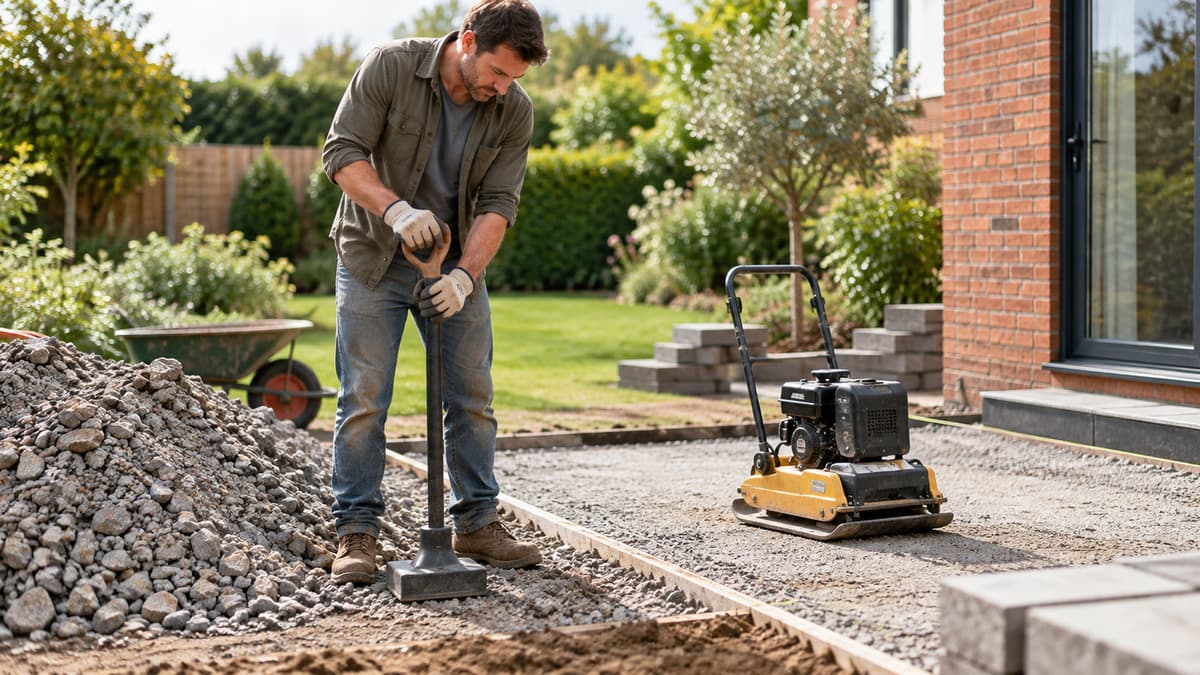
Compacting MOT Type 1 properly on anything wider than a footpath edge is plate work. Hire firms and paving sources agree: vibrating plates densify granular fill in overlapping passes, and a hand rammer is for edges, small pads, and spots the plate cannot reach. After you strip failed stone and spread a 50 mm lift, a plate compactor is the realistic tool for the open area.
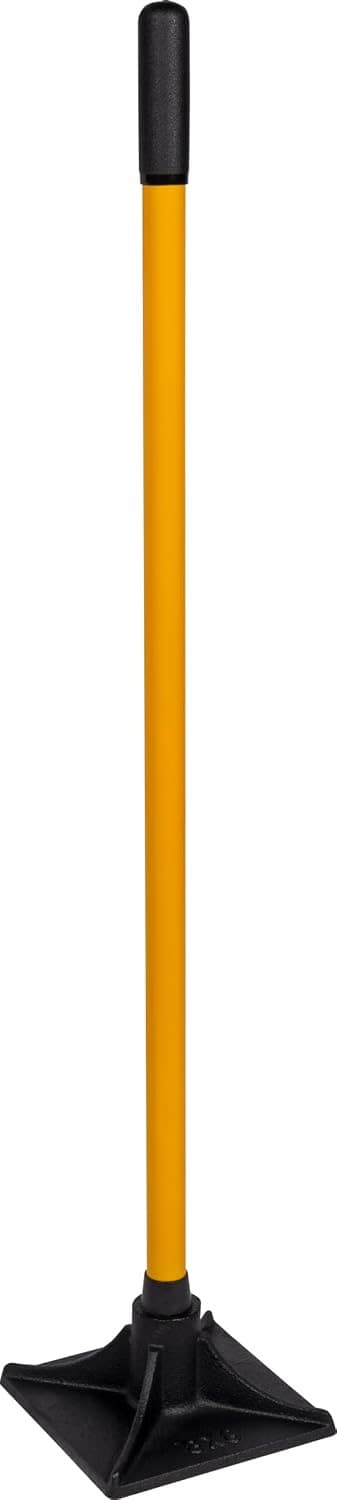
The Roughneck ROU64379 on our tamping rammer comparison is a top pick for a one-piece 200 mm face when you firm thin lifts on a small bay, or tamp up to a wall after the plate has passed. Reviews describe Type 1 pads done over several sessions, and a plate that is more consistent when the rectangle grows. A tamper will not compact stone that is still trapped under the flags.
Know when to stop. Drive-sized areas, large settlement toward the house, or a sub-base that stays soft after a test strip need plant hire or a landscaper, not another afternoon with a 5 kg head. The hand tamper for a patio page applies here too: if the whole exposed base sponges, the repair is to strip, compact in layers, and relay, not joint sand and hope.
A day’s plate hire plus a bulk bag of Type 1 often beats more jointing product on a patio that still moves. The plate compactor patio sub-base page sets lift thickness and fall before you choose petrol or electric hire. If the patio shares a drain with a neighbour or sits against a cavity wall, treat a change in level near the brickwork as a drainage question first.
Common questions
Why did my patio slabs sink after winter?
Can I just re-point the joints?
How do I know the sub-base was never compacted?
Should I lift every slab?
Will a hand tamper fix a sunken patio?
When do I need a landscaper?
Is sharp sand under slabs the same as a compacted sub-base?
How much fall should a patio have?

Peter F. is the editor for DIY & tools at productscompared.co.uk. Comparisons in this category are checked against amazon.co.uk listings, review evidence and public UK sources.
Related articles

Compact MOT Type 1 in thin layers
One thick dump of hardcore will still move underfoot after a winter. The fix is lift height, not a bigger hammer.
Hand tamper or a day's plate hire
A £46 tamper and a hire plate solve different parts of the same rectangle. Price the job before you lift slabs.

When a hand tamper is not enough
If the whole area sponges under your heel, the tool in the shed was never sized for that sub-base.