Compact a gravel path: when to firm it, not on a calendar

There is no fixed schedule to compact a gravel path. Firm the surface when it scatters; rebuild if your heel sinks through to a failed base.
On this page

You raked the garden path on Sunday, and by Wednesday the centre looks thin while shoulders of stone sit in the lawn. Honest United Kingdom path guidance does not give a statutory compact a gravel path timetable. Maintain the surface when only the top loosens. Rebuild when your foot finds soft ground beneath the stone.
We drew on Wickes path instructions, Pavingexpert sub-base notes, and tool guides that match rammers to narrow work. Nothing here is a lab compaction test. A qualifying purchase through our links can earn a commission at no extra cost to you.
In short
Do not firm gravel on a calendar. Re-tamp when the path scatters, washes, or feels crunchy underfoot but still has a firm layer beneath. Rebuild with compacted MOT type 1 under gravel, or the depth your guide specifies, when your heel sinks through to soft ground. Keep edging intact, fix waterlogging before you blame the stone, and use a hand rammer on a narrow path. Hire a plate only if you are reworking a wide sub-base. After rain, wait until the surface is damp, not muddy, before you firm it.
There is no fixed interval
Gravel paths differ by traffic, slope, stone grade, edging, and whether anyone compacted a sub-base. A link to the shed used daily scatters faster than an occasional route through a border. Clay that holds water moves differently from free-draining sand. A post that promises every spring, or twice a year, is guessing at your garden.
Schedule inspection, not compaction. After heavy rain, walk the line in dry shoes and note where stone migrated. After a dry fortnight, check whether the surface skates. Act when those checks fail, and leave a stable path alone. Wickes puts compaction at construction and in controlled lifts, not on arbitrary dates. Firm the path when raking no longer restores a level crown for more than a few days. Stop topping up when each bulk bag disappears into soft ground without improving the heel test. You are then feeding a failed base.
A loose surface on a firm base
Many garden paths are a compacted granular layer with decorative gravel on top. Traffic and rain loosen the surface while the sub-base stays acceptable. Rake stone back from the lawn, add a little matching gravel if the crown is worn, dampen a dust-dry surface, then work a hand rammer in overlapping passes. You are re-knitting the top few centimetres, not building a motorway sub-base. Walk on the grass beside the path so you do not undo the pass. A square face around 200 mm suits a typical footpath.
Angular gravel with fines knits under blows. Large rounded pebbles roll apart, so a decorative layer with no fines needs more raking and rewards tamping less. That is a design limit, not a tool fault. Match the existing grade when you add stone. Mixed sizes look patchy and compact unevenly. Tip small quantities, rake, then firm before the next bucket. One deep loose dump behaves like the failed thick lifts in compact MOT type 1 in thin layers: the top may look fine while the new stone stays loose underneath.
A path that moves under your heel
The heel test separates maintenance from rebuild. Pavingexpert treats a finished compacted layer as something that should not move underfoot. Apply that to the whole path, not only to MOT under slabs. A few millimetres of slide is normal scatter. Several centimetres of sink into soft material is not. Scrape a troubled spot. Compacted aggregate or hardcore within the build depth can still be a top-up. Dark topsoil or soft fill that was never compacted will not be fixed by more gravel.
A rebuild strips back to stable ground, puts edging in if it is missing, then builds the sub-base in thin lifts. Wickes path guides describe trench depth and roughly 50 mm compaction passes before the surface course. That is not an afternoon with a tamper. Owners who compact once at install usually built a base. Owners who fight a sinking path every winter often spread stone on soil. If slabs sit on the route, movement may be bedding failure. On a pure gravel line, still separate surface scatter from sub-base give.
Rain, edges and waterlogging
People search gravel path after rain and assume they must compact at once. Water washes fines downhill, floats particles into borders, and leaves larger stone proud. A wet paste smears under the tamper. Wait until the material is damp, not sloppy. Puddles mark low spots that keep washing out until you rake and firm the crown, or adjust the fall. Standing water also softens a marginal sub-base, which makes freeze-thaw worse. Wickes notes that waterlogging may call for a deeper base at build time. Repeated puddling on an existing path is a cue to check depth and drainage, not only to add stone.
A firm middle with naked borders usually means missing restraint. Brick, timber, steel, or a haunch against a wall keeps gravel in the traffic line. Without it, rain and feet export stone to the lawn. Repair the edge, rake the gravel back, then firm. Frost heave on clay can ruck a path that was acceptable in October. Spring work is often a rake and a firm. Deep cracks into soft ground send you back to the heel test.
Which tool for a top-up
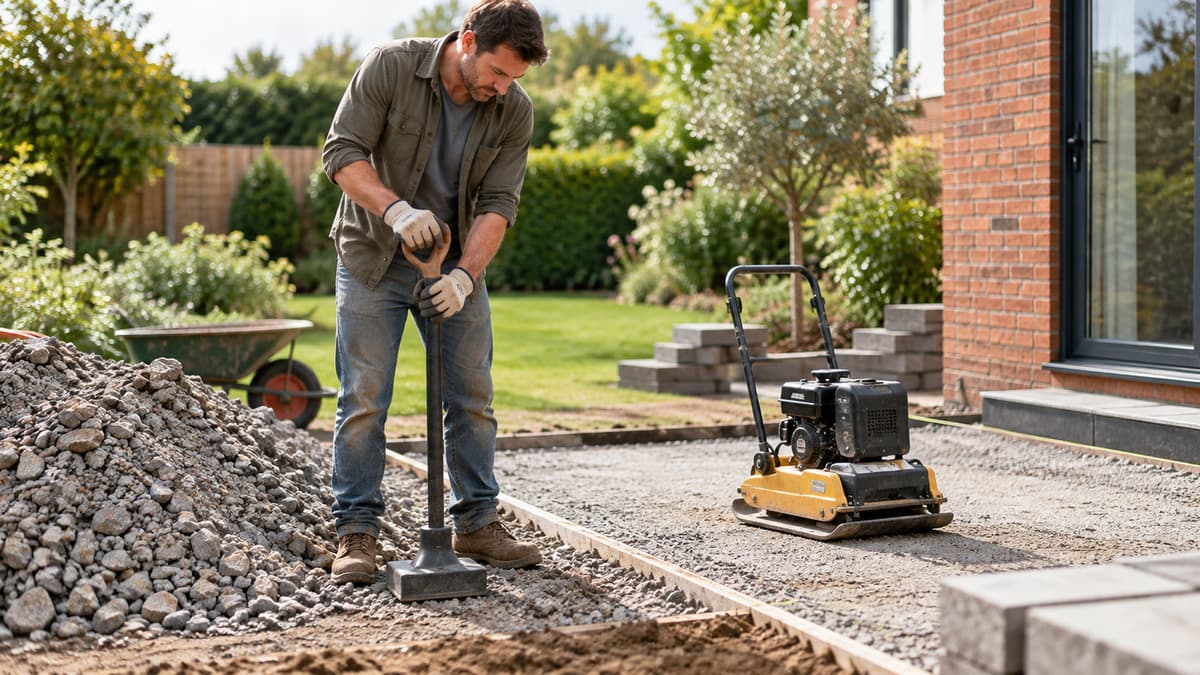
For a narrow path, a hand earth rammer is the default. DIY Extra pairs rammers with confined hand work and vibrating plates with larger spreads. Lift and drop on overlapping points, and dampen scatter that skids off the face.
The earth rammer comparison top pick for repeated garden use is the Roughneck ROU64379 at about £45.99 on amazon.co.uk in the listing we track: a 200 × 200 mm cast-iron head, a one-piece fibreglass handle, and a listed 5.4 kg. UK reviewers use that class on small patches and path edges. It suits paths, post holes, and shed bases over several years. It is the wrong buy if you only hire a plate once for a wide rebuild. The best value pick in that comparison is a lighter sectional tamper for occasional jobs. Loose bolts and a lighter mass limit serious sub-base work.
Hire a vibrating plate for a broad sub-base, not for a metre-wide gravel line. Plates need room, protection for nearby glass, and ear defenders. On a full-width drive, a day’s hire often beats an evening of shoulder ache. On a serpentine path the plate guard catches plants. Hand tamper or a day's plate hire sets out the hire maths. When a hand tamper is not enough covers a light tamper that still leaves the path moving after proper lifts.
Buyer comments in the hub research said dry material barely compacted until water was added. Too wet, and the face smears. Use a watering can, rake through, wait, then tamp. Wear gloves, and keep pets off loose stone. Kiln-dried jointing sand is for gaps between pavers, not a path surface. Brushed onto scatter it tracks indoors and washes like fines. The kiln-dried sand comparison explains that job. When the base, the edging, and the fall are sound, you may go a year or more without the rammer. When the heel sinks through, stop topping up. Firm the path as often as it proves it needs it, and not one pass sooner.
Common questions
Calendars, top-ups, rain washout, edging, and a failed sub-base are answered below. Hand-rammer prices on amazon.co.uk sit on the earth rammer comparison. For a wide rebuild, the plate compactor comparison covers hire machines. Hardcore under paving, rather than decorative gravel alone, belongs with the thin-layers MOT guide.
Common questions
How often should I compact a gravel path?
Can I just add more gravel instead of compacting?
Why does my gravel path wash out after rain?
Is a hand tamper enough on a narrow gravel path?
Do I need edging on a gravel path?
When is it a new sub-base, not a top-up?
Should I use kiln-dried sand on a gravel path surface?
Can I compact gravel when it is wet?

Peter F. is the editor for DIY & tools at productscompared.co.uk. Comparisons in this category are checked against amazon.co.uk listings, review evidence and public UK sources.
Related articles

Compact MOT type 1 in thin layers
Why one thick lift of hardcore stays loose underneath, and how UK guides use about 50 mm lifts.

When a hand tamper is not enough
The signs that more hand blows will not fix the base, and when to hire a plate instead.
Hand tamper or a day's plate hire
Whether a £24–£46 hand rammer beats a day's wacker hire for your patio or path base.