Fatwood vs firelighters
You light a log burner most evenings, and the basket holds two things that both get called natural: resinous pine sticks, and a box of wood-wool or wax lighters. Fatwood vs firelighters is a choice of material, not a ranking of the seven fatwood listings. Fatwood is pine plus the resin already in the wood. A wood-wool lighter, a waxed cube, or a white paraffin block is a different product, and we kept those out of the fatwood rows for that reason. The fatwood prices and weights are on the [fatwood comparison](/hub/fireplaces-and-stoves/fatwood). A qualifying purchase can earn us a commission at no extra cost to you. Figures for the sticks are from our amazon.co.uk files on 19 October 2026. Lighter prices below are a UK retail range, not listings in this set.
You light a log burner most evenings, and the basket holds two things that both get called natural: resinous pine sticks, and a box of wood-wool or wax lighters.
You light a log burner most evenings, and the basket holds two things that both get called natural: resinous pine sticks, and a box of wood-wool or wax lighters. Fatwood vs firelighters is a choice of material, not a ranking of the seven fatwood listings. Fatwood is pine plus the resin already in the wood. A wood-wool lighter, a waxed cube, or a white paraffin block is a different product, and we kept those out of the fatwood rows for that reason. The fatwood prices and weights are on the fatwood comparison. A qualifying purchase can earn us a commission at no extra cost to you. Figures for the sticks are from our amazon.co.uk files on 19 October 2026. Lighter prices below are a UK retail range, not listings in this set.
Our top picks
| Badge | Product | Pack | Net weight | Damp-weather claim | Note | Price | Offer |
|---|---|---|---|---|---|---|---|
| Best overall |  BIUDECO BIUDECO fatwood sticks in a tin | Pocket tin | 177 g | Seller: less predictable weather. Waterproof not stated | 4.7 | about £11.48 | View offer |
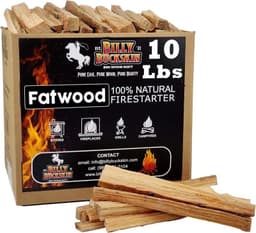
| Best value |  Billy Buckskin Billy Buckskin 10 lb fatwood sticks | 10 lb box | 4.54 kg | Seller: lights when wet | 7.9 | about £29.18 | View offer |
 Pure Garden Pure Garden 10 lb fatwood sticks | 10 lb box | 4.54 kg | Seller: lights when damp or wet | 8.5 | about £28.64 | View offer |


On this page
Two different starters
On a log burner
When fatwood is the better buy
Cost and the label
Common questions
Are fatwood sticks a firelighter?
Which starter avoids wax and paraffin?
Do I still need kindling with either?
Is fatwood cheaper per fire?
Can I cook over fatwood as I would over wood wool?
Related pages
Sources
Public UK sources used for this comparison. amazon.co.uk prices, stars and review counts were taken from the listings on 19 October 2026.
- GOV.UK, smoke control area rules (retrieved 19 October 2026)
- Air Quality (Domestic Solid Fuels Standards) (England) Regulations 2020 (retrieved 19 October 2026)
- GOV.UK, selling wood for domestic use in England (retrieved 19 October 2026)
- Ready to Burn (retrieved 19 October 2026)
- HETAS, how to light a fire (retrieved 19 October 2026)
- HETAS, carbon monoxide (retrieved 19 October 2026)
- Paul Kirtley, fatwood (retrieved 19 October 2026)
- Woodland Ways, fat wood (retrieved 19 October 2026)