Independent comparisons. We may earn from shop links. More info

Fatwood buying guide

Updated: 22.10.2026

You have a log burner and an amazon.co.uk tab of fatwood from a £12 tin to a box near £29. A 180 g tin can cost about ten times more per kilogram than a 4.54 kg box, and none of the seven listings we kept show a Ready to Burn logo. This guide is the criteria: what the sticks are, when the kilograms are worth paying for, how to judge resin, and what the missing English wood label means. Prices from the files on 19 October 2026 sit on the [fatwood comparison](/hub/fireplaces-and-stoves/fatwood). A qualifying purchase can earn us a commission at no extra cost to you.

You have a log burner and an amazon.co.uk tab of fatwood from a £12 tin to a box near £29.

Our top picks

On this page

What you are buying

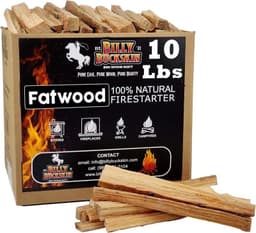
Fatwood is pine heartwood that has taken up the tree's own resin, split into sticks that catch from a match and pass the flame to kindling. Paul Kirtley, writing from East Sussex, describes sound pieces as dense, golden-orange or reddish, heavier than ordinary pine, and pine-scented on a fresh cut. A wood-wool cube, a paraffin block, and a ferro-rod kit are different objects, even when a title calls them natural. Two of the seven listings are 4.54 kg boxes. Four are pocket packs from China of about 177–180 g. One page at £4.59 contradicts itself and should not be used as a price example. Resin sticks against wax or wood wool is fatwood or firelighters.

Box or tin

From the printed prices and weights on 19 October 2026, Pure Garden is about £6.31 per kilogram and Billy Buckskin about £6.43. The tins land at about £65, £72, £87 and £88 per kilogram, in the order BIUDECO, MOTHNUR, Garneck, and ADOCARN. A tin is not a poorer species of wood. It is a poor price for the same job if you light a stove on most evenings and then compare only the sticker. Two or three sticks at each lighting, the sellers' own note, treats 4.54 kg as a starter store, not the winter's fuel. The logs still do the heating. Billy Buckskin states sticks of about 203 mm by 7.6–31.8 mm. Pure Garden does not state a stick size. The conditional pick is on best fatwood.

How to judge a stick

Colour, heft, and smell are a rule of thumb, not a British Standard and not a result we measured. Look for reddish or orange wood, dark resin veins, and a stick that feels heavy for its size. Pale, light pieces behave like ordinary kindling, which sits damp and refuses a match. Refuse a page that disagrees with itself. The £4.59 listing, ASIN B0GRTGRSVR, says 50 g and 12 inch sticks in the title and 28 g and about 10.2 cm in the technical details. Do not invent a price per kilogram from either figure. Billy Buckskin's flavour line says hickory while the description says pine, which is a catalogue clash, not a scent you should shop for. Oily or well impregnated, if a review uses those words, is a more useful quality signal than a flavour name.

The label England expects

In England, wood sold for domestic burning in a unit under 2 m³ is supposed to carry the Ready to Burn logo, the supplier's name, and a certificate number, at a certified moisture of 20 percent or below. None of these seven listings print that logo or a certificate number. A sentence that says the sticks light when damp is about resin shrugging off surface moisture. It is not that moisture certificate. A missing logo does not prove the sticks are wet, and it does not let you call the packet certified kindling. Fatwood is still wood. In a smoke control area you burn wood only in an appliance the rules allow, and you do not send chimney smoke into the neighbourhood. Scotland, Wales, and Northern Ireland run their own arrangements.

Common questions

Is a 10 lb box better value than a tin?
On price per kilogram, yes, when the weight is printed once and agrees with the title. The two 4.54 kg boxes here are about £6.31 and £6.43 per kilogram. The coherent tins are about £65 to £88 per kilogram. The box is the better spend only if you will use something like 4.5 kg as a starter. If the sticks will sit unused, a 180 g tin wastes less wood.
How many sticks are in 4.54 kg?
These two boxes do not say. A specialist retailer has claimed about 120 sticks in a different 10 lb box, and that claim is not these ASINs. What the Pure Garden and Billy Buckskin pages do say is two or three sticks under dry firewood. Plan the purchase as a mass of starter, not as a counted bundle.
Is the £4.59 listing a bargain?
Only if you ignore a broken specification. The title says 50 g and 12 inch sticks. The technical details say 28 g and about 10 cm. There is no brand and no review text. Until those lines agree, there is no honest price per kilogram, and a £11.48 tin with one stated weight is the clearer small purchase.
Does lights when wet mean the wood is certified dry?
No. Sellers use that line to describe resin, which shrugs off surface damp better than plain kindling. Ready to Burn is a separate moisture certificate at 20 percent or below, with a logo and a number. These listings do not show it. Wet logs will still smoke if the starter catches and the fuel does not.
What should I check in a smoke control area?
Fatwood is wood. You need an appliance that is allowed to burn the fuel the manufacturer specifies, and you must not release smoke from a chimney. A Defra-exempt stove is exempt only when you follow that plate. If you cannot tell whether your stove is exempt, ask the installer or a sweep before you treat any starter as permitted.

Related pages

Sources

Public UK sources used for this comparison. amazon.co.uk prices, stars and review counts were taken from the listings on 19 October 2026.

  1. GOV.UK, smoke control area rules (retrieved 19 October 2026)
  2. Air Quality (Domestic Solid Fuels Standards) (England) Regulations 2020 (retrieved 19 October 2026)
  3. GOV.UK, selling wood for domestic use in England (retrieved 19 October 2026)
  4. Ready to Burn (retrieved 19 October 2026)
  5. HETAS, how to light a fire (retrieved 19 October 2026)
  6. HETAS, carbon monoxide (retrieved 19 October 2026)
  7. Paul Kirtley, fatwood (retrieved 19 October 2026)
  8. Woodland Ways, fat wood (retrieved 19 October 2026)