Independent comparisons. We may earn from shop links. More info

How to light a log burner with fatwood

Updated: 22.10.2026

You already have the sticks and the stove manual is somewhere in the house. The failure mode is familiar: the firebox packed with resinous wood, the air slide shut, and a sheet of black on the glass before the logs have caught. This is how to light a log burner with fatwood on a closed stove, using two or three sticks as the seller describes, then kindling and dry logs. Camping and open ground are a different job, on [fatwood for camping](/hub/fireplaces-and-stoves/fatwood/sub/fatwood-for-camping). The rows are on the [fatwood comparison](/hub/fireplaces-and-stoves/fatwood). Nothing here is a measured burn time.

You already have the sticks and the stove manual is somewhere in the house.

Our top picks

On this page

Before you strike the match

Read the plate on your stove before you copy a method from a stick packet. HETAS says manufacturers differ on lighting, and that you follow the manual. If the manual is missing, ask the installer or a chimney sweep rather than guessing from a product bullet that says wood stove. Fatwood is still wood. In a smoke control area it belongs only in an appliance that may burn the fuel the manufacturer allows, and chimney smoke is still restricted. Have a carbon monoxide alarm in the room, to BS EN 50291, and test it. HETAS says England and Wales require one on a new or replacement solid-fuel install. The alarm is not a substitute for a sweep. Clear the ash so the inlet can breathe, and set aside dry logs. Charnwood, a UK stove maker, talks about fuel under 20 percent moisture. A resin stick does not dry a wet log.

Where the sticks go

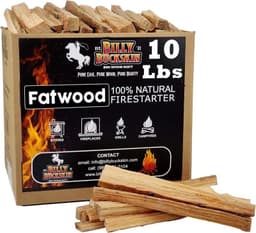
Use two or three sticks, not a firebox full of them. That count is the instruction on the Pure Garden and Billy Buckskin listings: sticks first, dry firewood with them, then a match. Billy Buckskin adds a practical detail. Hold the match on a thick piece so the resin flows and the flame takes. These tins do not state a stick size and only Billy Buckskin states one on the bulk box, about 8 inches long. You can lay the fire in either of the two patterns HETAS describes, as long as your manual allows it. In a traditional crib, the fatwood sits with the kindling. In a top-down stack, larger dry logs go down, kindling above, and the two or three sticks where the match can reach them at the top. Fatwood takes the firelighter's place. It does not delete the kindling or the logs. Filling the stove with resinous wood is how you smoke the glass. If you are choosing between resin sticks and a wood-wool lighter, see fatwood or firelighters.

Air, door, then close down

Start hot. Air controls open, primary air available, and the flue given a chance to draw before you choke the fire. A shut vent at lighting is the usual reason resin smoke has nowhere to go but the glass and the room. Charnwood tells its own owners to light with the air fully open and the door ajar, then to shut the door once the fire is going and not to leave it open. That is one maker's instruction. Your plate may say something else about the door. Follow the plate. Once the logs have caught and the flue is drawing, close the stove down to the running setting in the manual. Fatwood's job is over by then. The heat for the evening comes from the logs, not from a continuing feed of resin sticks. Morsø's UK guidance says the glass blacks from wet wood, from wood with a lot of resin, and from a fire that is running too low.

When smoke means stop

Some smoke and a sharp pine smell at first light are what you should expect from resin. Black tar-like marks inside the stove are a different signal. HETAS treats those deposits as a clue that the flue may be lining with creosote, not merely that ash needs a brush. Wet fuel, a starved air supply, and a fire that never gets hot are the usual causes. Defra's public guidance says sweep regularly, up to twice a year. That is a ceiling in the wording, not a promise that twice a year is right for your chimney. If the carbon monoxide alarm sounds, shut the stove down, ventilate, and leave. HETAS says to seek NHS 111 or 999 if anyone feels unwell, and not to relight until a competent person has checked the appliance and the chimney has been swept.

Common questions

How many fatwood sticks do I use?
Two or three, which is what the bulk-box listings say, under or beside dry kindling and logs. Hold the match on a thicker piece if the resin is slow to flow. A whole firebox of sticks is not the instruction, and it is the habit that smokes the glass.
Do I still need kindling and logs?
Yes. Fatwood is the starter. Kindling bridges the flame to split logs, and the logs are the fuel that heats the room. You can put fatwood where the firelighter would sit. You cannot skip the dry wood around it, and you cannot treat wet logs as acceptable because the stick caught.
Should the air vents be open?
At lighting, yes, unless your manual says otherwise. Open air lets the flue draw and gives the resin smoke a path up the chimney instead of onto the glass. Close down to the running setting only after the logs are burning.
Top-down or sticks underneath?
Either, if the manual allows both. HETAS describes a traditional lay and a top-down lay. In both, the two or three sticks need a match and an air path, with dry kindling and logs doing the rest.
What if the carbon monoxide alarm sounds?
Turn the appliance off, open windows, and leave the room. If anyone is unwell, use NHS 111 or 999. Do not relight until a competent person has checked the stove and the chimney has been swept.

Related pages

Sources

Public UK sources used for this comparison. amazon.co.uk prices, stars and review counts were taken from the listings on 19 October 2026.

  1. GOV.UK, smoke control area rules (retrieved 19 October 2026)
  2. Air Quality (Domestic Solid Fuels Standards) (England) Regulations 2020 (retrieved 19 October 2026)
  3. GOV.UK, selling wood for domestic use in England (retrieved 19 October 2026)
  4. Ready to Burn (retrieved 19 October 2026)
  5. HETAS, how to light a fire (retrieved 19 October 2026)
  6. HETAS, carbon monoxide (retrieved 19 October 2026)
  7. Paul Kirtley, fatwood (retrieved 19 October 2026)
  8. Woodland Ways, fat wood (retrieved 19 October 2026)