Stove fan not spinning: heat, place, or failure

A stove fan not spinning is usually a cool top, a poor spot, or a dead module. Check the heat and the placement before a return, and leave a hot base alone.
On this page

You lit the stove half an hour ago, the glass is bright, and the small fan on the top has not turned once. A stove fan not spinning on that first evening is common, and it is usually the plate, the spot you chose, or a module that no longer makes power. These heat-powered fans sit on a log burner or a multi-fuel stove and push warm air into the room.
A thermoelectric module between a hot base and a cooler top makes the electricity, so there is no plug to check and, where the listing matches that design, no battery to swap. Check the heat, then the placement, then whether the unit has failed. A return for a fan that was only cold wastes the evening.
In short
A stove fan not spinning needs a hot base and cooler fins, stood clear of the flue. Many units in this comparison are listed as starting around 50°C on the stove top, and Ecofan's wood models start higher than that. If the plate is inside the stated band, the place matches the maker's warning, and the blades stay still, the module has usually failed. Replace the fan.
When a stove fan not spinning is the temperature
The blades turn because one face of the module is hotter than the other. Ecofan's UK FAQ describes that split as heat at the base and cooler fins above. When both ends sit at a similar temperature, there is little electricity and the fan stays still. A bright fire behind the glass does not mean the top plate is hot yet. The plate is the surface the base touches, and it lags the flames you can see through the door.
There is no single start figure for every model sold in the UK. Valiant's sheet for the FIR361 states a start around 50°C, an optimum stove surface of 80–250°C, and a maximum of 340°C. The JossaColar listing B0BDM14HVM states 50–350°C and says the fan will not generate electricity below about 50°C. Ecofan's wood models start higher than 50°C and are quoted up to about 345°C. Ideal Home's ceiling comment is about 350°C. Judge the fan against the sheet for that model.
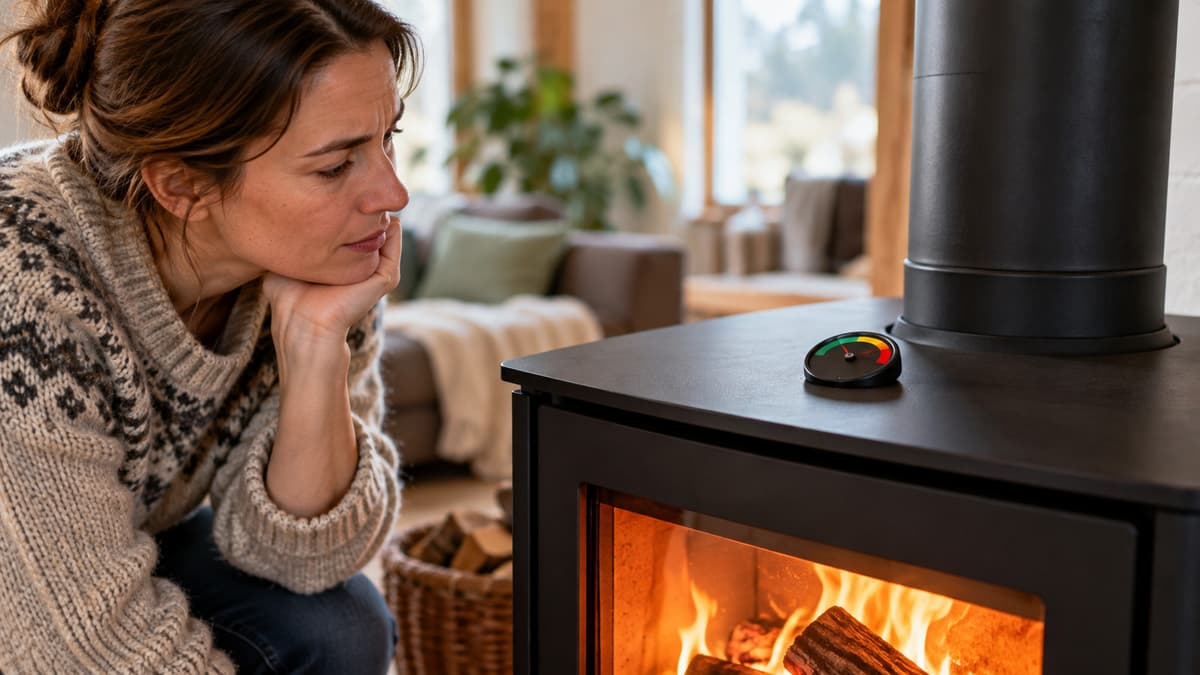
A flue-pipe thermometer reads a different surface from the plate. The Valiant FIR361 box, listing B00LEO7W7U, includes no thermometer. JossaColar lists a magnetic one. Treat it as a guide to the plate, and follow the stove manual for the fire. Twenty minutes of kindling is too early for a fan whose useful band sits nearer 80°C. If the plate is still under about 50°C after a normal burn, more waiting will not start this type of fan.
Where you stand the fan
Stove fan placement changes both ends of the module at once. Valiant's sheet says the fan should never go in front of the flue, and that the start moves with how close the unit is to the hotter part of the top. Ecofan's FAQ makes the same point, because the fins have to stay cooler than the base. TheGreenAge adds the gap behind: leave space so room air can reach the fins. A fan parked under the flue collar heats the fins along with the base, and the blades do little.
The front lip is the other usual miss, and it is often the coolest part of the plate. Move the fan only when the stove is cold, towards the rear and still clear of the flue, with the base on bare metal. A glove, a trivet, or a pad of ash holds the module off the plate. Height catches a low mantel. Valiant's FIR361 sheet lists 199 mm, while the amazon.co.uk size line of 8 × 7 × 4 cm on B00LEO7W7U does not match that sheet, so the catalogue size is the wrong figure for the gap.
If the fan only starts in one hotter patch, that was placement. The routine for putting it on, letting it run, and taking it off is on the how to use a stove fan page. A heat powered fan will not start when the spot removes the temperature difference.
Stove tops that stay too cool
Some stoves will not run a wood-stove fan however carefully you place it. Ecofan's UK FAQ says inserts are not the normal use. The JossaColar listing includes some embedded fireplaces in the warning that a top under about 50°C will not run the fan. A cool-touch skin is built so the outside stays cooler, which is the opposite of what the module wants from the base.
A gas fire is a different heat pattern. Ecofan's gas model uses a cooler range, and that model is not among the twelve heat-powered fans in the stove fan comparison. TheGreenAge notes that low-temperature fans exist as a different product, not a setting on the fan you own. If the plate stays under the band on a normal fire, this type is the wrong tool.
These units suit a freestanding stove with a flat hot top, which is what stove fans for log burners sets out. A low mantel pushes a tall fan to the front lip. Low gaps and insets that fail are on the small stoves page. Running the fire harder only to spin the blades can push the stove into a roar, and the fan will not close the air controls.
When the module has failed
A fan that turned through the winter and now sits still on a hot top has a worn module. Ecofan does not sell its module as a spare, and the listings in this set do not offer one to fit at home. Opening the housing on a warm stove is a burn. Replacement is the usual end.
Review notes here are comments, not a failure rate. Some Valiant notes describe fans lasting through winters. Others describe units that died after a season or two. A Tomersun mini was described as erratic after about three months, and one Ykgutilu review said it stopped after a couple of months. Intermittent running on an unchanged plate is the same fault. A stove fan not working in that pattern is the module.
The FIR361 listing states a one-year warranty. Inside 30 days, the Consumer Rights Act 2015 gives a short-term right to reject faulty goods. Two winters of use sits outside that window, so the warranty on your order is the clock left.
The top pick if you replace it is the Valiant FIR361, about £39.99, with 4.5 from 2,228 amazon.co.uk reviews. It starts around 50°C on the sheet, so it will not solve an inset, and the box has no thermometer. JossaColar is the best value in the set at about £27.99, with 4.6 from 5,531 reviews, and its bullets carry the under-50°C warning. The twelve listings are on the stove fan comparison.
A qualifying purchase can earn us a commission at no extra cost to you. We have not lab-tested these fans. Prices and counts are from the amazon.co.uk listings. The stated 420 CFM on the Valiant page was not measured here.
Checks before you return it
Leave the fan in place while the stove is alight, and keep your hands off a hot base, including one that has tilted up. Read a thermometer on the plate, not on the flue. Under the start figure on your sheet, the fan is behaving as specified.
On a cold stove, sit the base flat on bare metal, clear of the flue, with space behind the fins. Clear ash, cloth, and trivets from underneath, then light again. A start only in the hotter patch was placement, and the fan can stay in use.
On a hard burn, watch from a distance. JossaColar's listing describes a lift above 350°C. Valiant's maximum is 340°C, with a thermally controlled actuator on the page. A lifted base can slow or stop the blades. Let the fire ease. Pressing the fan back down works against that protection.
If the plate, the spot, and the contact are right across more than one fire and the blades stay still, treat the module as failed and pack it while the warranty or the 30-day right applies. If the top never reaches the band, another model will sit still for the same reason. Stop there, rather than buying a different blade count for a cool top.
Common questions
Why is my stove fan not spinning?
How hot does the stove top need to be?
Can placement stop a stove fan?
Will a stove fan work on an inset?
It spun yesterday and does not today. What changed?
Should I spin the fan by hand?
Can a stove fan be too hot to spin?
When is the fan actually broken?

Peter F. is the editor for DIY & tools at productscompared.co.uk. Comparisons in this category are checked against amazon.co.uk listings, review evidence and public UK sources.
Related articles
How to read a stove thermometer
A stove-top gauge and a flue-pipe gauge show different numbers. Read the top plate when you are judging whether a fan should start.

Signs a log burner is too hot
Glowing metal, a roar, and blackened glass mean the stove is too hot. A fan that has stopped is not the cut-off for the fire.

What a stove fan costs to run
A heat-powered stove fan has no plug, so the cost is the purchase. It does not add a kWh figure to the electricity bill.