Stove thermometer wood burner: read the right number
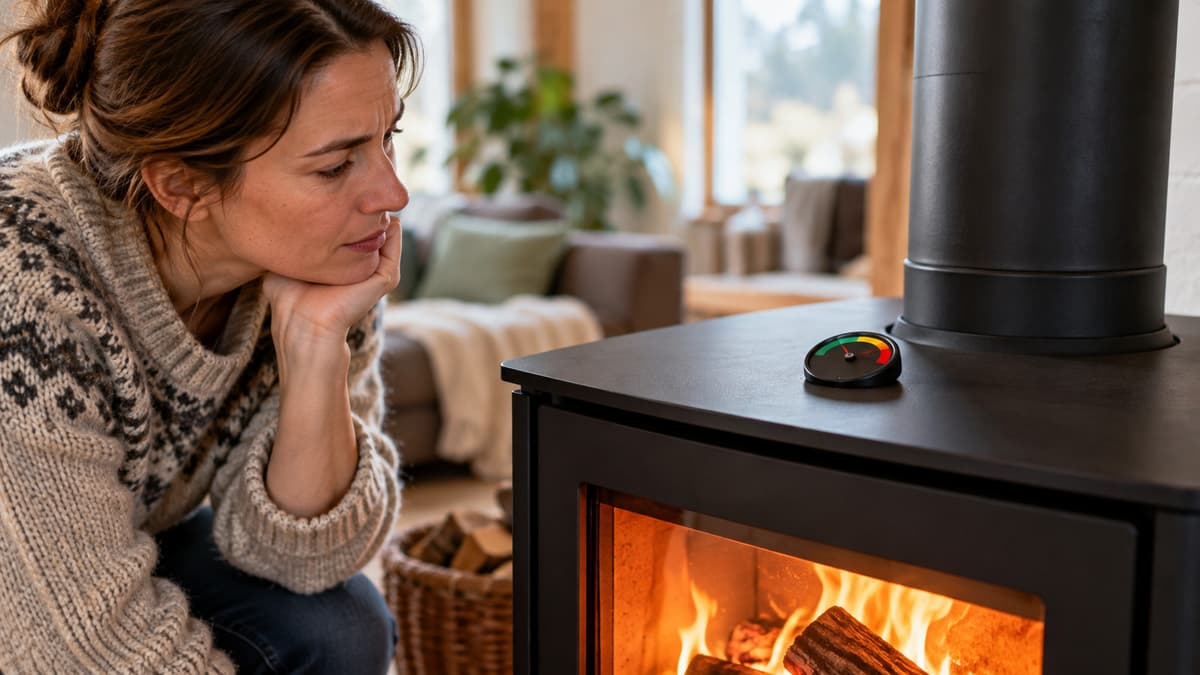
A stove thermometer on a wood burner reads one surface. Flue pipe and stove top differ. Fit the magnet where that dial says, and follow the stove manual.
On this page

The magnetic dial that came with the fan is stuck to the stove top, and the needle sits in the green. The room is still too hot, or the flue pipe is ticking as it expands, and you cannot tell which number you are looking at. A stove thermometer on a wood burner reads the metal it is touching. It does not read the flames, and it does not read a different part of the installation.
The stove top and the flue pipe run at different temperatures, so a comfortable colour on the wrong surface is a misleading comfort. Decide which surface this dial was made for, what the printed band means, and whether a gauge in a fan carton has earned any trust. The figures below come from Valiant’s FIR116 page and PDF, from Compare the Firewood, from The Wood Burner’s thermometer guide, and from amazon.co.uk listings in our stove fan comparison. Products Compared has not calibrated these dials in a lab.
In short
A stove thermometer on a wood burner shows the temperature of one surface. A flue-collar or single-wall pipe reading is not the stove-top reading a fan uses. Coloured bands belong to that dial, and the stove manual outranks them.
Stove top temperature and flue temperature
Stove top temperature is the plate under your hand or under a fan. Flue thermometer temperature is the collar or the pipe the magnet is stuck to. Heat leaves the firebox, soaks the steel or cast iron, and only then reaches the flue, so the two spots need not match while the fire is steady.
A heat-powered fan cares about the top plate, because that plate warms its base. Valiant’s sheet for the FIR361 puts the start around 50°C, an optimum stove surface around 80–250°C, and a maximum of 340°C. Those are the fan’s limits, not a flue burn zone and not a ceiling for every British wood burner. A top near 70°C may only just wake a fan that starts around 50°C, while a flue gauge further up is already deep in its own scale.
A flue gauge parked on the stove top is reading a surface its colours were not drawn for, and you will adjust the fire to suit the wrong band. If the card says flue, leave the dial on the flue. If it says stove top, leave it on the plate. The magnet sees a patch of metal, not the flame and not the gas in an insulated pipe.
After the needle stops climbing, try a second spot on the same plate. If they disagree widely, treat the hotter spot as the one that can overheat a fan, and follow the stove manual for the fire.
Where to put a stove thermometer on a wood burner
Valiant’s FIR116 page and PDF prefer the flue collar, and they cite a magnet that holds to about 425°C. That figure is the magnet’s grip. It is not a safe stove temperature. Above it, the dial can fall onto the hearth. Compare the Firewood uses single-wall pipe about 30–45 cm above the stove, in a band around 110–250°C, and not twin-wall. The Wood Burner notes that stainless is often non-magnetic, so a modern flue may refuse the magnet.
Take the reading in this order.
- Put the dial only on the surface its card names: flue collar, single-wall pipe, or stove top.
- Keep it off twin-wall outer skin and off stainless that will not hold a magnet.
- Wait until the fire is established and the needle has stopped racing, then read that dial’s colour band.
- If the band and the stove manual disagree, follow the manual.
- Treat a high reading as a prompt to ease fuel and air. The gauge cannot close a vent.
Twin-wall outer skin stays cooler because the liner and the insulation sit between you and the flue gas. A low number there does not prove an optimum burn. Do not drill the pipe or tape a dial on to force a reading. A magnet that slides means the wrong metal. Use the collar or bare single-wall steel only where the sheet allows it, and mark the 30–45 cm height while the stove is cold.
Why the optimum burn zone is not one number
The coloured arc is the printer’s arc for that dial, not a British Standard. Valiant’s range is often cited around 125–300°C. The Wood Burner describes a Valiant scale nearer 140–280°C. Compare the Firewood discusses about 110–250°C on single-wall pipe at 30–45 cm. Averaging those three bands would invent a number none of them printed.
Read the band on the dial you own, on the surface it was made for, then follow the stove manual. The Wood Burner’s tie-breaker is that the manual wins. A multi-fuel stove and a wood-only stove do not share one ceiling. If the manual states a maximum, that figure outranks a generic green sector. If the manual is silent, use the dial to compare this evening with the last one. It does not issue a pass certificate.
A flue needle that stays low, burn after burn, is a reason to check moisture, air, and how you load the wood. It does not prove the stove top is too cool for a fan. A moderate top can sit under a flue already in its upper band. Set the air and the fuel, then let the needle settle. On a cold start, ignore the first jump when the door opens. That rush of air is not the optimum burn zone.
A gauge that came with the fan
A thermometer packed with a stove fan is a bundle, not a calibration. In this set, bundled gauges are the part reviewers most often say does not work. The Valiant FIR361, listing B00LEO7W7U, was £39.99 on amazon.co.uk with 4.5 from 2,228 reviews, and the box contains the fan only. A qualifying purchase through our link can earn a commission at no extra cost to you.
The FIR627 pack adds a magnetic thermometer at £44.99, with 4.7 from 195 reviews, and prints 45–300°C and a length of 199 mm. That span is the pack’s listed range. It is not the 125–300°C flue citation for the separate FIR116 dial, and it is not the FIR361 sheet’s 80–250°C stove surface. One hundred and ninety-five reviews is a thin sample beside 2,228, and the higher price is largely the gauge.
The Tomersun six-blade listing, B0FFGSTYT4, was £18.69 with 4.3 from 5,486 reviews, and one review says the included thermometer did not work. JossaColar’s six-blade fan at £27.99 lists a magnetic thermometer and a 50–350°C bullet, with 4.6 from 5,531 reviews. That bullet is the fan’s operating band, including a warning that it will not run below about 50°C. It is not a flue zone.
If two dials disagree widely on the same spot, do not average them. This comparison did not oven-test any gauge. A spinning fan means a warm base. A green flue needle does not mean the top plate has reached the start around 50°C.
When the needle sits in the red
Red means this dial, on this surface, is above the high band printed on it. Stop adding logs, ease the air control part of the way, and leave the door shut. Wait for the needle to fall. If the manual names a lower maximum, use the manual. The dial will not turn the vent.
A glowing body or pipe, or a fire that roars, has already gone past a colour sector. The thermometer will not stop it, and a heat-powered fan will not stop it either. The fan turns because the top is hot. A lift strip, where fitted, protects the fan. Valiant’s 340°C on the FIR361 sheet is that fan’s ceiling, not a universal stove limit. The stove fan comparison is about moving heat the fire has already made.
Valiant cites a magnet hold to about 425°C on the FIR116. Near that, the disc can fall. Leave it, and do not catch it or slide it with a bare hand. If you believe the chimney is on fire, get everyone out and call 999. After a runaway burn, leave the stove unused until someone qualified to service it has checked the appliance.
Common questions
Where should a stove thermometer go?
What temperature is best on a wood burner?
Why does my twin-wall pipe read cold?
Will the magnet stick to stainless steel?
Is the stove-top number the same as the flue number?
Can I trust the thermometer that came with the fan?
What if the needle sits in the red?
Does a thermometer stop overfiring?

Peter F. is the editor for DIY & tools at productscompared.co.uk. Comparisons in this category are checked against amazon.co.uk listings, review evidence and public UK sources.
Related articles

Wood burner too hot: the signs, and how to cool it
Glowing metal, a roar, and blackened glass mean the burner is too hot. A dial does not close the vents, and a stove fan does not either.

Stove fan not spinning: heat, place, or failure
A still fan is often a cool stove top, a poor spot, or a failed module. A flue-pipe reading is not the stove-top heat the fan needs.

Stove fan running cost: what you pay is the purchase
A heat-powered stove fan has no plug, so the cost is the purchase. It does not add a kWh figure to the electricity bill.