How much firewood for winter UK: plan the cubic metres

How much firewood a UK winter needs is the volume you will burn. HETAS puts a typical home at 1.5 to 3 cubic metres of seasoned hardwood for cold evenings.
On this page
- 1.In short
- 2.How much firewood for winter UK starts with evenings
- 3.Loose cubic metre versus stacked, nets, and builder's bags
- 4.Firewood cost per cubic metre needs a seller's name
- 5.Kindling cost per winter is a lighting bill
- 6.Moisture decides whether the cubic metre heats the room
- 7.Check the measure before you pay

You are looking at a builder's bag, a shop net, and a price per cubic metre, and trying to turn them into a winter. How much firewood for winter UK homes actually get through is a volume question before it is a price.
HETAS, the solid-fuel scheme, puts a typical home that runs a stove on cold evenings somewhere between 1.5 and 3 cubic metres of seasoned hardwood. Treat that span as a planning range. Your evenings decide where you sit inside it.
The pounds become a bill once the seller has named loose or stacked, and once that seller's name sits beside the figure. Kindling is a separate line for lighting. We checked public UK sources and amazon.co.uk kindling prices on 20 October 2026, and we did not run a weighed burn. If you buy through an amazon.co.uk link, a qualifying purchase can earn us a commission at no extra cost to you.
In short
A typical home lighting a stove on cold evenings sits in the HETAS band of 1.5 to 3 cubic metres of seasoned hardwood. A loose cubic metre holds less timber than a stacked cubic metre, and a shop net usually costs more per metre than a bulk delivery from a yard. Price any figure against a named seller and a named measure, then add a small kindling bill for lighting.
How much firewood for winter UK starts with evenings
Start with the evenings you actually light. HETAS puts a typical UK home that uses a stove on cold evenings between 1.5 and 3 cubic metres of seasoned hardwood. A few cold nights sit at the low end of that band. Most evenings from the first frost into March sit at the top. Two houses with the same stove can still be a cubic metre apart if one idles the air and the other runs the fire hard.
Logs Online puts light use at about 1 to 1.5 cubic metres, moderate use at about 2 to 3, and heavy use at about 4 to 6 or more. That table is their rule of thumb, not a household survey. The ground they share with HETAS is about 2 to 3 cubic metres for regular evening fires.
The HETAS band is written for a stove. An open fire sends more heat up the chimney, so the 1.5 cubic metre floor is a weak guide for a grate, and this page has no multiplier to swap in. If the stove is your only heat, use the merchant's heavy band and leave room for a top-up.
Loose cubic metre versus stacked, nets, and builder's bags
How many cubic metres of logs are on the lorry depends on the word next to the number. A loose cubic metre includes the air gaps as the logs are poured. A stacked cubic metre packs those gaps, so the same stated number holds more wood. Ask which measure is on the invoice before you compare two quotes.
A builder's bag is often about 0.8 to 1 cubic metre on the HETAS note. A bag with no stated fill is not yet a cubic metre you can budget. Ask for the loose volume and write it on the quote.
Nets cost more per cubic metre than bulk wood. HETAS makes that point. The shop price covers splitting, bagging, a retail margin, and a quantity you can lift. A domestic net is a slice of a metre.
Supermarket logs suit a weekend away and make an expensive route to 2 cubic metres. The bulk bag is the winter stack, and the net is the top-up when you run short. Wet wood and dense hardwood both weigh more, so weigh one bag against the title before you scale that price up to a season.
Firewood cost per cubic metre needs a seller's name
Firewood cost per cubic metre needs a seller and a measure, or it is not a price you can pay. Compare the Firewood tracks kiln-dried listings per loose cubic metre by species, and the rows move. One week's alder and one week's oak are two lines for that week.
Scarrotts, in Wiltshire, listed seasoned wood from £140 per loose cubic metre and kiln-dried wood at £160 a metre on the page checked for this guide. The £20 gap is that yard's board. Put the name beside the figure.
Defra's seasoning note says kiln-dried wood should be at 20% moisture or below if it is stored properly, and that seasoned is not a defined standard. The kiln dried logs price buys drier fuel when the load still meets 20% in your store.
Kiln Dried Logs says spring and summer buying is often cheaper, by around 20 to 30% in their article. Treat that band as their claim. The earlier sticker holds only if the wood stays as dry as it was on delivery day.
Kindling cost per winter is a lighting bill
Kindling cost per winter is the lighting line, and it stays smaller than the logs. On amazon.co.uk on 20 October 2026, small bags were about £6 to £9 and a stated 10 kg bundle was near £12. That shelf is the one in the kindling comparison.
One small bag a week from the start of November to the end of February is about sixteen bags, roughly £100 to £145 at those prices. Two loose cubic metres on the Scarrotts board, at £140 to £160 a metre, come to £280 to £320 before delivery. Sticks catch a charge of logs. They do not replace 2 cubic metres of hardwood.
If the offcuts are already yours and already dry, that comparison also includes splitters. If you would have to buy the wood in order to split it, the bag is the smaller spend. Weigh a huge stated bundle that has little review history before you call it a saving. Lignite briquettes are a separate manufactured fuel. A briquette tonne and a loose cubic metre of hardwood do not share one shop-sticker conversion. Price the fuel you mean to burn.
Moisture decides whether the cubic metre heats the room
Part of a wet cubic metre is water you paid to boil off. Defra's seasoning note says kiln-dried wood should be at 20% moisture or below when it is stored properly. For small retail volumes in England, Ready to Burn and that 20% mark still apply.
A cheap net that arrives wetter than the mark is poor value, because you will burn more of it for the same evening. Seasoned is not a defined standard in that note, so ask what moisture the yard measured and when. Wood that left a kiln dry and then sat uncovered through October is a different product from the advert.
Dry logs take water back on soil or under a sheet that cannot breathe. The log store comparison is where a rack has to match the delivery you have ordered. The top pick is the VOUNOT adjustable log rack, at £30.39 on amazon.co.uk in that set, with 4.3 from 1,451 reviews.
Heights are 40, 53 or 65 cm, and widths run to 150 cm. The box is an open powder-coated frame, with no waterproof cover and no capacity stated in cubic metres. It holds a few days of logs by the door. A winter of 1.5 to 3 cubic metres still needs a raised, ventilated store over the bulk of the load.
Check the measure before you pay
Write the answers down before you pay. Which evenings will you light, and which band matches them: the HETAS span for a stove on cold evenings, or the Logs Online light, moderate, and heavy thumbs if the yard uses those words. Is the quote a loose cubic metre, a stacked one, or a builder's bag with a stated fill. Whose name is on the pound figure, and is delivery included.
For a small bag in England, is Ready to Burn on it at or below 20% moisture. For a loose load, what moisture figure did the yard write down, and on what date. The spring and summer gap Kiln Dried Logs describes lasts only while you can keep the wood at the moisture you paid for. A lower price left on the lawn until November is water you stored yourself.
Common questions
How many cubic metres do I need if I light the stove most evenings?
Is a loose cubic metre the same as a stacked one?
Why is a net from a shop so much dearer than a bulk delivery?
Does kiln dried always cost more than seasoned, and is it drier?
Should I add kindling on top of the log order?
When is the cheaper time to buy firewood?
What if the bag says a weight and the stack looks small?

Peter F. is the editor for DIY & tools at productscompared.co.uk. Comparisons in this category are checked against amazon.co.uk listings, review evidence and public UK sources.
Related articles
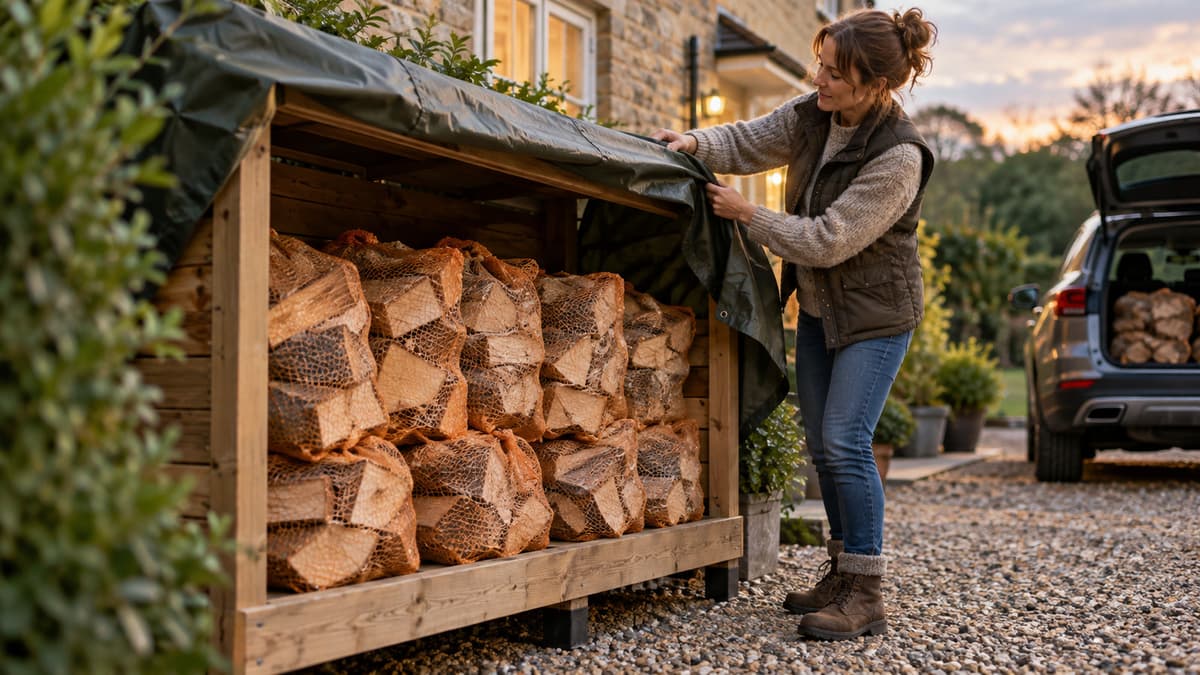
How to store kiln-dried logs
A dry delivery picks up moisture if the stack sits on the ground or under a sealed sheet.

Fatwood or kiln-dried kindling
Resin sticks catch quickly. They are a poor stand-in for a certified log, and a poor fuel under food.

Open fire or a wood-burning stove
Settle the appliance before you fix a winter volume. An open grate and a stove do not burn the same pile.