Independent comparisons. We may earn from shop links. More info

Powder vs CO2 fire extinguisher

Updated: 20 October 2026

A powder vs CO2 fire extinguisher choice is the cloud you then have to see through, and a gas that smothers flame without cooling what remains. Powder covers solids, liquids and gases, then fills the bay. CO2 leaves no film, and embers in a solid can light again. This page is from the Products Compared editorial team. We compared four amazon.co.uk listings captured on 19 October 2026, and none is a CO2 cylinder. The [fire extinguisher comparison](/hub/fire-protection/fire-extinguisher) holds those four pages. A qualifying purchase can earn us a commission at no extra cost to you.

A powder vs CO2 fire extinguisher choice is the cloud you then have to see through, and a gas that smothers flame without cooling what remains. Powder covers solids, liquids and gases, then fills the bay.

Our top picks

On this page

What both are allowed to do

Powder and carbon dioxide sit on the same list for live electrical equipment, which is why the titles look interchangeable. BAFE points to BS 5306-8: the media are a non-conductive powder, CO2, or a clean agent. The permission is about conductivity. It does not describe a tidy room afterwards, and it does not claim the two agents cool a fire in the same way. Isolate the supply before you discharge, if the switch is reachable without crossing the fire. BAFE’s order is to switch off first, then fight only while the fire is still small enough to leave. A consumer unit can stay live on the incoming side after a circuit looks dead. With both agents allowed on a live board, the buy turns on the mess.

When powder is the better tool

ABC powder is the better tool when the fuels are mixed and you can live with the clean-up. It covers class A solids, class B liquids and class C gases. Hampshire and Isle of Wight Fire and Rescue Service allow powder or CO2 in a garage, and they keep CO2 for a space you can ventilate. The Fire Protection Association cites BS 5306-8:2012: powder obscures vision and can make breathing difficult. Kidde UK say the dust may permanently damage a computer, and a chip pan is a poor target. The examples are the unbranded 2 kg at about £19.99, with Kitemark EN3 and no numeric rating, and the Ogniochron 1 kg at about £23.42, printed 8A 34B and C. Those label checks sit on the fire extinguisher buying guide.

When CO2 is the better tool

CO2 is the better tool when the equipment must stay free of powder and the room can lose the gas. It leaves no dry-chemical film, and it is aimed at class B liquids and live electrical equipment. The Fire Protection Association say CO2 cools poorly, so embers can re-ignite once the gas thins. The horn frost-burns a bare hand, so hold the lever. In a cupboard, the gas is an asphyxiant. None of these four listings is carbon dioxide, so a residue-free job means you leave this table.

What to do with the cans in this set

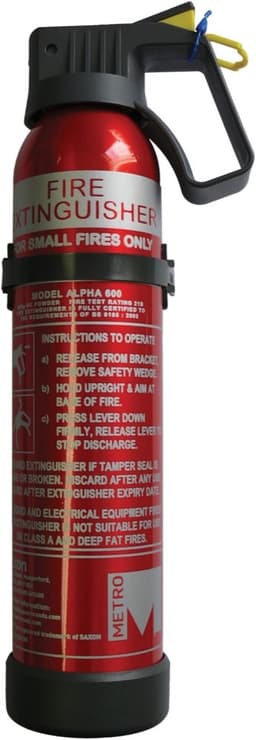
The Metro HG 098-00 is 600 g at about £14.28. The bullets say classes B and C, and safe use on electrical equipment. They never name carbon dioxide, and they never claim class A. The standard line is printed BS616 2002, which does not make the can a BS EN 3 CO2 unit. The Super Help SH2400 is 400 ml at about £11.99, with no fire class on the bullets. A UK review says the bottle excludes an electrical fire. Take the 2 kg or the 1 kg where the cloud is acceptable. Take neither can if you wanted residue-free cover. The best fire extinguisher page puts a skip case on each ASIN.

Common questions

Which one for a laptop or a server?
Use CO2 where you can ventilate, and isolate the supply if the switch is on your way. Powder may knock the flame down, and Kidde warn it can permanently damage a computer. A closed cupboard is a poor CO2 room as well, because the gas displaces the air. This set has no CO2 cylinder.
Which one for a garage with petrol and a consumer unit?
Use powder if the way out stays clear of the cloud. Petrol and timber can mean liquids and solids in one fire. Hampshire allow powder or CO2 in a garage and limit CO2 to ventilated spaces. The about £19.99 2 kg and the about £23.42 Ogniochron, marked 8A 34B and C, will both leave a film on the consumer unit.
Is CO2 safe in a cupboard?
No. CO2 displaces oxygen in a small space, which is the Fire Protection Association’s warning, and a cupboard is that space. The horn can frost-burn your hand. For an under-stairs cupboard, get out and call 999 rather than discharge into a box you are standing in.
Do I isolate the supply first?
Yes, if you can reach the switch without passing the fire and the fire is still small. BAFE’s order is isolation, then a non-conductive medium. A consumer unit can stay live on the incoming cables after a circuit looks off. If the isolator is behind the flames, leave.
Can the Metro 600 g stand in for CO2?
No. The Metro claims classes B and C and electrical use, at 600 g, and it names neither carbon dioxide nor class A. Reviewers treat it as a glovebox can, not a CO2 cylinder with a smaller fill. The Super Help 400 ml is further off: the bottle, in one UK review, excludes electrical fires, and the bullets print no class.
What if I only have the powder listings in this comparison?
Use the unbranded 2 kg or the Ogniochron 1 kg only if you already accept ABC powder and the cloud. The Metro and Super Help cans do not turn that gap into a CO2 option. Residue-free cover is a purchase outside this set.

Related pages

Sources

Public UK sources for this comparison, checked on 20 October 2026. Prices are amazon.co.uk shelf prices from 19 October 2026.

  1. Regulatory Reform (Fire Safety) Order 2005, article 6 (retrieved 20 October 2026)
  2. Fire safety in the home, GOV.UK (retrieved 20 October 2026)
  3. Fires in the home, GOV.UK Prepare (retrieved 20 October 2026)
  4. BAFE: how often to service fire extinguishers (retrieved 20 October 2026)
  5. BAFE: extinguisher type for live electrical equipment (retrieved 20 October 2026)
  6. Hereford and Worcester Fire and Rescue Service: fire extinguishers (retrieved 20 October 2026)
  7. Hampshire and Isle of Wight Fire and Rescue Service: fire safety equipment (retrieved 20 October 2026)
  8. Firesafe.org.uk: portable fire extinguisher general (retrieved 20 October 2026)