Fire extinguisher for the home
You are looking at a fire extinguisher for the home because a red cylinder feels like the responsible thing to put in the hall. In a private house in the UK it is optional, and several fire services would rather you spent the money on alarms and a way out. This page is from the Products Compared editorial team. We used the Fire Safety Order, GOV.UK and fire-service pages, plus four amazon.co.uk listings captured on 19 October 2026. We did not visit your house or run a fire test. A qualifying purchase can earn us a commission at no extra cost to you. The four listings are ranked on the [fire extinguisher comparison](/hub/fire-protection/fire-extinguisher).
You are looking at a fire extinguisher for the home because a red cylinder feels like the responsible thing to put in the hall.
You are looking at a fire extinguisher for the home because a red cylinder feels like the responsible thing to put in the hall. In a private house in the UK it is optional, and several fire services would rather you spent the money on alarms and a way out. This page is from the Products Compared editorial team. We used the Fire Safety Order, GOV.UK and fire-service pages, plus four amazon.co.uk listings captured on 19 October 2026. We did not visit your house or run a fire test. A qualifying purchase can earn us a commission at no extra cost to you. The four listings are ranked on the fire extinguisher comparison.
Our top picks
| Badge | Product | Stated classes | Standard on the listing | Fill | Note | Price | Offer |
|---|---|---|---|---|---|---|---|
| Best overall |  Unbranded 2 kg ABC powder with brackets | A, B and C | BS EN3-7:2004+A1:2007; Kitemark EN3 | 2 kg | 7.5 | about £19.99 | View offer |
 Ogniochron Ogniochron 1 kg ABC powder | 8A 34B and C-class | CE approved EN 3; RINA; MED | 1 kg | 7.8 | about £23.42 | View offer | |
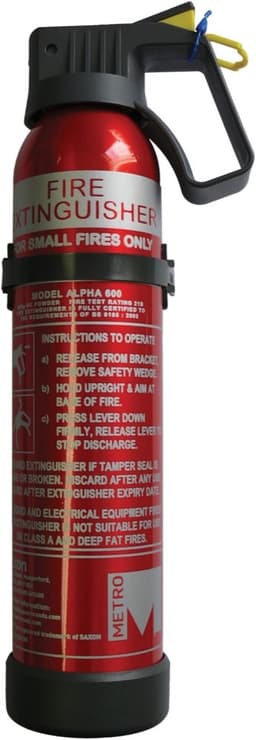
| Alternative |  Metro Metro HG 098-00, 600 g | B and C | BSI certified to BS616 2002 and Kitemarked | 600 g | 4.8 | about £14.28 | View offer |


On this page
What the law does not demand
What fire services tell householders
If you still buy one
What a small can will not do
Common questions
Does the law make me keep an extinguisher at home?
What should I buy first if I do nothing else?
Is powder the right kitchen choice?
Will a car extinguisher cover the house?
Who services a home cylinder?
Related pages
Sources
Public UK sources for this comparison, checked on 20 October 2026. Prices are amazon.co.uk shelf prices from 19 October 2026.
- Regulatory Reform (Fire Safety) Order 2005, article 6 (retrieved 20 October 2026)
- Fire safety in the home, GOV.UK (retrieved 20 October 2026)
- Fires in the home, GOV.UK Prepare (retrieved 20 October 2026)
- BAFE: how often to service fire extinguishers (retrieved 20 October 2026)
- BAFE: extinguisher type for live electrical equipment (retrieved 20 October 2026)
- Hereford and Worcester Fire and Rescue Service: fire extinguishers (retrieved 20 October 2026)
- Hampshire and Isle of Wight Fire and Rescue Service: fire safety equipment (retrieved 20 October 2026)
- Firesafe.org.uk: portable fire extinguisher general (retrieved 20 October 2026)